Five theories of local politics
A rural by-election becomes a test of old loyalties, new momentum and tactical voting

The Cuxton, Halling and Riverside by-election should be a small contest caused by a sad vacancy. Instead, it has become a useful little stress test for Medway politics, with the Conservatives defending old ground, the Greens chasing a historic breakthrough, Reform trying to turn visibility into votes, Labour keeping strangely quiet, and the Liberal Democrats technically involved. Here’s what each campaign thinks it is proving...
Five theories of local politics
Somewhere in Halling, probably not far from a doorbell with a 'no cold callers' sign, a political activist is preparing to explain why this is the by-election that matters.
That is the first absurdity of local campaigning. Everyone involved believes this is a vital democratic exercise, while many residents would rather not have their dinner interrupted by it.
Still, on 23 July, one of five candidates will be elected to Medway Council in a ward that has suddenly become one of the most interesting political tests in Medway.
The Cuxton, Halling and Riverside by-election follows the death of Conservative councillor Phil Filmer, one of the longest-serving figures in Medway politics. Filmer had been a councillor since the days of Rochester-upon-Medway City Council, later becoming one of the fixtures of the Conservative administration that ran Medway for most of the authority’s existence. His portfolios were rarely glamorous but always visible, like roads, bins, street lights, buses, the Medway Tunnel.
 Ed Jennings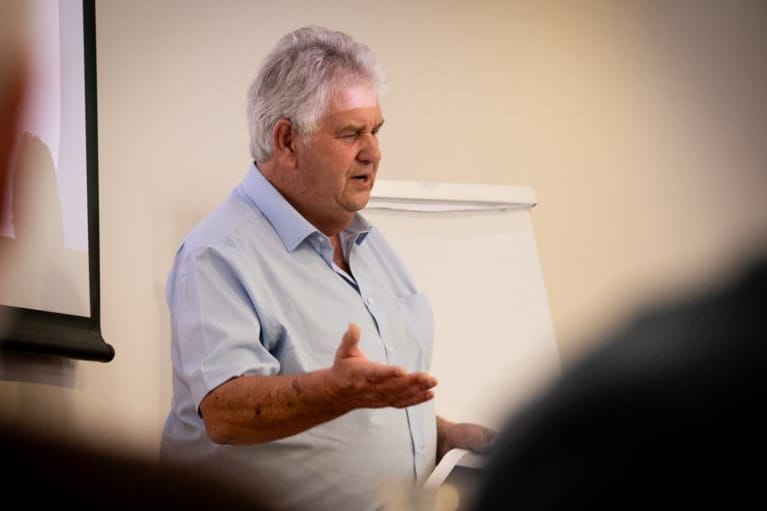
His death has left the Conservatives defending a seat that suddenly looks much less comfortable than it once might have done. In 2023, the party held both seats in the newly created ward, with Matt Fearn topping the poll with 880 votes and Filmer taking the second seat with 685. Just behind him was Green candidate Matt Nightingale on 641 votes. 44 votes separated the Conservatives from what would have been the first Green councillor ever elected to Medway Council.
That number, unsurprisingly, has become the foundation stone of the Green campaign. The party has repeated it so often that it may need its own imprint. The Greens are not merely telling voters they would like to win. They are telling them they nearly did, and that this time they can finish the job. It is a sensible message, and one that contains just enough truth to be powerful, though it does require ignoring some of the more awkward details of a two-member ward election where the Conservatives still topped the poll comfortably.
The difficulty for the Greens is that 2026 is not 2023, and the missing force in the last local elections now looms over the whole contest. Reform did not stand in Cuxton, Halling and Riverside last time. This time, it has become the party everyone else appears to be organising themselves around. The Conservatives warn that a vote for anyone else risks letting Reform in. The Greens insist Trish Marchant is the best candidate to defeat Reform. The Liberal Democrats have somehow managed to describe both Reform and the Greens as dangerous populists. Labour, in its own way, talks about unity rather than division.
Reform, meanwhile, has mostly been busy taking photographs of itself campaigning.
The Conservatives have selected Richard Thorne, which is about as straightforward a local Tory candidate as they could have found. Thorne lives in Halling, has been in the ward for more than 40 years, works locally, chairs Halling Parish Council and previously served as a Medway councillor between 2019 and 2023. On the nomination papers, Thorne is the only candidate to publish an address in the ward. Trish Marchant lists an address in Gillingham, while the other three candidates are identified only as having an address somewhere in Medway.
Thorne’s campaign is built around local rootedness, continuity and experience. He talks about congestion on the A228, the Lower Thames Crossing, housing development, infrastructure and the need for an accessible councillor. The Conservatives talk about him as someone who understands the villages. Kelly Tolhurst, the former Rochester and Strood MP, has endorsed him as someone who knows the local issues and would be a “vocal campaigner” for the ward. George Perfect, leader of the Medway Conservatives, has framed the contest more sharply, warning voters that anything other than a Conservative vote risks Reform winning the seat.
That is where the Conservative campaign becomes more interesting. Thorne is being sold as the rooted local candidate, but his political history is not quite as simple as the leaflet version suggests. Before becoming a Conservative councillor for Strood South in 2019, he stood in the same ward for UKIP in 2015. He then lost after contesting Fort Pitt in Chatham for the Conservatives in 2023. None of that is especially scandalous. Plenty of right-of-centre politicians moved from UKIP into the Conservatives after Brexit, but it does add a certain texture to a campaign where the Conservatives are now trying to stop their own voters drifting right again.
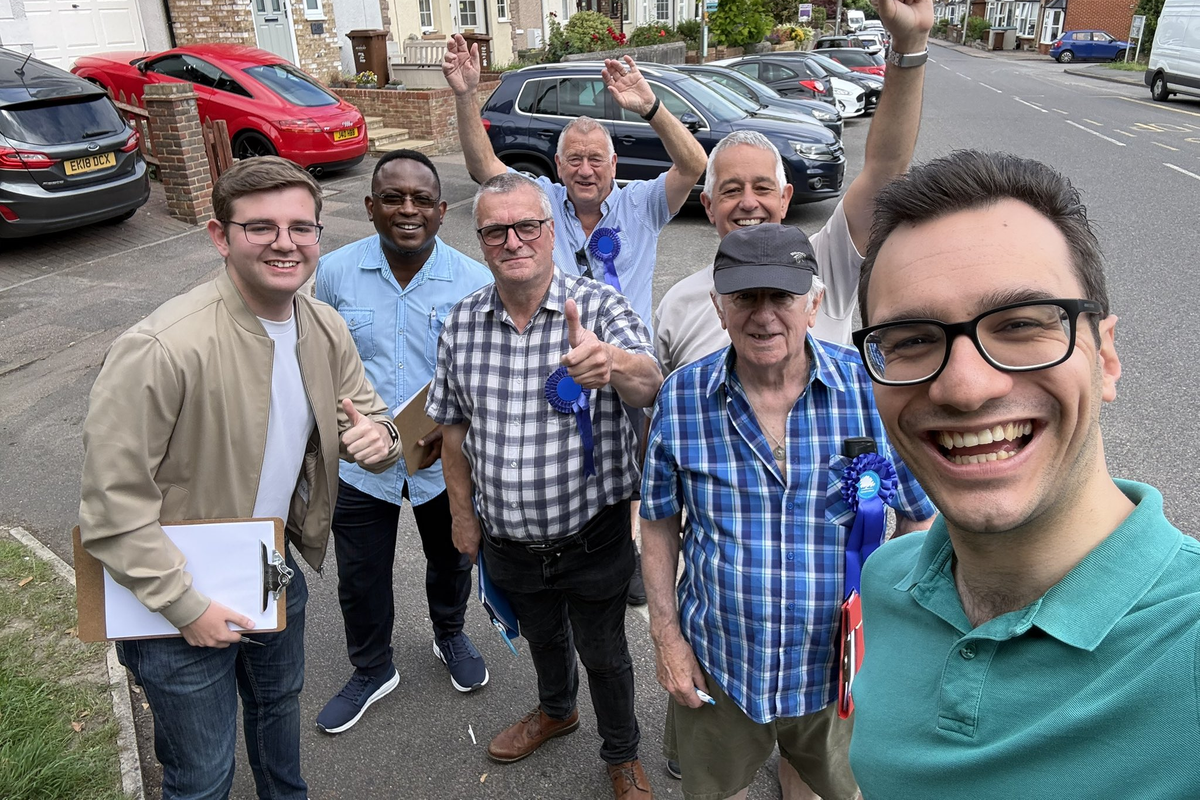
Visibly, the Tory campaign has been more traditional than spectacular. There are canvassing photos with clipboards, blue rosettes and activists on pavements, but not the constant stream of content Reform has produced. The impression is of a local association doing the usual things of knocking doors, asking residents to complete surveys, and trusting that Thorne’s name and Halling connections will carry weight. There has also been the occasional local Facebook oddity. In one exchange, a resident called Kizzi asked for the riverside to get some TLC, only for a reply to appear from a Karen Thorne, apparently posting on his behalf. “Hi Lizzy,” it began, before promising: “You’ll certainly get that tlc from me. Just need you to vote for me.” It is unlikely to make the campaign literature.
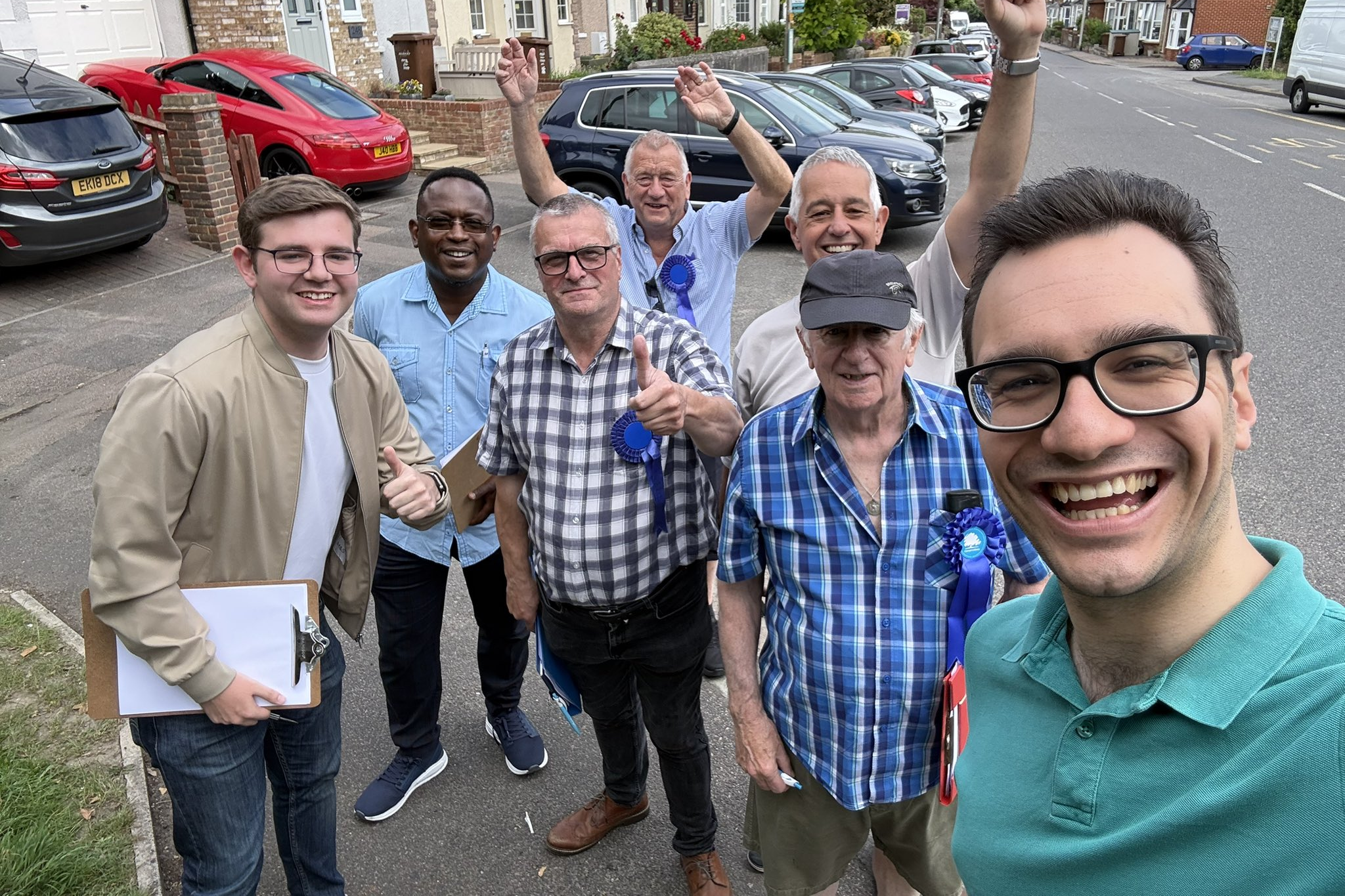
The Conservatives’ survey is standard local election machinery dressed as community engagement. It begins by asking about housing, green spaces, GP services and Medway Council’s management of local services and finance, before wandering into the more spiritually honest territory of local campaigning. How did you vote last time, who might you vote for next, can you deliver leaflets, would you like a postal vote, and might you one day want to become a Conservative councillor? That is not unusual. It is just the strange charm of electoral politics that the road from 'What matters to your family?' so often ends at 'Can we put you on a database?'
If the Conservatives are running on familiarity, the Greens are running on viability. Trish Marchant is not the candidate who came within 44 votes in 2023. That was Matt Nightingale, now Vice-Chair of Cuxton Parish Council, who has endorsed her instead.
Marchant has an electoral history so extensive that it almost becomes a feature of the campaign in its own right. She was the Green parliamentary candidate for Gillingham and Rainham in 2010, before standing for Medway Council in Rochester West in 2011, Gillingham North in 2015, Strood North in 2019, Rainham North in 2023 and Gillingham South in a 2025 by-election. Cuxton, Halling and Riverside therefore gives her something approaching a clean sweep of Medway on the Green Party candidate bingo card.
That line should not obscure the fact that she is a serious candidate. The Greens present Marchant as a chartered electrical engineer with 18 years of experience in the NHS and health, ten years in local government, 12 years in the water industry and more than 30 years as a Green Party member. She has campaigned on anti-austerity causes, against racism and the far right, and on environmental issues including the fight against new coal at Hoo. The point the Greens are trying to make is clear enough is that this is not a paper candidate or a protest name. It is someone who has spent decades putting the work in.
The Green campaign has been by far the most prolific online. It has produced graphics about Marchant’s biography, her support for LGBTQ+ rights, her plans to hold accessible surgeries, her desire to work with parish councils and community groups, her support for better bus services, and her belief that residents across a ward of villages, houseboats, new builds and traveller communities need a councillor who understands all parts of it. The tone is relentlessly earnest, occasionally slick, and sometimes magnificently homemade.
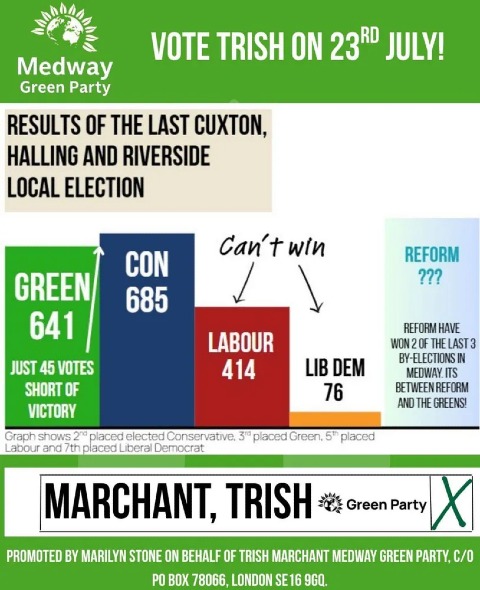
One Green graphic attempts to reduce the entire election to a bar chart, a skill usually deployed by the Liberal Democrats. It shows the 2023 result, places a 'Can’t win' over Labour and the Liberal Democrats, and gives Reform a pale box marked with three question marks. It is both a tactical voting argument and the sort of thing local democracy produces when someone has opened Canva with a point to prove. The message is obvious. Labour cannot win, the Lib Dems cannot win, Reform are the unknown danger, and the Greens are the only realistic challenger. It may be right. It may not. But it tells you exactly what the Greens think this election is about.
What the Green campaign has not shown, at least publicly, is much evidence of old-fashioned ground campaigning. There may well be canvassing, leaflet rounds and resident conversations happening beyond the view of social media, but the party’s public campaign has been dominated by graphics, endorsements and values statements rather than teams on the doors. That contrasts sharply with Reform, which has treated campaigning almost as a spectator sport.
William Burvill’s Reform campaign began with slick national branding and a polished launch graphic. He was introduced as a Medway resident who had worked with vulnerable people, SEND children, adults and foster care. His stated priorities were infrastructure before development, road safety, public transport, village character, green spaces and accountability. If you removed the Reform logo, much of it could have been issued by the Conservatives, the Greens or Labour without anyone calling the police.
But as the campaign has developed, Reform has found a more distinctive rhythm. Its central pitch is not really policy. It is presence. Burvill is shown at markets, at community events, on pavements with leaflet teams, at a dance night in cowboy attire, and standing solemnly beside a pile of fly-tipping on Pilgrims Way like a man who has discovered the body in the first act of a detective drama.
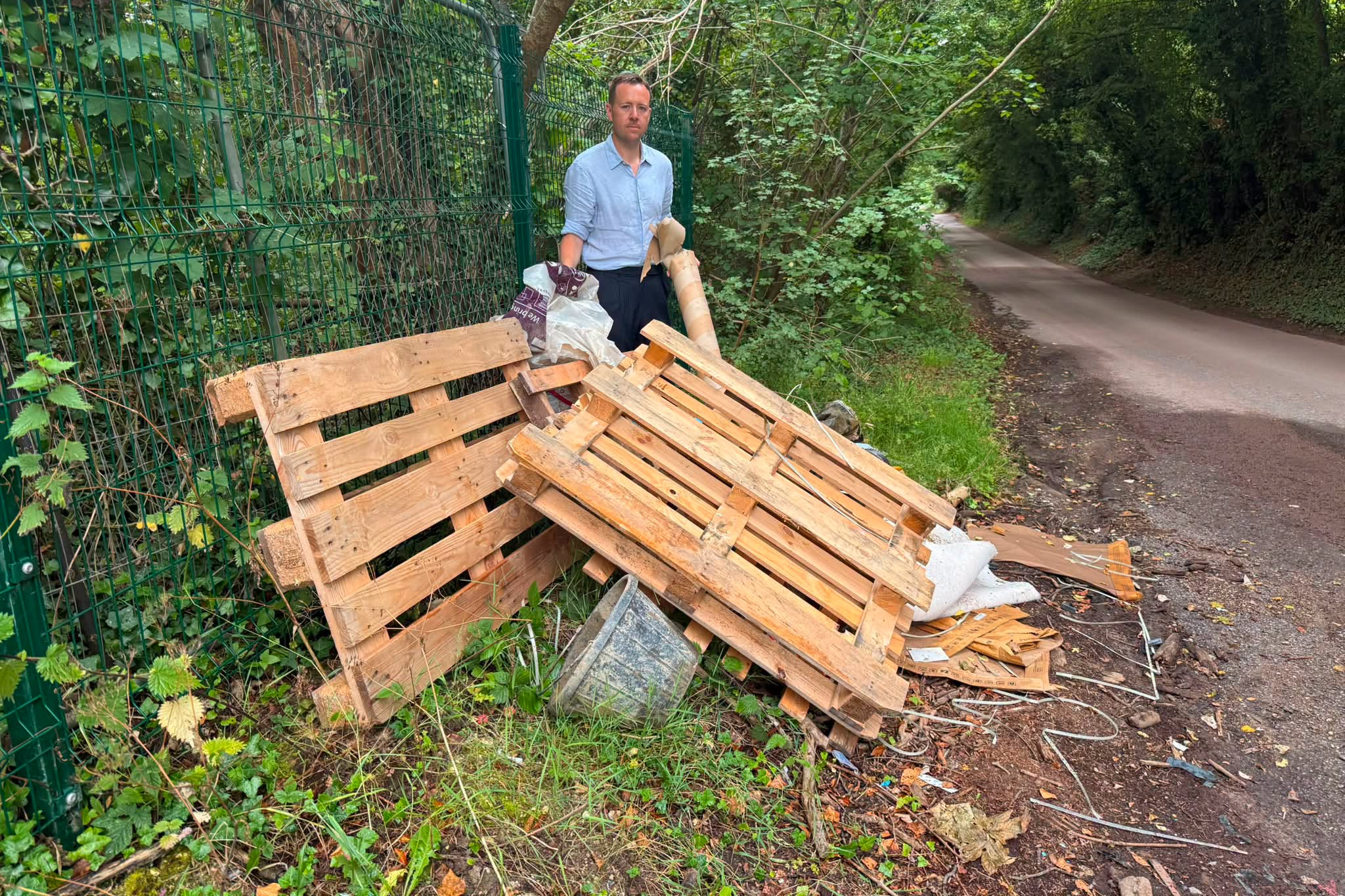
The fly-tipping material is probably Reform’s strongest local issue so far. One post showed Burvill reporting dumped waste to Medway Council after coming across it on his way to a community event. Another said he had submitted a Freedom of Information request showing that since 2021 there had been no fixed penalty notices, no prosecutions, and no CCTV cameras in the ward related to fly-tipping. The figures appear accurate, making it more than a photo opportunity. It is a clever piece of local campaigning, turning a pile of rubbish into an argument about enforcement, accountability and whether anyone has been taking the issue seriously enough.
Reform has also shown the greatest organisational muscle. Burvill has been photographed with leaflet teams, local activists and supporters. Linden Kemkaran, Reform leader of Kent County Council, joined the campaign and declared the party “in it to win it.” For a single Medway Council by-election, that is a notable show of force.
That visibility has produced friction. In one Halling Facebook group, an administrator complained that Reform campaigners had ignored a 'no cold callers' sign. Other residents replied with similar complaints. One said they were undergoing chemotherapy and suffering severe fatigue, and had not appreciated campaigners ignoring the sign when they called previously. Another claimed a canvasser apologised but said: “Sorry but we have to do this, it’s a democracy,” before being told that democracy did not require ringing that particular doorbell.
A Reform supporter responded that Reform supporters were “good people” who were fed up with Labour and the Conservatives locally and nationally, and only wanted to talk to residents. “We are human beings,” they wrote. “We only want the best for our country.” It was a perfect distillation of local democracy. Campaigners want to be seen as visible and accessible. Some residents would like visibility and accessibility to stop at the front gate.
Then there is Labour, which runs Medway Council and yet somehow feels like the quietest serious campaign in the contest. Iain Childs was announced as Labour’s candidate only after nominations had closed, which is rarely the sign of a party hurling itself into battle with total conviction. Childs stood in Rainham South East in 2023 and is now asking voters in Cuxton, Halling and Riverside to elect him as someone who can work closely with the Labour-run council.
That is not a bad argument. In fact, it is probably Labour’s strongest one. Everyone else is campaigning against Medway Council in one form or another. Labour can say that if residents want something done, electing a Labour councillor gives them a direct line into the administration already running the place. Childs has said he stands for “unity, not division” and wants to focus on roads, public transport, NHS services and green spaces. The problem is that nearly everyone else also wants to focus on roads, public transport and green spaces, while managing to sound louder about it.
Even Labour’s selection prompted a small burst of petty party needling. Green activist Matthew Broadley said he had expected Labour to select Stephen McCormack, a parish councillor in the ward and Labour’s best-placed candidate there in 2023. Labour councillor Joanne Howcroft-Scott replied politely that members had selected Childs, while fellow councillor David Field observed that this was “almost as surprising as the Green candidates who came close last time not deciding to throw their hats in the ring.” This is the sort of exchange that will not change a single vote but does reveal the strange little ecosystem of Medway politics, where everyone is watching everyone else’s candidate selection and pretending not to enjoy it.
Finally, Ron Gillett also exists. He stood for the Liberal Democrats in the ward in 2023 and received 76 votes. He is standing again. The Lib Dem campaign, such as it is, has produced a graphic calling for clean water, an end to the “stealth tax” on high streets and better street cleaning around Medway. The accompanying post urged voters to reject the “dangerous populism” of Reform UK and the Greens, which is certainly one way of describing a party whose local campaign has mainly consisted of bus services, councillor surgeries and a woman from Gillingham with a very long electoral CV.
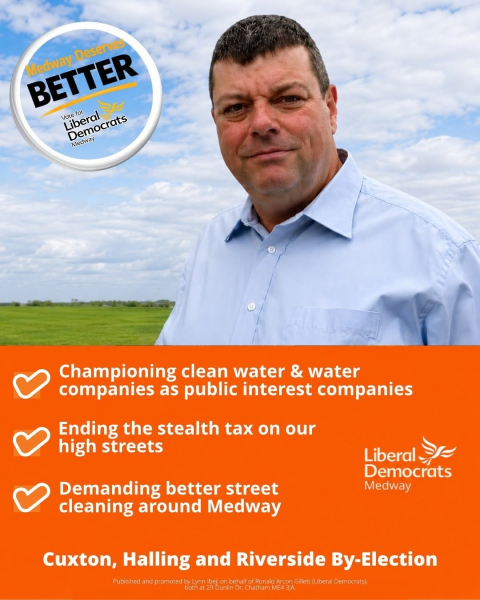
It would be unfair to say the Liberal Democrats are not campaigning. It would be more accurate to say that if they are, they are doing so with impressive discretion. Gillett is on the ballot, and that may be the main point. Every by-election needs someone keeping the orange flame alive, however faintly.
There was nearly another name in the mix. Graham Sergeant, who runs the Restore Britain Kent Facebook group, floated the idea of standing a candidate in June, asking members whether they should “find a candidate for the Cuxton, Halling and River by election on July 25th.” The post was accompanied by a photograph of his dog. They did not, in the end, find a candidate. Nor will the election be on 25 July.
So where does all of this leave the race? The 2023 numbers make the Greens look like the obvious challengers. The 2026 campaign makes Reform look like the party with momentum. The Conservative candidate looks well fitted to the ward, but the party he represents is trying to defend old ground in a political climate that no longer naturally favours it. Labour runs the council but has not made this ward a priority. The Liberal Democrats are present, which is something.
The real question is not whether the Greens can add 44 votes. It is where the Conservative vote goes. Filmer won the second seat with 685 votes, but that was before Reform stood here. If Thorne holds enough of the traditional Conservative vote, his local roots may be enough. If Reform pulls heavily from the right, the seat could fragment in unpredictable ways. If anti-Reform voters coalesce behind Marchant, the Greens may finally get the breakthrough they have been chasing across Medway for years. If the Lib Dems surge from 76 votes, we will all need to sit quietly in a dark room and reassess everything we know.
Cuxton, Halling and Riverside is not just choosing a councillor. It is testing five theories of local politics. The Conservatives believe local roots and an old campaign machine can still hold. The Greens believe persistence, values and tactical voting can finally get them over the line. Reform believes relentless visibility can turn national momentum into a third Medway seat. Labour believes, perhaps, that being the party in charge ought to count for something. The Liberal Democrats believe in standing, which is not nothing.
By the morning of 24 July, one of those theories will have been vindicated. The others will be explaining on Facebook that they were only a few hundred votes away, that the campaign was really about building for the future, and how national factors were what swung things against them.
Footnotes
Follow us elsewhere: Facebook, Instagram, BlueSky, and now WhatsApp for new story alerts.