Does Medway exist?
Medway was created after a bitter 1990s battle over whether the towns were one place at all. Nearly 30 years later, that argument is back.

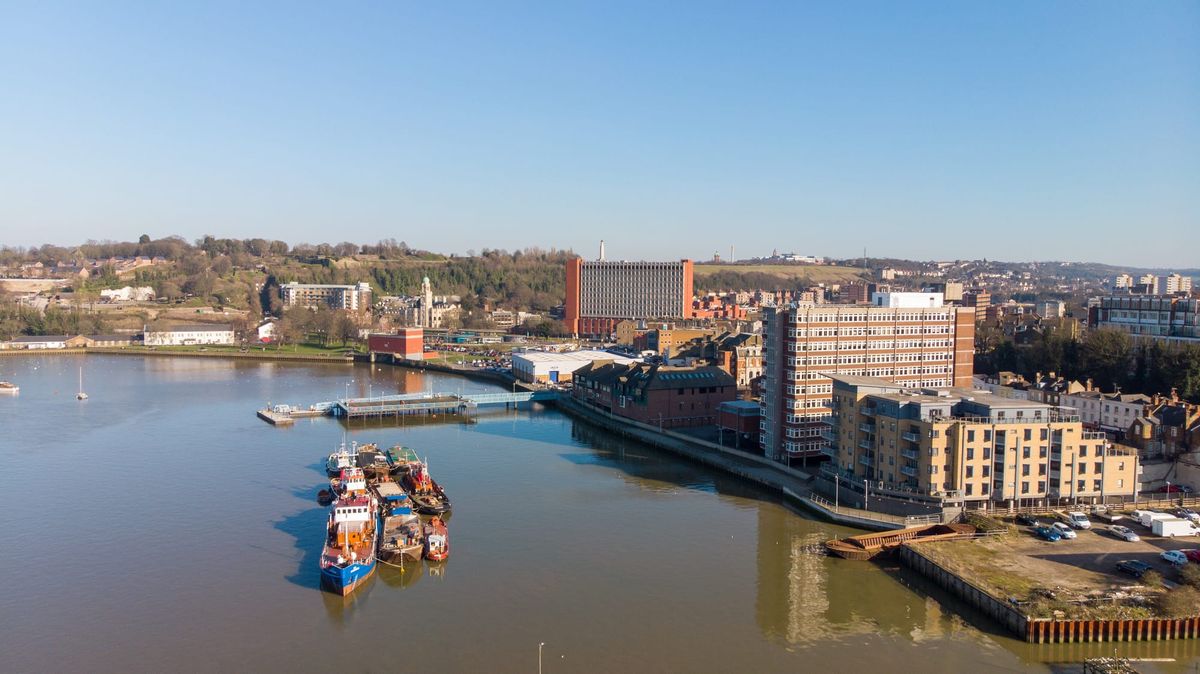
Nearly three decades after Medway Council was created, local government reorganisation is forcing the question of what Medway actually is. This edition looks back at the 1990s fight that brought Rochester-upon-Medway and Gillingham together, the arguments over identity, Kent, regeneration and city status, and whether Medway has become a real place or remains an administrative layer over older towns and villages.
Does Medway exist?
Medway was never inevitable.
Nearly three decades after the council was created, it has become established, kind of. The name on the council tax bill, the logo on the bin lorry, the place listed in school admissions forms, planning documents, regeneration strategies and every argument about potholes on Facebook. But Medway, as we now understand it, was created through a bruising political fight in the 1990s, at a time when ministers, councils, MPs and residents were arguing over whether the Medway Towns were a coherent place in their own right or merely a collection of old towns being forced into a new administrative container.
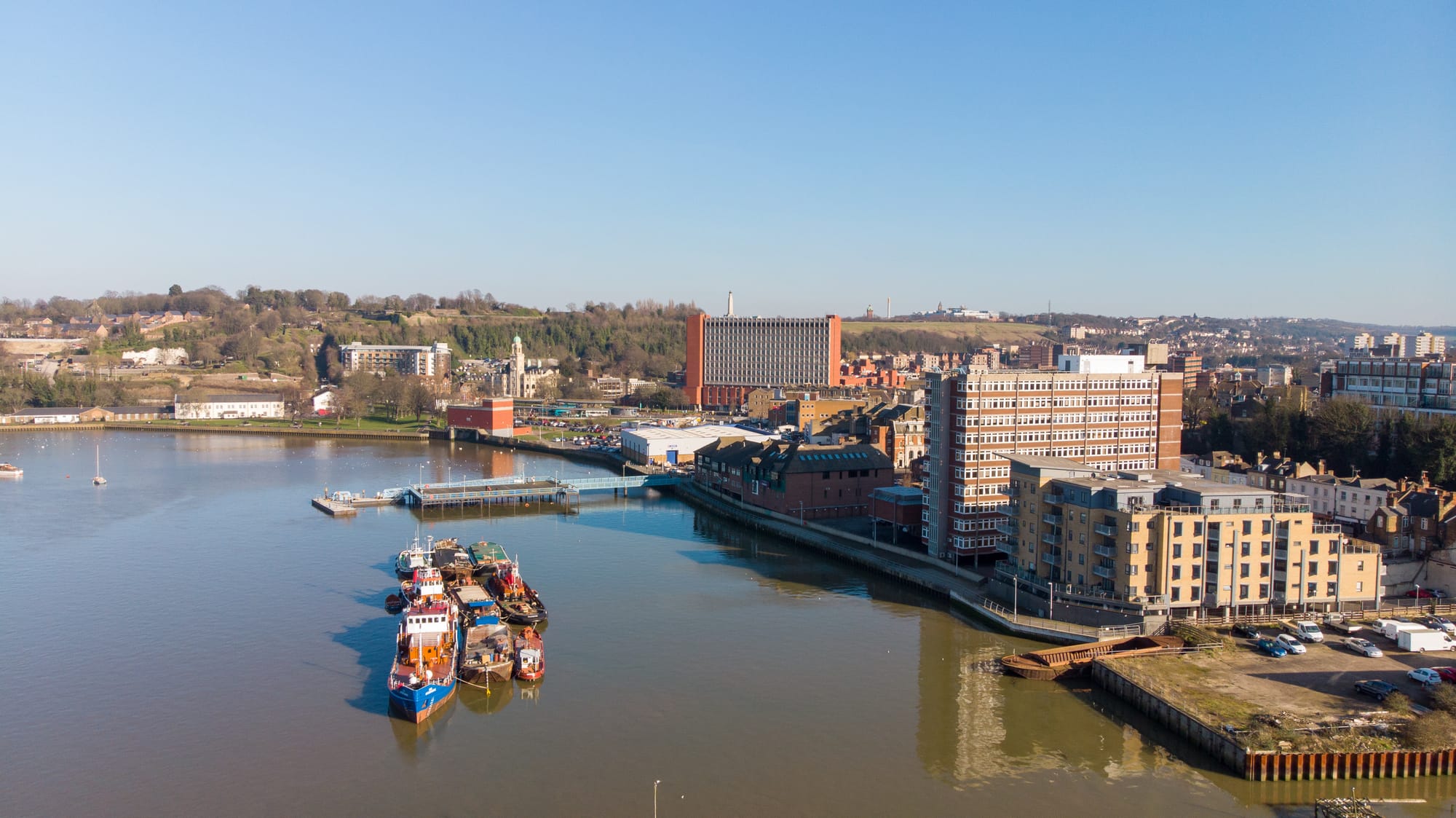
Before 1998, there was no Medway Council. Rochester-upon-Medway and Gillingham had their own councils, while Kent County Council handled county-level services from Maidstone. Chatham sat within Rochester-upon-Medway, an odd quirk that still lingers on a parliamentary level. Rainham was part of Gillingham. Strood, Rochester and Chatham were formally bound together, while Gillingham remained separate. Above them all sat Kent, with responsibility for education, social services, highways and the wider strategic functions that shaped daily life in ways residents did not always see.
The system was untidy, but local government usually is. More importantly, the places beneath it were real. Rochester had its cathedral, castle and city status. Chatham had the dockyard and the military history that shaped the area for centuries. Gillingham had its own civic life, football club and political identity. Rainham, Strood and the Hoo Peninsula carried their own loyalties and grievances. People did not need to be told where they lived, and few appeared to be clamouring for a new identity to sit above the old ones.
The government review of local government in the 1990s challenged that arrangement. Across England, ministers were looking again at the two-tier structure of county and district councils. The argument for unitary authorities was simple enough. One council would be clearer, more accountable and less confusing for residents than dividing responsibilities between different tiers. It was the sort of argument that always sounds obvious in Whitehall and much less obvious once it starts colliding with actual places, their histories, and their deep reserves of stubbornness.
Kent was initially expected to remain largely unchanged. In March 1995, Environment Secretary John Gummer told the Commons that the Local Government Commission had recommended no change in the present structure for 17 counties, including Kent, and that he had decided to accept those recommendations with two provisos. One of those provisos was that a short list of selected districts would be reviewed again, including “the Medway Towns, that is, Rochester-upon-Medway and Gillingham.” In other words, Kent as a whole had escaped sweeping reorganisation, but Medway had not.
Gummer presented the further review as a matter of consistency. Some large non-metropolitan towns and cities, many with previous county borough status, were being considered for unitary status elsewhere. Many also had “a significant need for economic and social regeneration,” with business, voluntary sector and service providers arguing that local government responsibilities should sit under one roof. Medway was placed in that category, partly because of its size and partly because ministers believed the area’s regeneration needs made it different from much of Kent.
That did not satisfy opponents.
In the House of Lords, Lord Aldington asked why the Government had announced a further consultation on a local government structure that had already been rejected by the commission after consultation “with all concerned.” He argued that the commission had already considered the relevant option and that around 70% of people in the county were against it, with an even higher percentage opposed in the districts under review. His question was blunt: Why were ministers “flouting the expression of local opinion?”
The Government’s answer revealed the divide at the heart of the whole debate. Viscount Ullswater, responding for the Department of the Environment, said the review was “more than just an opinion poll.” It was about securing “effective and convenient local government” that reflected local needs and identities. Ministers, he said, had received strong representations in favour of unitary status from north-west Kent and the Medway area, including written representations from Dartford, Gillingham and Rochester councils, the Medway Chamber of Commerce, and all four local MPs from Gillingham, Medway, Dartford and Gravesham.
There was a perfectly respectable argument inside that case. The Medway Towns formed one of the largest urban areas in the south east outside London. The area had major regeneration challenges following the closure of the dockyard. The Thames Gateway was becoming one of the great planning and economic development projects of the era. Former industrial land, transport links, housing growth, and employment were increasingly being discussed at a scale that did not fit neatly within older municipal boundaries. Ministers were not entirely inventing a problem.
But opponents were not inventing their objections either. They argued that the Government was taking a county that had been told it would largely remain unchanged, extracting one of its most important urban areas, and doing so against the expressed wishes of many residents. They warned of transitional costs, loss of economies of scale and weakened strategic planning across Kent. They also objected to the idea that Rochester, Chatham and Gillingham could be lifted out of Kent’s local government structure without something significant being lost.
By the time the structural change order reached the Lords in July 1996, the tone had hardened considerably. Lord Aldington moved a motion asking the House to decline approval and invite the Government to reconsider. He objected that it would create “a new county, if you please,” called the County of the Medway Towns. Chatham, “with all the historic associations of its dockyards,” and Rochester, with its cathedral, would no longer be part of Kent for local government purposes.
The argument was not only sentimental. Aldington said there was no evidence that local services had suffered because of the existing structure, and argued that both commissions had acknowledged the two-tier system was capable of meeting local needs. He warned that the change would cause disruption, loss of economies of scale and additional costs for both the new unitary authority and the remaining Kent. He also challenged one of the Government’s central justifications by arguing that the Thames Gateway was not sufficient reason to change local government structure, citing the commission’s own view that it was supplementary rather than central to the case for unitary status.
The Government case rested on a different reading of Medway. Earl Ferrers, defending the order, argued that Gillingham and Rochester together had a population of more than 240,000 and formed “one of the largest urban areas in the south east outside London.” The two district councils, he said, had common physical, economic and community interests, and putting them under one authority would be simpler and allow local services to be provided more efficiently. He went further, saying this part of Kent was “totally different from the remainder of Kent” because it was a large urban conurbation, while the rest of the county was not.
Ferrers also leaned into the rivalry point. The Local Government Commission, he said, had found that local rivalry between Gillingham and Rochester was damaging local interests and preventing the area from being recognised for what it was. That reads oddly now, partly because it sounds like Whitehall had concluded the towns were squabbling too much and needed to be made to sit together until they learned to behave. It was not quite a romantic origin story, but local government rarely is.
The opposition to the proposal produced some magnificent parliamentary language. Lord Shepherd, who supported unitary authorities in principle, said the Medway proposal was a “shotgun marriage” and argued there was not enough cohesion between the areas being brought together. Lord Bancroft suggested it was not a shotgun marriage but a “Kalashnikov union,” which may be the most dramatic description of local government reorganisation ever committed to Hansard. Lord Aldington had already described the merger as a “forced marriage” between Rochester and Gillingham because, in his words, they were “squabbling too much.”
For all the comedy of the metaphors, the underlying point was serious. Opponents believed Medway was being created through imposition rather than consent. They did not deny that the towns were connected, nor that there were shared challenges, but they questioned whether that was enough to override local opinion and centuries of identity.
The debate was not really about whether a single council might be tidier. It was about whether tidiness was a sufficient basis for making a place.
The question of Kent identity sat awkwardly in the middle of the debate. Ferrers was forced to explain that, for local government purposes, the Medway Towns could not technically remain part of the county if they were no longer served by the county council. Yet he insisted that “in historical terms nothing has changed” and that Gillingham and Rochester would still be in Kent. The Government would ensure the new authority remained within the jurisdiction of the Lord Lieutenant and High Sheriff of Kent. Residents, in other words, were not being expelled from the Garden of England. They were merely being administratively rearranged, which is exactly the kind of reassurance only government could think was reassuring.
The Lords tried to stop the order but failed. Aldington’s motion was defeated by 60 votes to 33, and the structural change went ahead. On 1 April 1998, Medway Council came into existence, taking over functions previously divided between Rochester-upon-Medway, Gillingham and Kent County Council. The Government had won the argument in Parliament. Whether it had won the argument in Medway was another matter.
The new authority inherited a problem no order could solve. It could take on services, budgets, councillors and staff. It could create committees, departments, logos and headed paper. What it could not do overnight was persuade residents that Medway was a place in the same sense that Rochester, Chatham, Gillingham or Rainham were places. Those identities had been built through centuries of history, work, religion, war, industry, transport, football, shopping and family life.
Medway had been built by statutory instrument. That is not quite as stirring.
The early years offered an immediate reminder that administrative change does not erase civic memory. During the transition to the new authority, Rochester lost its city status after the necessary arrangements were not put in place to preserve it. What might have been dismissed elsewhere as a procedural mishap became one of the defining wounds of modern Medway politics. The anger endured because it symbolised something much larger than a title. To many residents, Rochester had not simply joined Medway. It had been diminished by it.
That resentment has never fully disappeared. Campaigns to restore Rochester’s city status have returned repeatedly, often with a sense that something precious was carelessly lost when the new authority was formed. Whether or not city status would have changed anything practical is beside the point. Local identity is rarely practical. It is made of names, symbols, stories and stubborn attachments to places that existed long before the latest government order.
The same tension can still be seen across Medway. Ask residents where they are from and many will still answer with the town or village first: Rochester, Chatham, Gillingham, Rainham, Strood, Hoo, Cuxton, Walderslade, Twydall, or whichever other place feels most like home. The answer Medway is understood, but it is not always instinctive. For many residents, Medway remains the umbrella rather than the home, the name of the authority rather than the place they feel in their bones.
Yet it would be too easy to say Medway failed, because that is not true either. Over time, the new authority accumulated weight. Children grew up knowing no council other than Medway. Businesses began describing themselves as Medway-based. Schools, charities, arts organisations and sports clubs operated across the authority boundary as a matter of course. Local politics became Medway politics, even when individual wards and towns retained their own concerns. The name became useful, then familiar, then ordinary.
Physical change helped, too. The Medway of 2026 is not the Medway of 1998. Chatham Maritime, the universities at Medway, Rochester Riverside and years of waterfront regeneration have changed the way the area functions. The old municipal boundaries matter far less to daily life than roads, rail links, housing markets, schools, shops, employers and public services. People may still identify with their town, but their lives often operate across Medway.
This is the strongest argument that Medway did become something real. Not because residents stopped caring about older places, but because an additional layer of identity slowly formed above them. Medway did not replace Rochester, Chatham or Gillingham. It sat on top of them, awkwardly at first, then more comfortably with time. Council branding exercises sometimes felt forced, because council branding exercises usually do, but repetition and lived experience have a way of turning administrative language into ordinary language.
The result is a place that still feels unresolved. Medway is real enough for government, business, education, health, housing and politics. It is real enough for residents to complain about it constantly, which is as good a test of local identity as any. But it is not real in the same way Rochester is real, or Chatham is real, or Gillingham is real. It has not had centuries to settle into the landscape. It has had less than thirty years.
Local Authority is now on WhatsApp
We’ve launched a WhatsApp channel for Local Authority, where we’ll share new stories and the occasional major Medway development directly to your phone.
Council chaos, planning rows, disappearing pubs, strange licensing hearings, and the rest of life around the towns can now be available in yet another app you already check too much.
That is what makes the current local government reorganisation debate so strange. Kent and Medway are waiting to learn what shape the next map of local government will take, with a broad expectation that ministers will choose one of the five competing unitary models now on the table. If the timetable holds, new councils are expected to take over from 2028. For Medway, that means the authority created in 1998 may not reach its 30th birthday in anything like its current form.
This does not need to become another story about committee structures, vesting dates or the thrilling romance of boundary maps. The more interesting issue is that Medway’s existence is being questioned again, just as it has finally begun to feel normal. After decades of living with Medway, arguing about Medway, mocking Medway, defending Medway and occasionally pretending not to care about Medway at all, residents may soon find the institution that created modern Medway no longer survives in its current form.
The risk is not that Rochester, Chatham, Gillingham or the villages disappear. They will be fine. They existed before Medway Council and will exist after whatever version of local government comes next. The more interesting question is whether Medway itself has become strong enough to survive without the structure that created it. If the council changes, merges or disappears into something larger, does Medway remain a place?
Nearly thirty years ago, ministers argued that Medway was already coherent enough to govern itself. Opponents argued that this coherence was being exaggerated or imposed. Both sides were partly right. Medway was not invented from nothing, but neither was it waiting patiently to be discovered. It was built through politics, branding, economics, habit and the simple passage of time.
That may be the most honest answer to the question. Medway exists, but not because it was inevitable. It exists because government created it, institutions reinforced it, and residents gradually learned to live inside it, even if they never stopped belonging to older places too. The politicians of the 1990s thought they were settling an argument about local government. They were really starting a much longer argument about place. Nearly three decades later, it is still going.
Footnotes
Follow us elsewhere: Facebook, Instagram, BlueSky, and now WhatsApp for new story alerts.