“I hate having to do what anybody else has ever done”
What Steven asked Bronach Rae, collage artist and bodhrán player
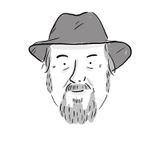
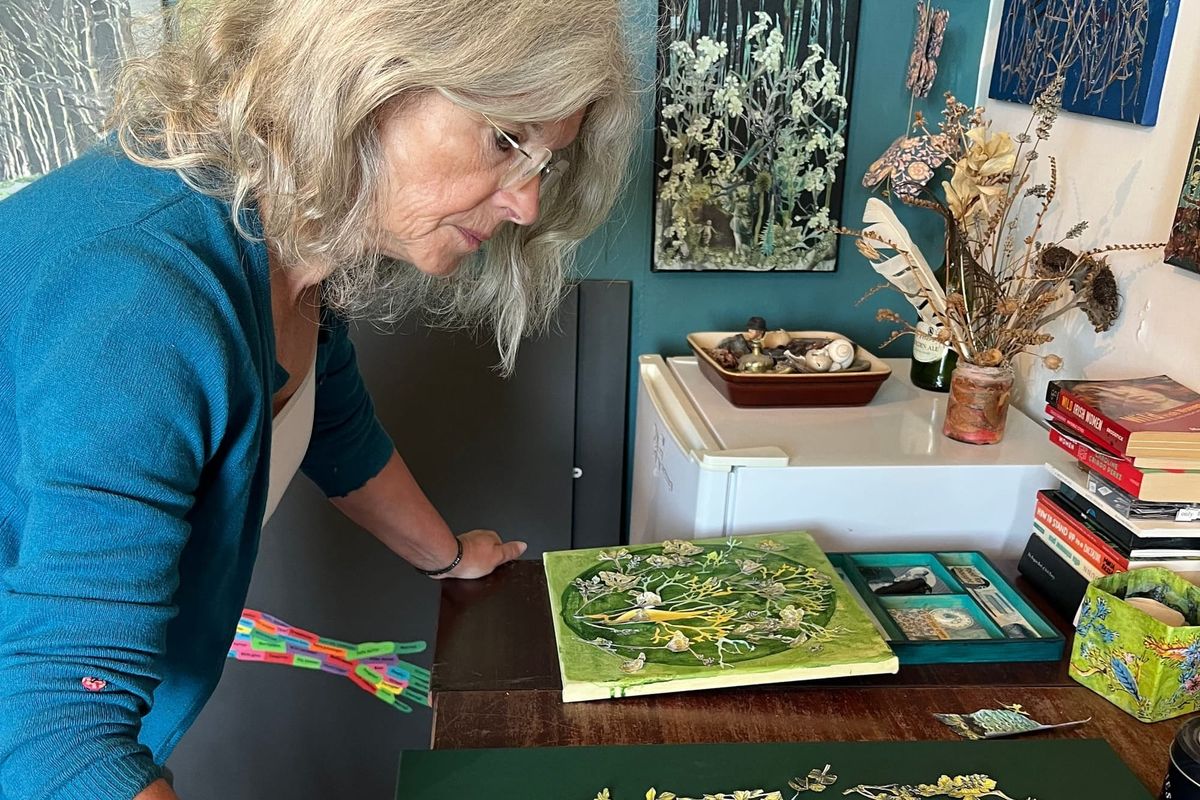
With Medway Open Studios around the corner, Steven met Bronach Rae and Simon Mills at their home studios to discuss their art, why they open their home to strangers and how autobiographical their work is. This is part one of a two-part interview. The second part, focused on Simon, will be published next week.
And are you known by any other names?
I dread to think. “That awful woman,” possibly.
You've never had any pseudonyms or released work under any other names?
In my life, most people have not called me by my name when they've seen it written down, because they couldn't pronounce it. I'd be called Bronwyn, Blodwyn. I'd even be called Bona. I've been called Brian. People can't... That's an alien name to them. I think it was created deliberately to annoy the English.
What is the origin of the name?
It's Irish, and it means sorrowful. I've been stuck my whole life overcoming that.
What is your official occupation?
It's a difficult one. I play the bodhrán in bands. I make collage and I work for Restoration House as front of house, and managing the volunteers during the open season. That's what I do at the moment.
What is your main focus creatively?
My main focus is having a good time, and if something's not fun, I'm not doing it.
If you had to pick a main focus between the art and the music?
It depends on the time of year.
Right now?
Right now, I'm focusing on preparing work and getting my act together for Medway Open Studios.
Do you have any other roles?
You know what? I don't know.
I think I'm an unofficial mother to a lot of people. I'm just one of those people that can't resist helping people. That's what I've done most of my life. I also am a person who likes to open a door for somebody. If I see an opportunity for someone to improve their opportunities in life, I will open that door for them. It's about thinking what can I do to help that person get that job or put people together that might be like-minded that could help each other. I love doing that.
Nobody wants to do what I do, and I don't think anyone can copy it
You're focused at the moment on being an artist. What does that entail?
I'm a collage artist, and I'm probably the only person I know that does what I do. I've always made things in life. I've had no training whatsoever. Didn't do art at grammar school or anything else like that, but I've always made things. I was making some collages when I met Simon. I made a collage of all the important things in his life.
I was using magazines, and then I got an iPhone, and it changed my life. I know that's a ridiculous thing to say. It meant I could go out and take photographs of things that I wanted to take photographs of, like pieces of landscape, flowers, things that interested me and then Simon bought me a six-colour printer. I would come home, edit, print them off, cut them out and make up my own world.
I think a lot of it is influenced by what I've read, because I read so much. Maybe in the past I could have been someone who did front covers, album covers and things like that for people as well.
Nobody wants to do what I do, and I don't think anyone can copy it. It's as simple as that.
It's been fantastic. When I go out, I'm looking at everything. We've been in Greece, and I've taken photographs of unusual plants, of tall buildings, and then I put them together, and whatever happens, happens.
I can sometimes be quite political with them as well. I can do what I want.
I'll steal anything, and I will use it in a different context
Why do you use tiny scissors rather than a scalpel?
I can't be bothered with scalpels. I hate having to do what anybody else has ever done. This is why I think I've developed the stand I've got, because as far as I'm concerned, no one else is doing it. People tear strips of paper or put bits of whatever it is on. I don't do any of that. I spend all my time with all the bits in my head, I'm thinking, beginning to build the thing and then I do it on canvas or I paint a canvas and then I will… with all the bits that I've cut out, I'll place them, step away and then move them, it can take quite a while. It actually takes about half an hour just to stick it all down. That's the easy bit. The imaginative bit is putting all these unusual things together, changing the scale, changing the colour, whatever it might be.
I steal images. I took little bits of John Craxton's paintings. I've taken pictures of things in museums, churches, you name it. I'll steal anything, and I will use it in a different context.
How can your work be political?
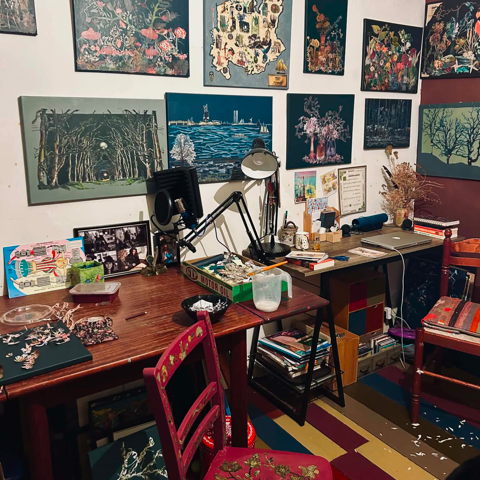
It was about refugees and about safety. I had really interesting images of trees, and in the middle, at the end of this avenue of trees, is the light from the middle of the vines. It's the only light, and the piece is called Sanctuary? With a question mark because you think I'm going to be safe, but you don't know what you're walking into.
How would you describe Medway Open Studios?
It's an opportunity for people you've never met before to come and actually see what you're doing, because quite often, most people only see art when it's on the wall. To see something in a studio where the person works that maybe is a work in progress, and that you could have that conversation, to say how do you do that, how long does it take?
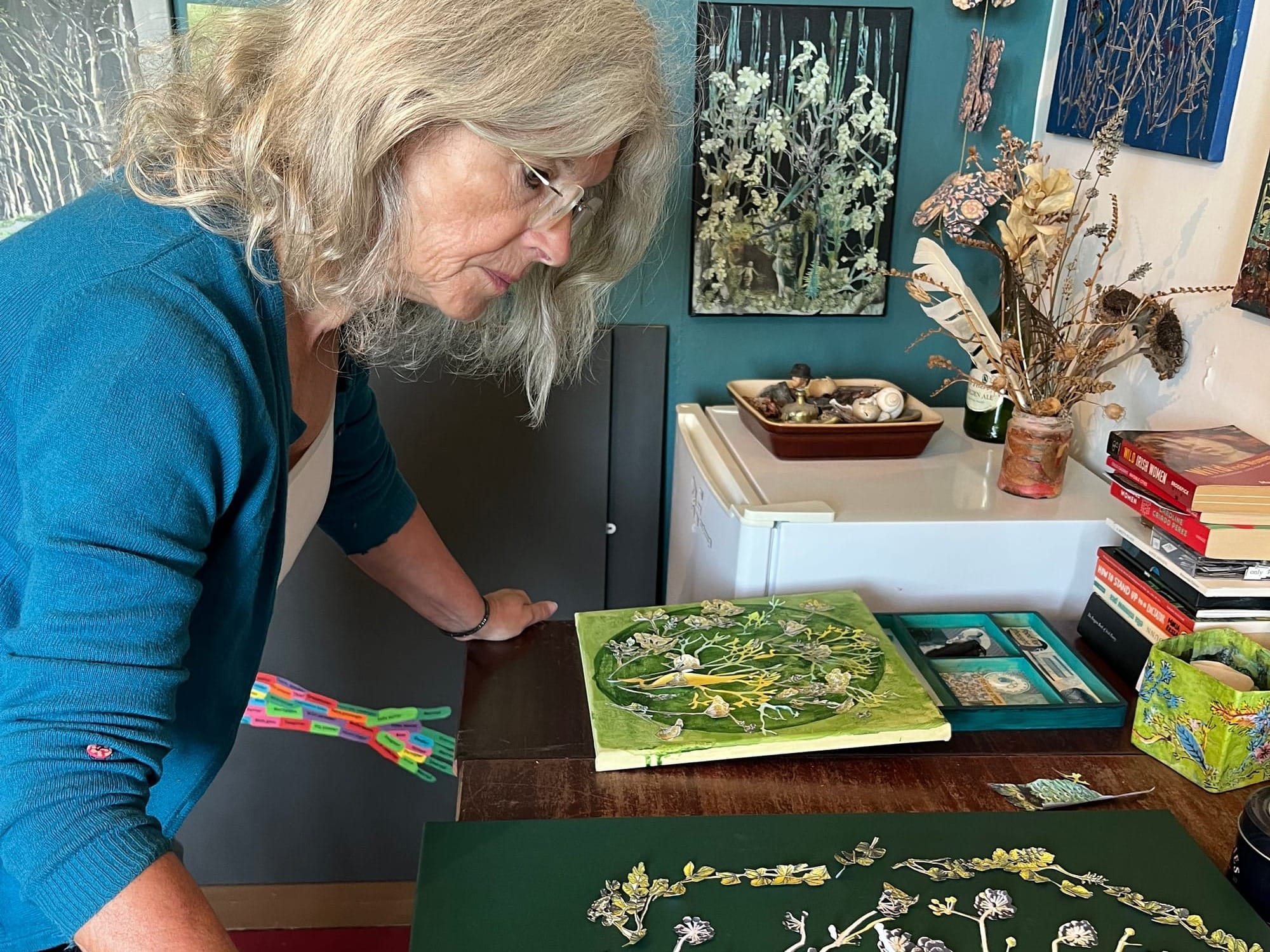
Quite often, I get offered workshops for people because they find it absolutely fascinating. I think it's an opportunity for people to see what's going on in Medway, and it's a brilliant concept that people can come in. We say to people, go through the whole house, just don't touch our stuff, and anything you see on the wall is for sale. We will move stuff around. We've run out of wall space, quite frankly.
Why did you decide to take part in the first place?
It was my idea when Simon did it on his own. He was very much against. I'm used to inviting people into the house. It wasn't a big deal for me. Simon said I should be in this as well. He encouraged me to go ahead and do this because I had always done work, but it was for myself. It was brilliant to have the opportunity to do that, and there were two very different artists in the same place. We're not rivals. He can't do what I can do, and I certainly can't do that, but we can inspire each other.
When people come, I say don't forget the toilet and the bathroom and people are like 'Wow!' People take in the whole house. It's great because I can talk up Simon's work.
Do you remember the moment when you realised collage was your medium?
Bronach: Simon must have encouraged me.
Simon: I said to her you're an artist, because being an artist is about being able to see things. I knew Bronach was an artist even before she started.
Bronach: I like the inventiveness of what I'm doing. I couldn't do what Simon does. I couldn't replicate or create a scene.
Obviously I generate a lot of paper, coloured paper and I'm very keen not to get rid of something like that, so with all the bits that are left over, I make 3D pieces like bowls things you could put flowers in. They're all made 100 % from the paper that's left over.
For me, there's a mystery and a wonder
How autobiographical is your work?
Oh, that's a question. Most of the work I do is influenced by the amount of reading I've done, and then going out in nature. Simon very much wants to be connected with the world out there. When I was at work in the past, I worked out expeditions, and there's nothing that excites me more than the real world. I'm trying to depict that in anything that I'm doing. Beauty in the shape of old trees, the patterns that are in nature, looking at flowers, plants or whatever, or the shape of a landscape. I'm not interested in doing anything with people. Not because I hate them, but that's not my forte. I can't interpret that. For me, there's a mystery and a wonder.