Councillors halt consultation on Grain and Cliffe fire station closures
Plus Innovation Park, planning latest, Dickens’ chalet, and IntraFest


Kent Fire and Rescue Service’s plan to consult on closing five on-call fire stations, including Grain and Cliffe, has been paused after members of the Kent and Medway Fire and Rescue Authority agreed to examine the proposals in more detail. We look at why the Hoo Peninsula stations have become the centre of a wider argument about risk, demand and geography, alongside next week’s council diary, planning, news in brief, and more.
Councillors halt consultation on Grain and Cliffe fire station closures
The plan was supposed to be straightforward.
Kent Fire and Rescue Service wanted permission to begin a public consultation on a major review of emergency cover. Buried within it were proposals to close five on-call fire stations, including Grain and Cliffe, two small Medway stations that suddenly found themselves at the centre of a much bigger argument about risk, money, geography and what happens when public services decide a place is too quiet to keep covering in the same way.
By the end of a meeting this week, the consultation had not been approved.

Instead, members of the Kent and Medway Fire and Rescue Authority agreed to give themselves more time before deciding whether the proposals should be put to the public. A cross-party working group will now examine the plans in more detail before an extraordinary meeting, where members will vote again on whether to launch the consultation.
For the Hoo Peninsula, Grain and Cliffe fire stations have been saved, at least for a little bit longer.
The proposals have not been rejected. The fire service still believes they are necessary. The financial pressure has not disappeared. The review will come back. But the authority had been expected to send the plan out to consultation this week. Instead, after pressure from firefighters, Medway councillors and Medway Council itself, members told the service to pause.
Medway Council leader Vince Maple proposed the delay, arguing that the authority had been offered a “pretty binary choice” between launching the consultation or not launching it.
His proposal created a third route. Do not start the consultation yet, set up a cross-party working group, and spend more time testing whether any credible alternatives exist before the public is formally asked to respond.
After the meeting, Maple described the decision as a “pragmatic pause.”
“The original proposal today was pretty binary, either start consultation or not,” he said. “My proposal gives additional time for consideration on a cross-party basis of other potential options before any public consultation.”
The review requests a significant change in fire cover. KFRS is proposing to close five standalone on-call fire stations at Grain, Cliffe, Wye, Chilham and Westerham. It also wants to remove on-call sections from four other stations at Herne Bay, Deal, Tunbridge Wells and Faversham, while changing shift patterns and moving resources towards daytime cover.
The fire service argues this is not simply about cuts. It says the proposals would lead to an overall improvement in response times and an increase in daytime emergency cover. It also faces around £2m in savings due to changes in government funding and rising costs.
Its case is that resources should move to where they are most needed, not where they have historically been based.
Before the meeting, Medway Council had already made a formal intervention over one of the proposed closures.
Medway Council chief executive Richard Hicks wrote to the fire authority asking it to remove Grain from the closure proposals. The letter did not reject the wider review. In fact, it acknowledged the pressures facing the service and the reasons for revisiting resources.
But Hicks argued that Grain needed to be treated differently.
He pointed to the Isle of Grain’s geography, its industrial risk, its major energy infrastructure, international electricity interconnectors, Black Start power generation capability and the possibility that the village could become isolated from the mainland during a major incident.
It was not a noisy letter. It was the chief executive of Medway Council saying, in fairly sober emergency-planning language, that the fire service may be underweighting the risk of one of the most strategically sensitive parts of Medway.
That argument sits at the heart of the dispute.
KFRS is looking at demand. Its critics are looking at the consequences.
On paper, Grain and Cliffe may not be among the busiest fire stations in Kent. On the ground, they sit on and around one of the more unusual pieces of Medway, a rural peninsula with isolated communities, one main access route, major industry, flood risk, coastal settlements, quarries, pools, wildfires, and large bits of nationally significant infrastructure that most residents probably only think about when something goes wrong.
Chief Executive Ann Millington made the fire service’s case forcefully in a letter to authority members before the meeting, after Peninsula councillor Michael Pearce challenged the proposals.
She said the review had involved more than 60 professionals, external scrutiny of operational data and conversations at every fire station. She also dismissed the idea that critics had produced a workable alternative.
“Not one person, including the FBU, can offer any alternative that doesn’t cost more money,” she wrote.
Millington said the current model no longer matches demand, arguing that moving two fire engines from night-time cover would allow the service to make three additional engines available during the day. She acknowledged that response times in some low-demand on-call areas may increase slightly, but said the countywide effect would be better overall cover.
“This is a rebalancing of resource to follow demand, not a reduction in resource,” she wrote.
Pearce’s letter was more direct.
He argued that approving a consultation would place the closures on an “official path” and said the review underestimated the Hoo Peninsula’s geography and risk profile. He challenged the idea that a fire engine based at Strood for 12 hours a day would be an adequate replacement for local stations at Grain and Cliffe, particularly when access to the peninsula depends so heavily on the A228.
He also pointed to the sums involved. According to figures in the review, closing Grain would save £94,497 a year, while closing Cliffe would save £122,052. Between them, removing two of the peninsula’s three local fire stations would save a little over £216,000.
That figure makes the argument feel less abstract. For KFRS, the closures sit inside a much larger countywide rebalancing of resources. For local councillors, it looks like two rural Medway stations are being put at risk for relatively modest savings.
Chris Spalding, the independent Medway councillor for All Saints ward which covers Grain, also lobbied authority members before the meeting. He said he had read the full review and had sent a 20 page objection to the members, arguing that the proposals contained errors and omissions.
One of his central complaints was that he had asked for blue light response times from Strood and Chatham to Grain St James school, but had not received them.
After the meeting, Spalding described the outcome as “saved for now,” saying he had argued for the consultation to be refused and for new proposals to be developed using fuller information.
He credited Medway councillors Barry Kemp and Vince Maple, along with KCC councillor Richard Palmer, for supporting his arguments in the chamber.
The authority did not accept Spalding’s case and throw out the review altogether. It did not accept Pearce’s case and remove Cliffe and Grain from the plan. It did not accept Medway Council’s request to take Grain off the closure list.
It decided it was not ready to put the proposals to the public.
Consultations are often presented as neutral exercises. They rarely feel that way to the communities facing closure proposals. Once an organisation formally consults, it has already decided which option it wants to test. By delaying the consultation, authority members have kept the debate one stage earlier, allowing alternative approaches to be examined before residents are asked to respond.
The Fire Brigades Union will see that as a partial victory. More than 200 union members marched to fire service headquarters in Maidstone before the meeting, and the union continues to warn that 76 jobs could be at risk if the review proceeds.
Regional chair Tim Green said the delay was not the result firefighters wanted, because the union wanted the proposals rejected outright. But he accepted it was better than the consultation starting immediately, and warned that strike action remains on the table.
KFRS is now presenting the delay as an opportunity for authority members to spend more time with the data.
In a statement after the meeting, the service said its governing body had voted for “additional time” before launching public consultation. Millington said there was a significant amount of data for members to consider and that KFRS would work closely with the cross-party group to support its analysis.
The next few weeks will test whether the fire service can hold the argument together.
Fire services cannot ignore changes in demand, crewing, prevention work, funding and the decline of the traditional on-call model. Millington is right that rejecting this proposal does not remove the need to find savings.
But Grain and Cliffe are not just dots on a demand map.
They are places where the argument about fire cover becomes more complicated than call volume. The Hoo Peninsula is awkward, isolated and industrial. It contains communities that already feel remote from decision-making and infrastructure that matters far beyond Medway.
The fire service says it is following the evidence.
Its critics say the evidence is too narrow.
An extraordinary meeting will now decide whether the closure plans finally go out to public consultation. In other words, Grain and Cliffe have not been saved in the long term.
They have been given a stay of execution.
Local Authority is now on WhatsApp
We’ve launched a WhatsApp channel for Local Authority, where we’ll share new stories and the occasional major Medway development directly to your phone.
Council chaos, planning rows, disappearing pubs, strange licensing hearings, and the rest of life around the towns can now be available in yet another app you already check too much.
Council matters
Meetings next week:
- Tuesday: Cabinet meets to discuss developer contributions, a mobile home policy, and the disposal of the Innovation Park Medway northern site to a mystery company that might want to take on a message plot of land right next to an ever-expanding BAE Systems.
- Wednesday: Planning Committee is set to refuse an application for 150 new homes east of Rainham and approve three new HMOs.
New planning applications:
- Removal and relocation of Gordon Road turnstiles at Priestfield Stadium.
- Installation of two golf simulators in Hoo.
- HMO application for Cleave Road in Gillingham.
In brief
🌊 Scientists have warned that salt marshes in the Medway estuary are under threat.
🚧 A vehicle crashed into the Medway Tunnel, damaging lighting and forcing its closure yesterday.
🎭 The reopening of the Brook Theatre has been delayed until 2028.
🏰 Rochester Castle reopened this week after staircase repairs were completed.
✍️ £240,000 has been awarded by the National Lottery to restore Charles Dickens' writing chalet.
🥵 It's a bit warm.
Property of the week
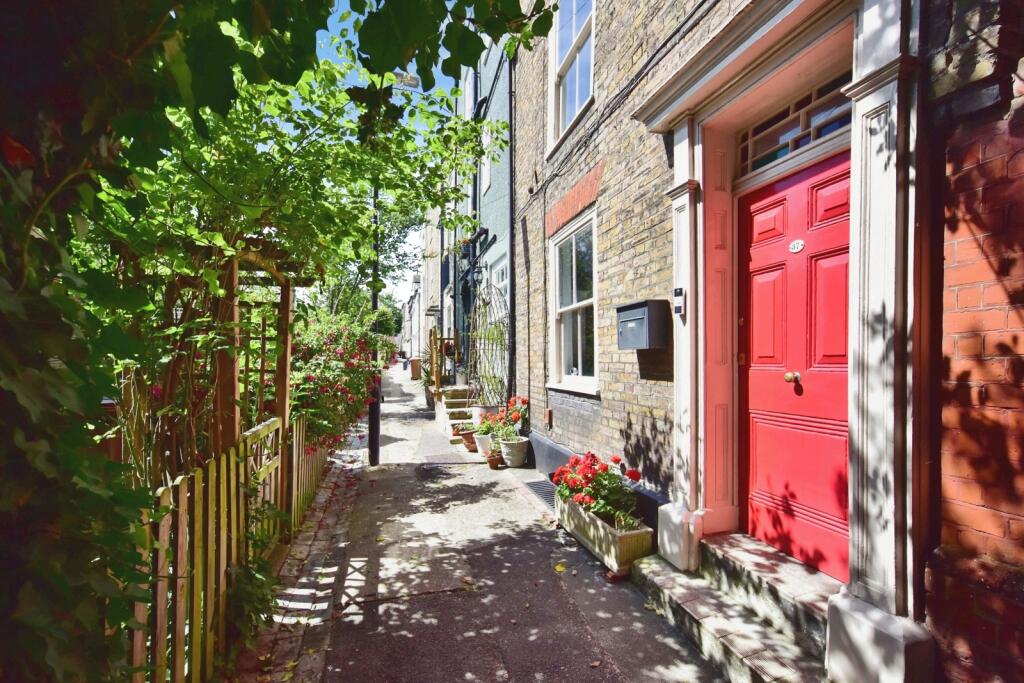
This three-bedroom end-of-terrace on Maidstone Road in Rochester is on the market for £500,000 and is basically the full character-house checklist in one of the parts of town where that still means something. You get the conservation area, the central Rochester location, the cellar, the exposed brick, the old fireplaces, and enough wood, beams and uneven charm to remind you that “period property” is not just something agents write when a house has one sash window left. The kitchen and dining space at the back is the modern bit, with rooflights doing the heavy lifting, while the upstairs bathroom has a pleasingly standalone bath. There’s a rear garden, an outbuilding, and the High Street and station close enough to make this feel like a very Rochester version of practical. It is not cheap, obviously, but at least this one looks like it knows why.

Review: IntraFest
Chris de Coulon Berthoud explores Medway's newest festival...
One particular gripe I have with social media discourse these days is the relentless drumbeat of miserable gits slagging off Chatham. Perhaps the most eloquent riposte to that negativity I’ve seen to date was IntraFest on 13 June, a day of music, food, heritage, and joyful, good-natured fun. Stretching along historic Chatham Intra, the area between Star Hill in Rochester and Sun Pier in Chatham, IntraFest filled the venues, shops, restaurants, and riverside, with music, community and, mercifully, sunshine. I dressed for a much colder day, making the twelve hours I spent in tweed an endurance test.
The event was anchored between two stages, the main stage at Gray's car park, and a second hosted by Decktronix and Ranscombe Studios. Throughout the day, chatting with visitors to the area, what came up again and again was a delight at finding this place and the rich creative infrastructure right here on their doorstep.
It wasn’t only locals who were discovering what Intra has to offer. One man I spoke to had travelled 11 hours from Teesside with his family specifically to catch The Solarflares. He was, he said, “blown away,” by the bands, by the atmosphere, and by the sense that something real was happening in Intra.
By mid-afternoon, the queues told their own story about how popular this was. Jody Carrington, the driving force behind the day, was emphatic. "I cannot think of a better way to spend funding than bringing a community together like we have done today. Everything we wanted to happen has happened. People have come here and seen how cool it is. We wanted to put it on the map and let people see what's here, all the artists, all the studios, the bands, the venues. We've honoured our past, the people who were here before, and we’ve shown people today that this isn’t a place that you just pass through.” I asked if anything had gone wrong, and, beaming with happiness, she laughed; “Literally nothing negative. Apart from running out of beer!”
Jodie Elwin, another of the organisers, told me, “It's exceeded our expectations. It's been amazing, and there's been such a really good atmosphere along the whole High Street. There's been a whole community feel, and it's been just great to see everybody from completely different walks of life coming down here and enjoying the fun.”
The Singing Loins, a quintessential Medway band if there was ever one, singing about mermaids and dolphins, “As far as Chatham Reach,” as the sun glittered off that stretch of the river, was a moment that cemented that success.
Grace Duffy made a passionate speech to highlight the threatened Royal Function Rooms, the Rochester former music venue facing conversion to flats, urging people to act before another venue is lost.
The Solarflares summed the day up, singing as the sun lowered in the sky and the shadows lengthened, “There’ll never be a day to leave Medway…”
Events this week
🎛️ Sat 27 Jun - Minimus // Informal, experimental, interactive noise afternoon. Walter Burke Way, Chatham Dockside. Free.
Footnotes
Follow us elsewhere: Facebook, Instagram, BlueSky, and now WhatsApp for new story alerts.