“There was three of us in this marriage, but I was two of them”
What Steven asked Hilary Cooke, CEO of Medway Pride

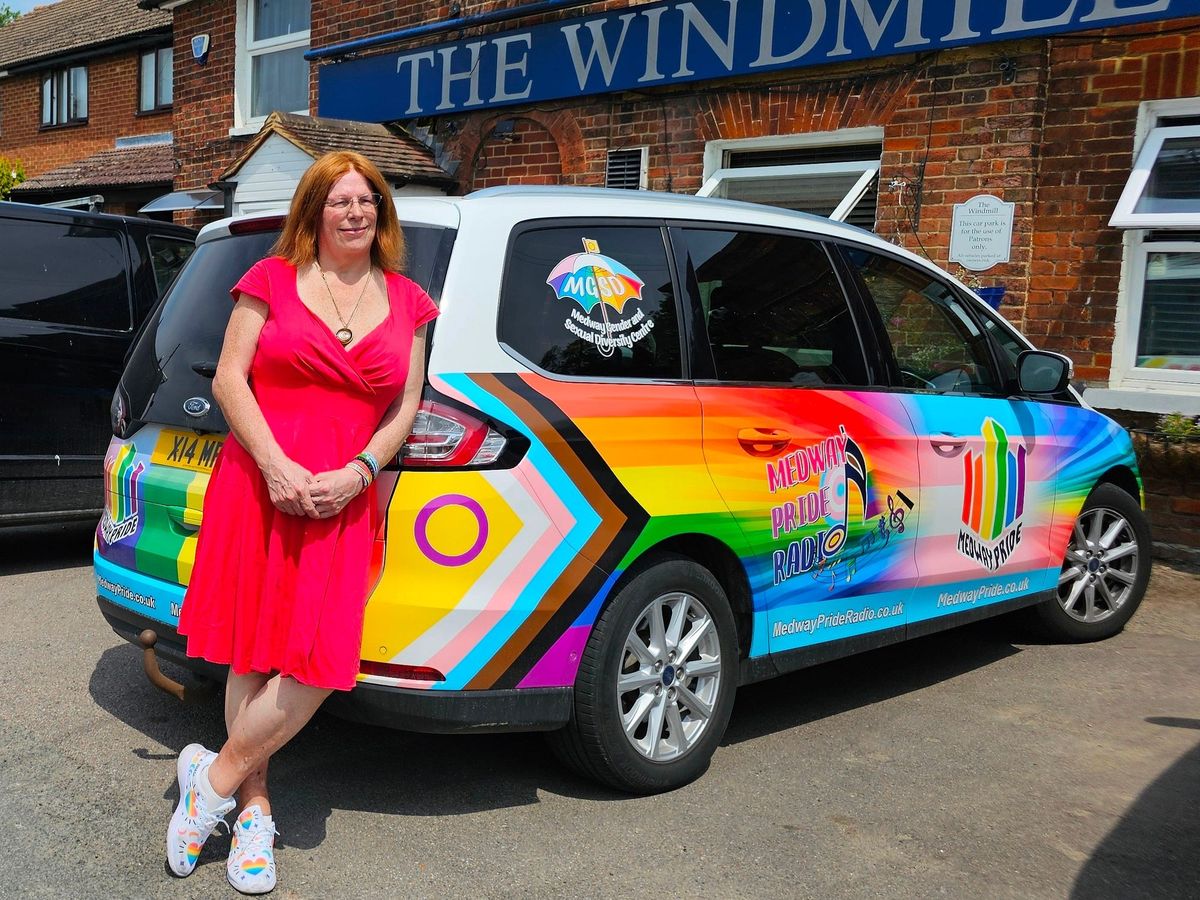
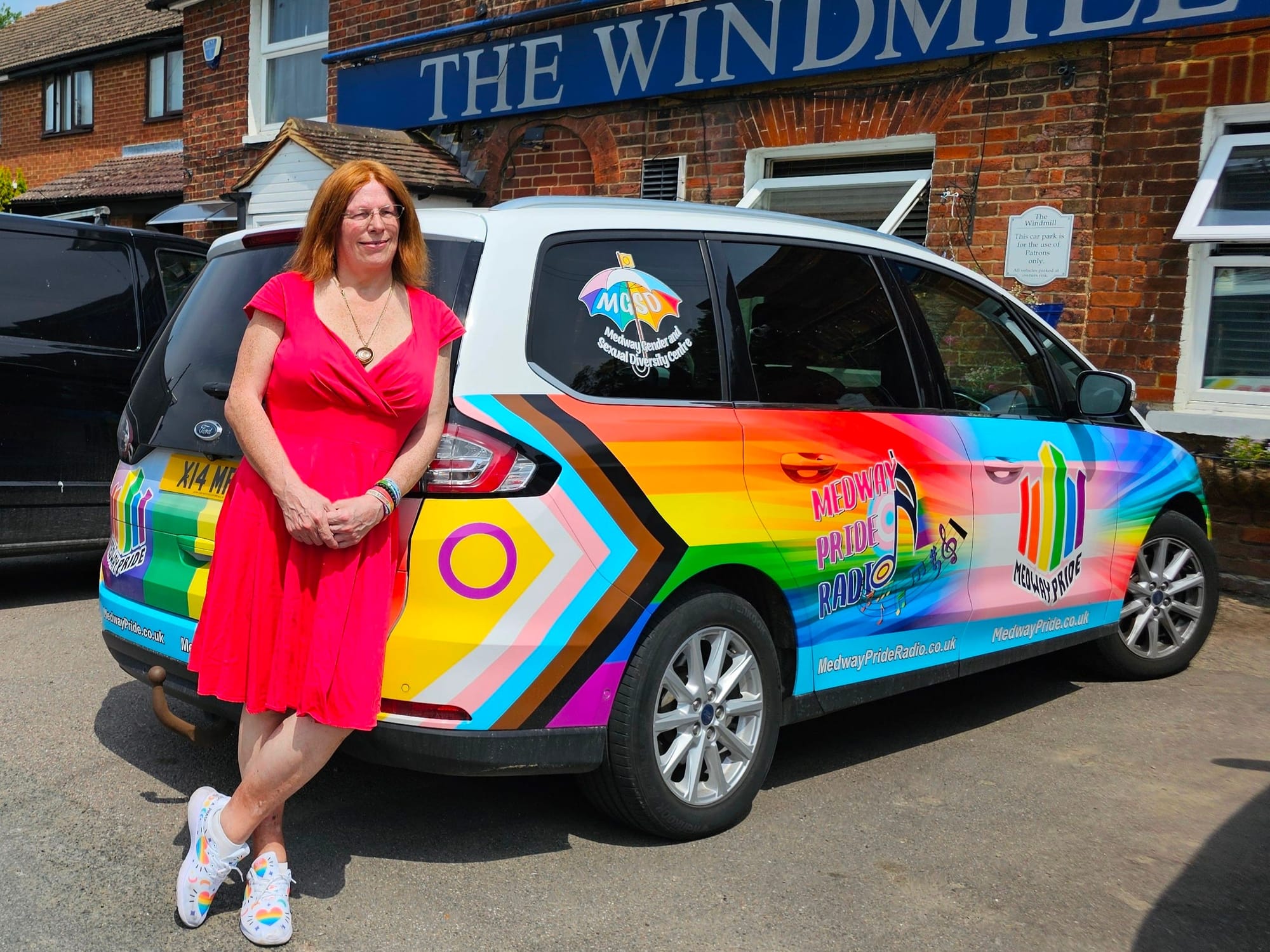
Electrologist Hilary Cooke is the CEO of Medway Pride and the manager of a pub in Burham. Steven met her at The Ship in Rochester and they talked about how Medway Pride started, Hilary’s previous career as a ship builder and her remarkable trip to America, which she mentioned after the interview had finished, but we managed to get the recorder switched back on…
How did you come to be CEO of Medway Pride?
That journey starts back in about 2010 when I was asked by a local charity if I could help with some people that they were supporting. They were a mental health charity who they described as members of the LGBT community. But when I went to see them, they were actually ten people and eight of them were trans, hence they hadn't got a clue about how to help them back then. The short story of that is that led me to set up an organisation called the South East Gender Initiative initially to support those people through their transition route. In 2014, that group or that organisation became Medway Gender Sexual Diversity Centre and, come 2019, the community at large were wanting to form a Pride event in Medway. Questions were being asked, ‘Why had we not had a Pride event in Medway?’ To which I replied, ‘Well, we did have two.’ We had one in 2013 and one in 2014 that was formed by a group that were going under the name the LGBT Kent and Medway Community Action Group. We had a couple of picnics in the Vines back then. But that group as a whole then decided to go and help Margate Pride set themselves up again.
In 2019, we hadn't had anything going on since 2014. The group that were trying to get that together failed to raise enough funds to have the event go ahead. This would have been the 50th anniversary of the Stonewall events that led to the very first Pride parades in New York. So early in 2020, I was asked by some charities to see if I could find out what had happened with this event. I did a bit of an investigation and spoke to the organisers, and they explained how they tried to raise the money through one of these fundraising organisations, like a self-funded thing through donations, but that hadn't worked out. Although they'd got some money promised, because they didn't hit a target, they didn't get any money. I said to them at that point, “If I find some funders who are willing to come and help, do you want to put it on next year?” To which they all said, “Yeah, that's good.” I went and found some funders. When I called them up to say, “I've got some funders,” half the group had drifted off. There was only a couple of people left. They wanted to help, but they didn't want to be involved in the fundraising. When it comes to choosing a chair, they all stepped back and said, “You can do it, because you know the fundraising, you have the connections.” I thought, “Oh, okay then.”
The Medway Pride event, unfortunately, occurred during covid. We had to set up a Pride event that nobody could attend physically. A good friend, called H, and I worked on the support work that I used to do, or still do, and at the same time as I was organising that Medway Pride, they were organising the very first Gravesham Pride. We found ourselves in the same boat. We joined forces and the people we were going to have on stage, we got them together to make videos, and we live-streamed either people playing live or video recordings. For seven days, 24/7, we had this event roll on. World Pride managed one day virtually, and we did seven. It was after that that Medway Pride CIC was formed. Up until that point, we were a bunch of people who were trying to put something together. That's how I happened to end up as Chair.
How much of that time is spent wrangling funders?
Initially, we had quite a few funders who came in to support the following year's event. The very first event that was live-streamed. We didn't really need a lot of funding for that, because the artists all decided to give their time for free as it was covid and they weren't doing anything else. It didn't really cost us a lot other than people's time. The following year, which was an in-person event, we were lucky to have support from local businesses. The cost of that event wasn't immense. With some grant funding from local businesses, Medway Council, and sponsors, we managed easily to put that one on. When we moved on to the next year, which was at Rochester Castle with a parade, that was going to be a much bigger event. We needed to get more sponsorship or funding from somewhere. What occurred there was we went to some major fundraisers like the Arts Council and the National Lottery, and they stepped in with funding that covered about 50% of the cost. With our existing sponsors from the previous year, we managed to have enough money to put on that event. We've been lucky since that we've had committed funders from the universities in Medway, from a few of the local businesses, who've been repeat sponsors. We've been lucky each year that we haven't really had to go out and seek lots more sponsorship.
This year has been a different story because some of those large grants that we got from the Arts Council and the National Lottery aren't available. They're funding different things. Different priorities. The Arts Council funded us for three years, and they did say at the very beginning that they don't fund projects forever. I think they got to the end of their cycle of funding for our event. They've gone on to different projects because all these projects need support. That's meant that we've got to look for more funders, which is what we have been doing. At the moment, we are seeking ways to fill that gap. We've got new sponsors on board. It's been a difficult year for businesses with increases in tax through national insurance. The world view of diversity and equality projects has taken a dive with Donald Trump being in power and asking multinationals not to run those programs if they wanted to work with the US government, which has an effect outside of America. There's been lots of pressures on organisations, which has made it more challenging. When a Pride event finishes, we have about a month off to rest, write a report to give to our funders, and at that point we start intimating how they're to support us the next year. It's like an 11-month cycle of funding.
You recently formed Burham Community Pride?
That is a business that I set up. It's not a Pride, as in an LGBT pride organisation. A local pub in the village of Burham was going to close, and it was the last real pub in the village out of seven. There is another business that has a bar, but it's more restaurant than pub. This pub was the last pub where you go play darts, music, everything else. A friend and I foolishly, two years ago, decided we'd save it. No plan. We just jumped in and turned it into a real community pub, a hub. We have people like the Women's Institute, we have book clubs, we do all the things that you would have running at a community pub, your Sunday lunches, all of that. We put on music events, jazz once a month, an open acoustic mic. We have an electric blues rock jam night. We've got poetry nights. We're trying to build up that community atmosphere and keep the pub alive.
When did you set up Hillary's Electrolysis?
I set up in Intra in 2012. It's been a while.
What is electrolysis?
Ah, yes, my other profession. Electrolysis is a method of permanent hair removal. Basically, way back in 1870, an ophthalmologist, I think that's how you pronounce it, was trying to cure people from going blind. Basically, their eyelashes were curling and causing blindness. They developed this process where you inserted a probe into a hair follicle, passed an electric current through it, and that killed the root of the hair, stopped the hair growing. That process is pretty similar to what we do today, only we use different blends of currents today to kill off hair. But yeah, it's a permanent method of hair removal.
Is your client base wholly trans?
It's quite diverse. The reason I got into electrolysis, apart from being made redundant and not finding another job, was that I knew I had electrolysis myself years earlier, and I had this group of people that I was supporting who needed hair removal. I thought I'd take the opportunity to learn how to do that skill and set up a business. The trans community were my very first clients, but today my clients are a mix of either ladies who've reached a certain age and are starting to develop a few hairs they don't want them, ladies of any age who have health conditions similar like polycystic ovary syndrome, which converts estrogen, and they end up with hair growth similar to male patterns. And as well as trans women, some who not only want to get rid of hair on their bodies, for aesthetic reasons, but I used to work with the NHS for surgical reasons, where they may need hair removal for surgery. I used to do that as well. Occasionally, I get some men who want hair removal shaping beards so they don't have to shave all over the place. Maybe enquiries about hairy shoulders and various other things.
Let's go back to the beginning. Where were you born?
I was born in a place called Stockton-on-Tees. People might have heard of that from the Stockton to Darlington railway because it was bringing coal mainly, and goods, into Stockton, which was the nearest port. It became very famous as the first passenger railway.
What brought you to the Medway Towns?
I would have to blame Margaret Thatcher and Norman Tebbit, because I used to work in shipbuilding. That all got closed down along with lots of other things in the northeast in the ‘70s. Norman Tebbit said I had to get on a bike and go and find a job. Via Holland, I ended up in Kent in 1978. I've been here ever since.
And when did you come to Medway?
That was ‘78. I moved down to work with a company based in Strood. That was my first view of the Medway towns, getting off at Strood Station.
What jobs did your parents do growing up?
My dad worked in shipbuilding. Riveter, welder, but most of the time that I was aware of what he was doing, he was a councillor. He was a convener of shop stewards within the Boilermakers Union. A councillor of Stockton on Tees, he became the mayor of Stockton, and then he was on the County Council or Cleveland Council, and he became the leader of that and the chair of that as well. Mainly politics. He was, I remember, he was the agent for Bill Rodgers. For people who don't know, that's Lord Rodgers now, who was Transport Secretary in Harold Wilson's government. I remember seeing lots of big posh cars turning up, especially at times like the Durham Miner’s Gala, as the Labour politicians of the day would always travel up to Durham for the Miner’s Gala, and we always went there.
And your mother?
Me mum! My mum was a housewife. There was six of us to bring up.
Did you enjoy school?
Did I? I had to be very good at running at school. Mainly to run away from bullies. I was very good at cross-country running, which is what I used to like to do. I'm a bit dyslexic. Back in the day, when I was at school, if you spelled something wrong, even if the answer was right, you didn't get marked up. I wasn't very academically good at English in school, but I was pretty good at maths and technical stuff and art. Those were my favourite subjects.
And what age did you leave school?
I left at 16. I did my CSEs as they were then.
Then went straight into shipbuilding?
Yeah. The choice back in the day, you'd have the chap come round to talk to you about what jobs were on offer, and he suggested that I should join the army. I said I didn't think that was a good thing for me particularly, but then I discovered he told everybody in the year that they should join the army. Maybe he was an army recruitment officer more than a careers advisor. Which left working in an iron factory, working in a chemical factory, or shipbuilding. Shipbuilding seemed the better of those choices.
Have you ever been a member of a political party?
Yes, I'm a member of the Labour Party. I've been a member of the Labour Party on and off since I was first able to join, from a very young age. I used to deliver leaflets for Lord Rodgers back in the day. I've been an active, if not card-holding, member of supporting them for a long time.
Has your name ever appeared on a ballot?
I did stand for the Labour Party in the Tonbridge and Malling council elections. Wasn't a seat that we were going to win, but they needed somebody to stand in it. I sort of volunteered.
Is that near where you live?
Yeah, although I live in Rochester, it's in Tonbridge and Malling.
How did you do?
Oh, from memory, it was around about 400 votes, which was pretty decent. There was a local campaign going up against Peter's Village. There were some people specifically standing against the development, and they got a lot of votes.
You've never stood again?
No.
Other than what we've mentioned, do you have any other additional roles, paid or unpaid?
I used to DJ for events and things, karaoke DJing and that sort of stuff. All the rest are volunteering. I am supposed to be retired now.
What does your average day entail?
I would get up and answer a few emails, sort out the radio schedule for the day, then come to work at my clinic over here in Rochester, and then go monitor the pub. Sometimes I might have to do something in the morning for the pub, before I get here, but always end up back at the pub to make sure things are running alright. Sometimes I work the bar there, other times it's odd things that have broken or shopping or whatever for the pub and then eventually when I get home, send some more emails out.
Who is the most famous person you are one degree of separation from?
I suppose it would be Mark Segal. They were at the Stonewall Riots. They're the editor of the Philadelphia Gay News.
What do you do to unwind?
Unwind? Eh... Have a pint? Watch telly. I don't do a lot of exercise these days.
What are you watching on TV?
Mainly the news. I'm a news junkie. I have to watch several different versions of the news to try and get a picture of what's going on.
Within Pride circles, is there an unpopular opinion that you have?
I'm not one for banning people from things, although I disagree with people in politics or maybe some organisations have fallen foul of some Pride groups, like the police. I've spent decades working with these organisations to build bridges, and my views on those bodies and those people are probably different to some people who don't think they should be part of or involved in the Pride movement.
A number of Pride organisations have distanced themselves from political parties, specifically the Labour Party. What is Medway Pride's relationship with political parties?
Like any group that can have influence, you want to be able to use that influence for your cause's benefit. I'm continually talking to MPs and local politicians about issues that I think they can help us support.
When you hear the tone of conversation recently, have you considered no longer being a card-carrying member of the Labour Party?
I think they're going through a difficult patch at the moment. I keep coming up with excuses as to why things might be happening the way they are. World events, other things going on. I think it's always better to be on the inside communicating than being on the outside trying to influence. I don't think at the moment, even though it's very challenging, I don't think that I wouldn't be involved in the Labour Party.
Who has been the best Prime Minister of your lifetime?
The ones that I would like to say have also done things that I disagree with. I suppose the one that was very positive for me, but also disappointing, was Tony Blair. We suffered a lot of Thatcherism. Before that, I suppose you've got to go back to Wilson and that era where things weren't so polarised.
Can you give us some understanding of what it was like to come out as transgender in the 1980s?
I have to go back before that. I suppose my first realisation, I was about nine or ten. I started cross-dressing around that era. Didn't think I'd told anybody, but of course, living with five other siblings, people noticed stuff. I knew by then that things weren't right. I tried to subdue things by cross-dressing and being myself in private. When I got married at 19 and a half, about a year into my marriage, I came out, and then that wasn't something that was welcomed, but it wasn't a deal breaker. It was more of, ‘If you want to keep it private, that's fine.’ I had some kids coming along in my early 20s and you can't keep things private.
My final stage of coming out, I was 30. I felt at that stage that life, although it was brilliant in some ways, it just wasn't right. It was a very challenging time, in so much as I was needing to find assistance for both my mental health and a medical route to get from where I was to where I needed to be. My GP at the time wasn't very supportive, suggested I should join a rugby club. He thought that would help. I explained that wouldn't really help the situation. Over a period of about five years, I went through this process of trying to seek help. My partner at the time, we still get on great. They become more attuned. A shock at first, but not such a big issue by then. We worked through a very difficult time. There was three of us in this marriage, but I was two of them. That all happened through the mid-80s, up until I finally managed to find my route to medical transition in the early 90s.
How would you compare that to what people transitioning are going through today?
Well, it's probably even more difficult now for people than it was for me. I couldn't get a referral via the NHS, I had to seek a private medical route. I was fortunate enough, if you can call it fortunate, that I was a director of a company, and they sacked me for transitioning. I got some money paid out, which meant that I could afford to transition privately. A private transitional route back then was about three years to go through the hormonal treatment process before you got to surgery. Today, it's very difficult not only due to cost but waiting times to seek private treatment, especially if you're a young person because of the bans on certain treatments. Not being allowed to have treatments of anything under 18 years of age has made it very difficult for young people to access treatment. For adults, if there’s seven gender clinics in the UK, you can refer yourself to any one of them, but they've all got long waiting lists. If you were to refer yourself or your GP referred you to the nearest clinic in London for adult services, the last time I looked, the waiting list for a first appointment is 13 years. Not 18 weeks, but 13 years. That's just the first appointment to talk to somebody. Then you've probably got another five to seven years after that first appointment to get through the system. The government are trying to come up with new routes to try and resolve that waiting time.
I do a lot of work with the local NHS, et cetera, around trying to find ways to alleviate some of the problems. It always comes down to funding in the end. If funding isn't available, even though the will might be there, they're not going to be able to do things.
What advice would you have for someone considering transitioning today?
Identify what support you need. Not everybody wants to medically transition. It's identifying what you need to move your life forward and, then seek that support. That support might just be social transition. People go through stages. It might start off with experimentation, you might get to a point where you're happy with where you are in that transitional process, and you might decide to change your name and live full-time. If medical support is your goal, then it's to get on a register for that support as soon as possible, because there will be a long wait, but eventually you get to the front of the queue, and in the meantime alleviate the distress that's caused by gender incongruence.
After the interview had finished, Hilary made a comment that required the recorder to go back on!
How did you end up on the Jerry Springer Show?
Well, I used to do a lot of media back in the early 90s, trying to raise awareness of trans people, to make sure that people didn't think they were all scary and try and put a human touch on it. Very difficult at the time through sensationalism. I did quite a few interviews, and one of these media stories was picked up by the National Enquirer. I had this person ring me up who said they were on the Jerry Springer Show. I hadn’t heard of it. They said we'd like you to come over and do an interview on the show. I've done a few interviews in the past, and they'd all been filmed as live, and I know that people would edit stuff out, and quite often they had somebody on the show who was a bit negative.
It's an adult chat show. Fine, I don't mind talking about anything. They flew me, my new boyfriend, my ex and her new partner out to Chicago. We could stay for a week because it was cheaper to fly out and come back a week later than the next day. We had a nice holiday, went and did the Jerry Springer Show, and they took us into different rooms. They were trying to say, we want you to talk about this and have a discussion with your partner about that. I said, ‘Why would I do that?’
Well, because it's television. I said we're not antagonistic amongst each other. We're quite happy. We'll talk about stuff, but we're not going to attack each other verbally. Anyway, we went out on stage, and they were filming the first half. Jerry Springer said, this is what they call the British reserve. He asked me this question, and I started answering it. I got halfway into my answer, and he asked me another question. I said I'll get to that one when I've finished answering the first one, thanks. I just continued answering the first one. Anyway, something must have been said in the break before we went out again, and they decided that, as we weren't going to fight each other, they would like it if we could both marry our new partners on stage. My new boyfriend said, ‘I'm not divorced yet from my existing wife.’ They said, ‘It's only television. It's not real.’ They weren't very happy, but it was fun.
Footnotes
This interview has been lightly edited for length and clarity.
You can read our previous interviews here.
If you want to suggest ideas or send tips for people to interview, email Steven.
Steven Keevil still manages to watch hundreds of films a year. He recommends Fantastic Four. He listened to no music whilst writing this, but recommends reading A Short History of the Apocalypse by Frankie Boyle.