“The times I've been accused of being drunk is unbelievable”
What Steven asked Phil Bungay and Martin Nagler of the Medway Neurological Network
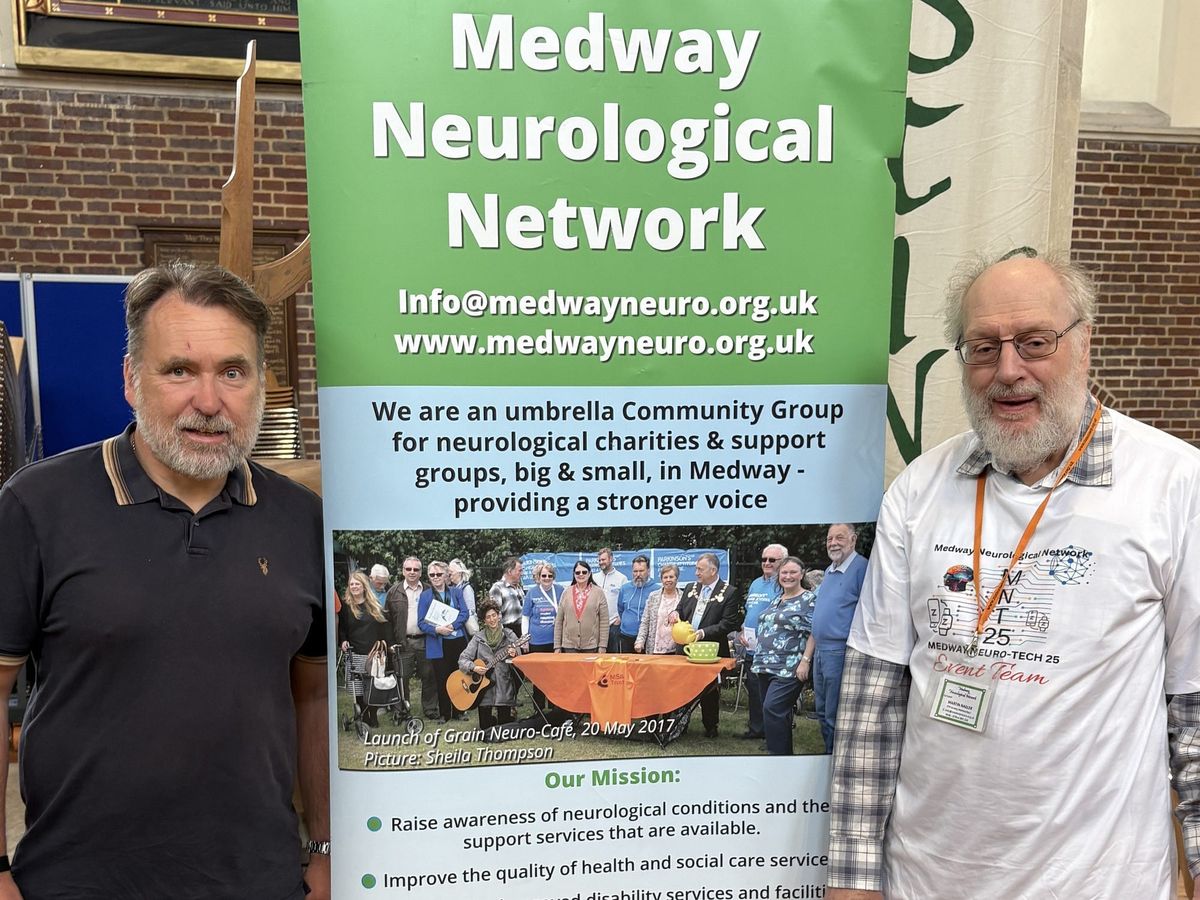
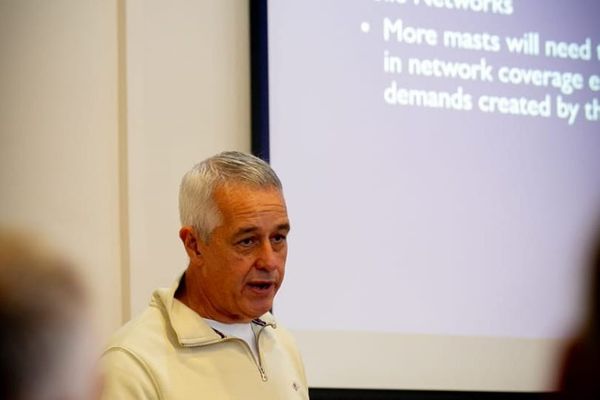
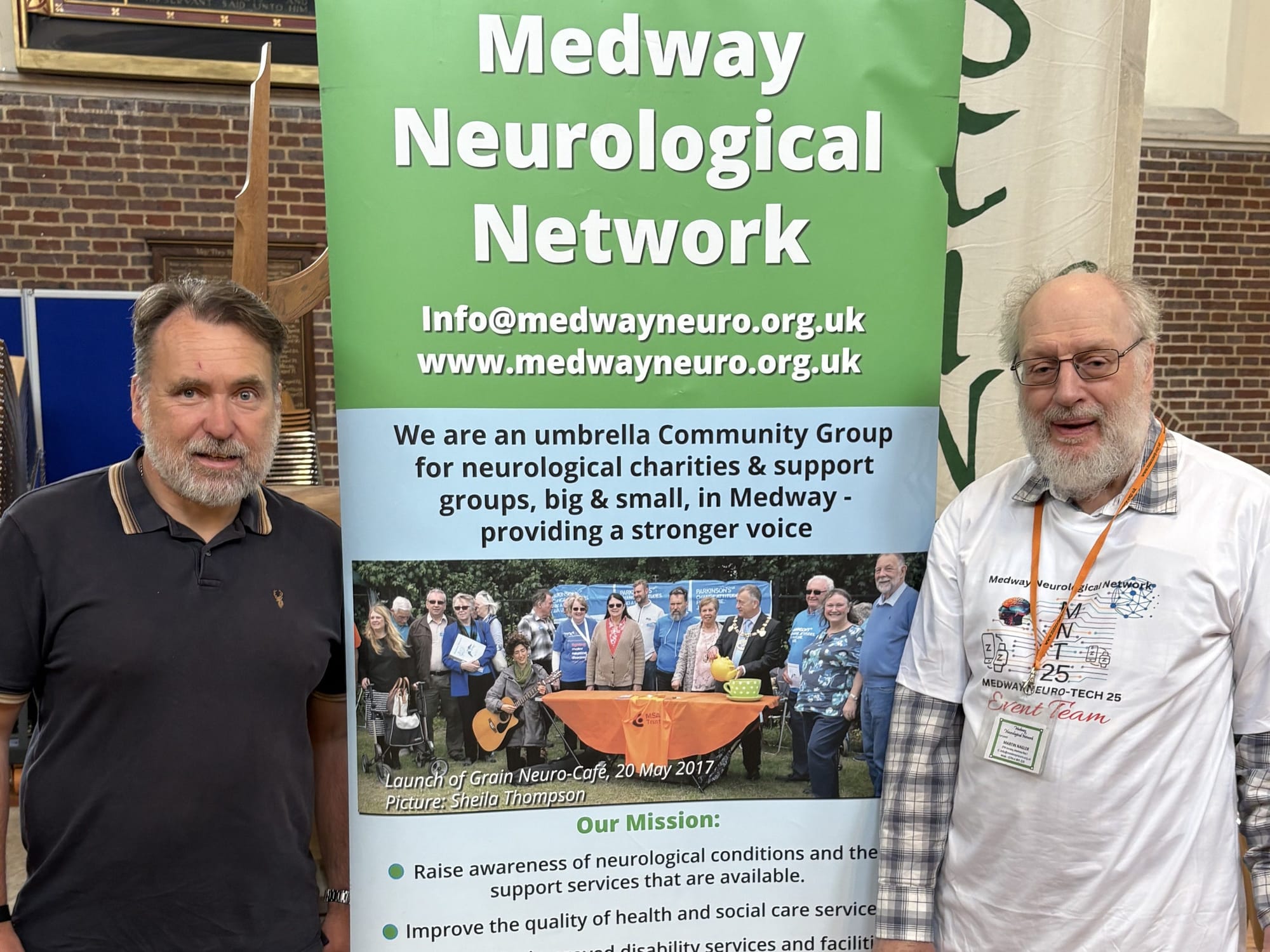
The Medway Neurological Network is a community support group for charities and groups for those with neurological conditions. Steven sat down with Phil Bungay and Martin Nagler from the group, ahead of their Neuro-Tech 25 event, at St Augustine’s Church in Gillingham, which regularly hosts Medway Neuro Café, an opportunity for those living with neurological conditions, as well as carers, to meet for information, support and friendship. They talk about their respective conditions, the upcoming conference, and the work of the network.
Note: Phil has speech difficulties due to his Parkinson’s, and some information was provided in written format later. Those sections are italicised below.
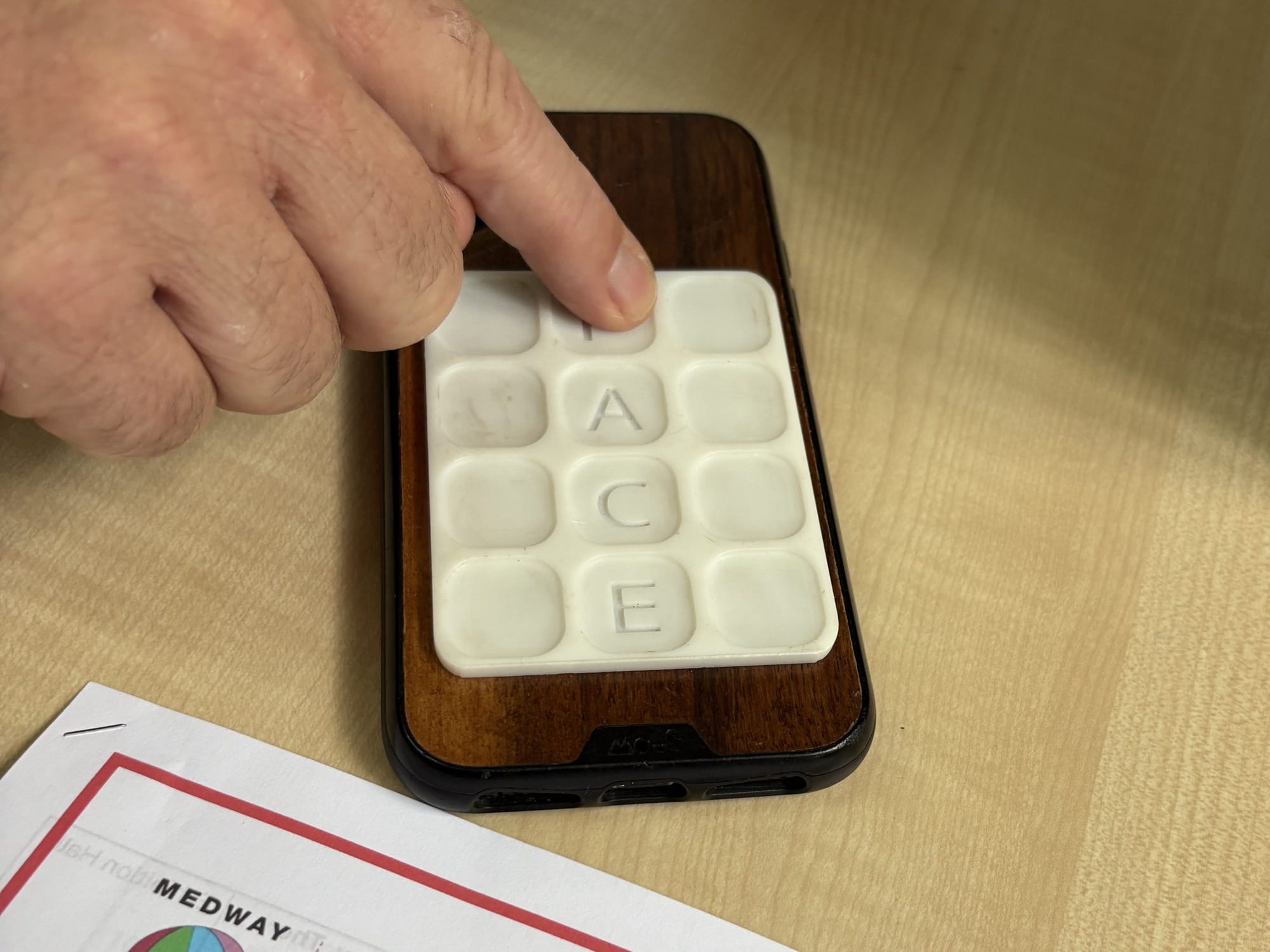
Phil is showing me a device on the back of his phone. Relatively simple in nature, pushing down on the squares, it supports him with his speech.
Martin: We heard about it. What they had, they had bricks on the wall. So, you're looking for walls somewhere, you point to a brick. But one of the designer’s sons came up with the idea of having little bricks on the phone.
Phil: My son William… He was really willing. This was the best thing. I was thinking, ‘Oh, I can't.’
That's incredible!
Martin: It is incredible. Before Phil developed the speech problem, he was the most talkative person in the world. He's got all these thoughts and ideas. It must be the height of frustration.
What does this help with?
Phil: This… helps with control.
Martin: It's like a lot of these things, you never know how you are going to respond to it. Some things help some people very much. Through trial and error, see what works for you.
Let's talk about Neuro-Tech 25. When is that?
Martin: That is Thursday the 4th of September, at the Pilkington Building, Medway Universities.
How long have you been running the Neuro-Tech?
Phil: It is our 10th Birthday.
Martin: The Medway Neurological Network, it’s our 10th anniversary. Phil and I met at Medway Hospital at the neurology department in 2015. At that time, I was chair of the Medway Multiple Sclerosis Society. My main condition is Allied Multiple Sclerosis, but not actually Multiple Sclerosis. My lesion is in my spine, rather than my brain. The closest thing that was an organisation locally was the MS Society, and at that time, they accepted people with allied conditions. They're not so obliging now. I volunteered, and I soon ended up being chair.
One of the things we wanted to do was to engage with other people in the neurological community, particularly looking for other people that needed MS support. We negotiated with the hospital to have a small information stand in their waiting room once a month. That's when Phil came in and we got talking. The first thing Phil said, “Oh, well, if you're here, we'd like a stall as well." (laughs)
Phil: Going back a bit, I was at the time the co-ordinator of the UK (Parkinson’s) Working Age Group in Medway. We are quite fortunate that we have two proper groups. One is the branch, for people further along the journey, and the Working Age Group for people of working age.
Martin: We met in our different roles, but as we talked more about what we were doing for our organisations, it became obvious very quickly that there was so much overlap. Although we were saying MS or Parkinson’s, we were looking for the same sort of thing, to improve the services and all that sort of thing. And we were both aware of the national Neurological Alliance. It twigged, I'm not quite sure how, but why don't we have a local Neurological Alliance and engage with all the other groups providing support? One of the first people was my work colleague, Linda Nicolaides, because we were looking for a secretary. When we first started off, we were going to be co-chairs and find a secretary and a treasurer, but we couldn't find a treasurer. I ended up as treasurer (laughs).
Phil had been leading the alliance up until this year, when Linda's just taken over at our last AGM to be chair. That's our beginnings, really.
We will putting this interview out in August and let people know about the conference.
Martin: The first idea we had would be that it's for people living with a neurological condition to showcase technologies and say, ‘They're available, so this might help you.’ That was really the main aim. It still is the main aim, but what we quickly found was there was a lot of interest from the professionals, occupational therapists, around here, with various things being demonstrated. It looks as though it might be 50-50ish between the people that have the condition coming in, and those who are professionals looking to provide that technology. Of course, we've got a couple of speakers on AI, and we're thinking that AI technologies almost certainly will transform the way the services are provided.
Phil: I’ve got this... (Indicates the device on the back of his phone)
That's extraordinary.
Martin: That is very low tech.
Phil: I got… whilst in physical therapy… I think it was at King's College Hospital. They were… talking about all sorts of technical things, work-based. I started developing from the squares.
Martin: It really does work so well for you.
Phil: But… as Martin said, I do find my speech…. frustrating. (laughs) Because I used to be a talkative person.
Phil, with the Parkinson’s, I am assuming you are not working anymore?
Phil: I got out in 2017.
What was your job?
Phil: I worked for the Ministry of Defence in Whitehall. I was one of those who was on the train. Sent me to work at Whitehall. I worked for 29 years. Giving up work was hard. I wanted to leave normally. I was getting to work, and the whole process of getting to work made me exhausted. I couldn't do my job well, because I was getting to work so exhausted.
Martin, what was your occupation?
Martin: In the scientific service. I was working with, well, it keeps changing its name, but Overseas Development Administration and then the DFID. We're a scientific unit, and as soon as they called us ‘the Jewel in the Crown,’ they immediately wanted to privatise us (laughs). We used to work up in London in one of the scientific units called the Products Institute, and then we amalgamated with other scientific units in the same area and moved down to the University of Greenwich. I was working there, but I spent a lot of my time working overseas.
The idea was working in food safety and food security areas, setting up laboratories and trying to improve the quality for exports and for livelihoods of exporting countries. I'm specialised in something called mycotoxins, toxins produced by moulds. If the produce becomes mouldy, then it can contain toxins, and then of course, they can't export it. We were working from the farmer level right through to the exporters. I did a lot of work in southeast Asia initially. I was in Thailand working on Thai maize and the Philippines. I was called a Technical Cooperation Officer. I really enjoyed that. It gave more opportunities to reach your potential because at home you had people directly sitting on your head, and when you were out there, you had a whole lot more responsibility and had staff and counterparts. If I was overseas to send a report back, I had no one putting red ink through it, it just came straight back, and the things I asked for. It was fantastic. When you come back and try and write a report in the olden days, we had the typing pool, the person immediately above you would make changes or whatever. It was a real headache to work properly, and then a delay coming back from the typing pool. They introduced more errors and so on. But working overseas was fantastic for me.
What condition do you have?
Phil: In 2012, at the age of 45, Phil was diagnosed with Young-Onset Parkinson's. At the end of 2021, Phil was diagnosed with an additional condition, Hereditary Spastic Paraplegia type 7 - a general term for a group of rare inherited disorders that cause weakness and stiffness in the leg muscles. Most people with HSP will have inherited a faulty gene from 1 of their parents. Phil was diagnosed with the complicated form of the condition, as it is believed he inherited a faulty gene from both his parents.
Only one in 750,000. It's quite rare… In June, I went to see the UK specialist in HSP. Having HSP and Parkinson’s is even rarer (laughs). I only know of one other person that has both.
Martin: In 2005, I came down with rapidly progressing paralysis. My GP was convinced it was just a trapped nerve, even though it was affecting me all over. I went to him a good number of times over a short period of time and in the end, reception said; “Well, the doctor can't see you, he's got a full schedule. If you're so worried, why don't you go to A&E?” I went to A&E and I was admitted (laughs).
That was at Medway, and they transferred me up to King's. The first diagnosis was for a tumour in the spine, in the top part of my spine, which is the worst place to get it because it's very narrow there. Very poor prognosis. Then one of the neurologists gave me a very thorough examination, and I can hear now the magic words: “I don't think you have a tumour in your spine, I think it's what we call a pseudo tumour,” like an inflammation, “and it could be something like transversal myeloma.” It's demyelination (damage to the myelin sheath, the protective, fatty covering around nerve fibers) generally of the central nervous system. Later on, I was diagnosed with transversal myelitis. It affected both sides, one side worse than the other. I lost use of my left arm completely. I didn't know where it was or what it was doing. It used to frighten myself sometimes when it would fall into my lap. I didn't know what it was. No strength whatsoever in my fingers. I didn't have gloves on or anything. I was really quite poorly. But the thing with transverse myelitis (TM) is that, in general, the pattern of it is that you tend to have a rapid paralysis. You go down a long way. Some people go down so completely they can only wink their eyes, but I wasn't as bad as that. But you go really down, and then the body can naturally remyelinate. That's putting the insulation back around the nerves so it can carry the signals still. I was really very lucky because I think mine's probably gone up about 85%. I've still got lots of dead muscles in my shoulders because the damage caused by the initial attack isn't reversible in itself. You can get the signals back to some extent. I was very lucky.
What is the Medway Non-Visible Disability Initiative (NVDi)?
Martin: That's one of our main projects that developed, how long ago was that now…
Phil: Five years ago, isn't it?
Martin: It's quite difficult to describe how that came about.
Phil: Not every disability is visible. The Non-Visible Disability Initiative is that it affects... It's about getting knowledge and training out there.
Martin: I remember it was one of my ideas, because I was looking in a magazine and it was talking about travel in Berlin, and it said that they had this Access Berlin phone app, and I thought that sounds like a good idea. We could have an Access Medway phone app. It started with the idea of having a phone app, and then people who got interested developed it into what it's become. You need the information, but what is really needed is training for people to be aware of non-visible disability. When people do access places, local restaurants, parks and whatever, the staff do have in mind this person might be acting strangely or awkwardly, but in fact they might have a non-visible disability. We have to have training in how we respond in an empathic way, and the idea of training courses came up.
We worked with MidKent College to set up an NVQ course, which was run, and then the idea was to set up online courses, which we have developed. One is for customer-facing staff, and the other is for their managers. It's appropriate for all medical staff and care staff as well. There's a great interest in it, and the courses have been developed and they're awaiting the CPD (Continuing Professional Development) accreditation. Once that's done, we're going to go into a big launch mode to launch these courses. We also have in mind working with Medway Adult Education to offer a face-to-face alternative, like the Dementia Friends scheme. Just a couple of hours, and then people get a badge to say that they've received the training. That is also in hand. When we set it up, we didn't have in mind that it would be an integral part of Medway Neurological Network. It needed some governance, so we lent it our governance, but the idea always has been for it to be standalone. We've got a good way down that path.
Phil: I'll give you a perfect... The times I've been accused of being drunk is unbelievable. Having some time to understand… to give you time… they're thinking “I think he's had a few too many,” when it’s not that at all (laughs). I might, as well, enjoy a drink, or going out in a restaurant. All the NVDi is asking is a little bit of time for the individual. Time and understanding, because that is so important for lots of neurological conditions.
Martin: One of the roles we see for Medway Neurological Network is really to provide support for the rarer conditions, because people with Parkinson's or MS have quite strong local support groups, they can go to their socials and have exercise classes just for them. What we're trying to do is engage with the organisations representing the rarer conditions to provide the local support. It wouldn't be the focus support, but much more the friendly social space to combat the loneliness and isolation and things. But also, one of our main roles is signposting. If people come to that and they've got a particular condition, we can signpost them to appropriate service providers. We're really looking to provide services where there are gaps, essentially, though we don't like to do a gap analysis. Way back in about 2017, there weren't any singing therapy groups for people with neurological conditions. We actually set up Medway Skylarks with Canterbury Cantata Trust. That's an example of where we filled a gap. I think that's the best model of working.
Phil: Actually, setting up Medway Skylarks with Canterbury Cantata Trust… It's evidence-based through the Sing to Beat Parkinson's therapy.
Martin: Oh yeah, I forgot to mention that in particular. To use parts of your brain to cross over so you can use the crossover parts of your brain. You've got the right side of the brain controlling your left side, and it uses plasticity of the brain to overcome it.
Phil: Although I have… One thing I can always do is sing clearly.
Martin: Yeah, you can.
Let’s do some background questions now. Where were you born, and what brought you to Medway?
Phil: Philip was born on 16 March 1967 at West Hill Hospital, Dartford, to John & Margaret Bungay. John left the merchant navy in 1976 and became a publican at The Good Intent, Rochester, but in 1982, died of a heart attack.
Martin: I was born near Portsmouth, a place called Horndean. My work brought me to Medway when I managed to get a job with the Tropical Products Institute in London, and they moved to Chatham. That was around 1990.
Did you enjoy school?
Phil: Phillip enjoyed education at Highfield Secondary, becoming Head Boy, and West Suffolk College in Bury St Edmunds, becoming Vice-President of the Student Union. It was in Suffolk, living with his stepdad and his mum, that Philip started his Christian faith.
Martin: I wouldn't say I enjoyed it. I was a very anxious student. I remember being quite stressed out a lot of the time. On the other hand, I think the stress drove me on. Although it wasn't a very enjoyable experience, I did achieve quite well at school. I ended up being a house captain, head librarian and on the top boards in the chess team. That was good because that kept me out of the house a lot too. I would have lots of things to do, even the first 11 cricket for a time. I was very shy, and essentially, my CV was looking quite good, but I was quite stressed out a lot of the time.
What was your first full-time job?
Phil: In 1987, Philip joined the Territorial Army, serving in the Royal Army Ordnance Corps. In 1989, Philip was posted by the Ministry of Defence to Belfast, and in 1990, Philip married Louise Anne Smith at the Kings Church, Chatham. In November 1992, Philip was posted by the Ministry of Defence to Hong Kong. In Hong Kong, Louise worked in a Youth with a Mission (YWAM) kindergarten. Both Philip and Louise volunteered with Jackie Pullinger MBE, who had set up a Christian outreach programme, working with the drug addicts in the colony. On returning to the UK, they purchased a house in Rochester.
Martin: I studied chemistry, but I was really much more interested in the physical chemistry side of things, the technical side. I was specialising in nuclear magnetic resonance, MRI. I had solutions for identifying what the compounds were, snatch, release, sedation work. I got this job at Tropical Products Institute, which then became the Natural Resources Institute.
Can you or could you play a musical instrument?
Phil: I could play the piano… but probably not now (laughs).
Martin: Not very well, no. I was always interested in singing. I sang in the school choirs and with Skylarks. I wouldn't say I was a good singer. I enjoyed singing. I enjoyed playing the piano.
Who is the most famous person you are one degree of separation from?
Martin: Phil knows everyone. I am just on the side (laughs).
Phil: We are on good terms with local politicians.
Martin: I know Vince Maple.
Phil: Tracey Crouch, and we recently met with Lauren Edwards as well.
Who has been the best Prime Minister of your lifetime?
Martin: Oh my god. That's a very good question.
Phil: They are all…
Martin: It's so difficult. Maybe David Cameron has been the most benign.
Phil: Although his chancellor did austerity.
Martin: I'd like to say Tony Blair, but I can't forgive him for the Iraq war.
Phil: I don't want to say it. I hate to see the division, but she did turn around the Economy.
Where do you like to eat in Medway?
Phil: I went for lunch at Gurkha Fire. I'm into a place that the food is done well… and that's on a par with the Shozna.
Martin: I don't eat out too much in Medway, but I take my son to the Ship and Trades. That's okay. It’s got an outside eating area, and he's very concerned about covid, so he doesn't ask all the time. The only place I can get him to, if we sit outside.
What improvements have there been in Medway for those with a disability?
Martin: We're looking at actual achievements we've done rather than things in progress. I think it tends to be in waveforms. You think you've made some progress, and then something happens, you slip down. We are constantly trying to keep neurology on the radar because when you look at the priority areas of health, you'll find that neurology doesn't occur even in the top ten, and whenever the government come up and says ‘we're going to prioritise these things,’ what happens to all the conditions that aren't in top? The cake is only so big. I think we've never been winning some and losing some the whole time. You've got to put a lot of effort to stay still.
Footnotes
This interview has been lightly edited for length and clarity.
You can read our previous interviews here.
If you want to suggest ideas or send tips for people to interview, email Steven.
Steven Keevil still manages to watch hundreds of films a year. He recommends Caught Stealing. He listened to no music whilst writing this, but recommends reading Minority Rule: Adventures in the Culture War by Ash Sarkar.