The plaque that couldn't survive Medway
A rail mystery near Cuxton, a useful budget chart, and the latest Gun Wharf shuffle

A monument near Cuxton marking the UK rail speed record has disappeared from its hillside home, prompting questions about where it went and what Medway has lost in the process. We also look at a reader-made budget chart that makes the council’s finances easier to understand, and the latest messy stage of the £22m Gun Wharf refurbishment.
The plaque that couldn't survive Medway
For a little while, this looked like a mildly ridiculous mystery.
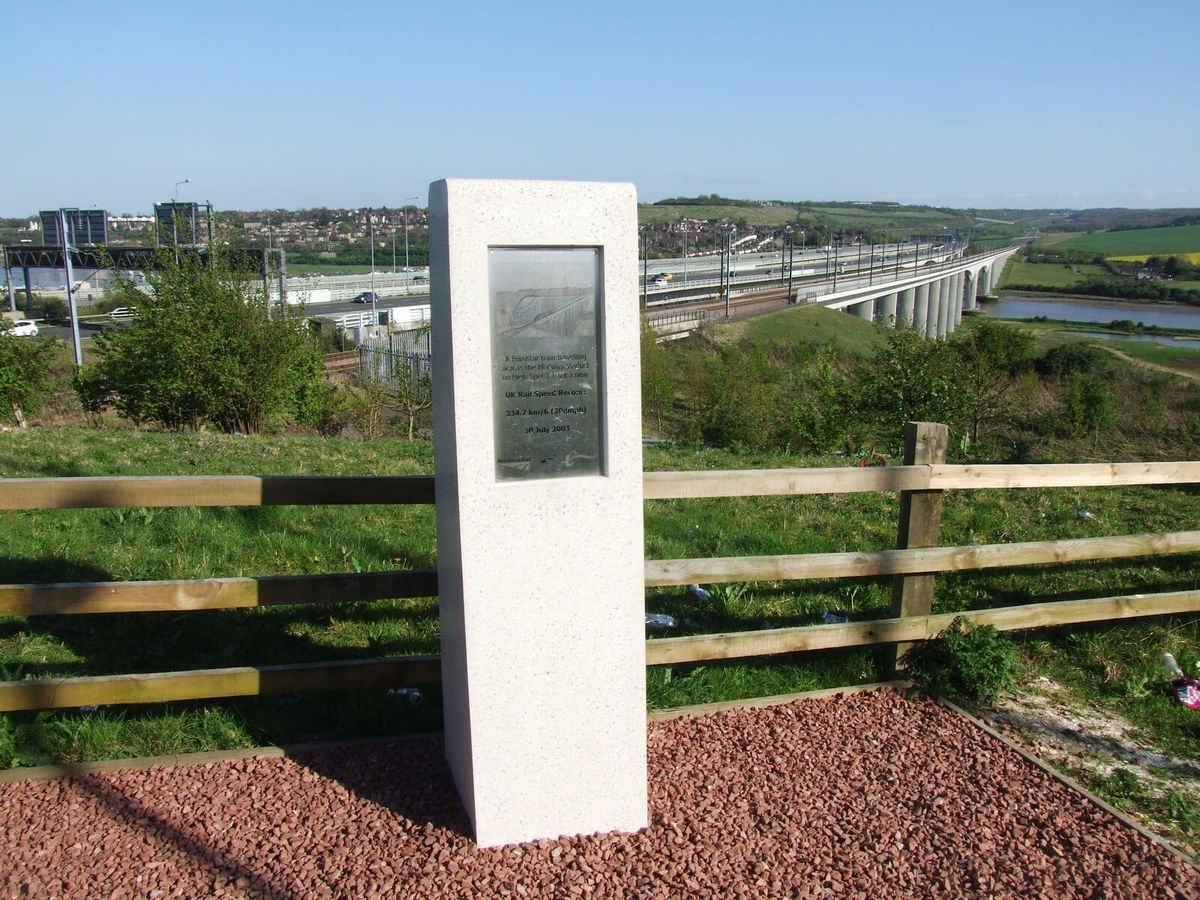
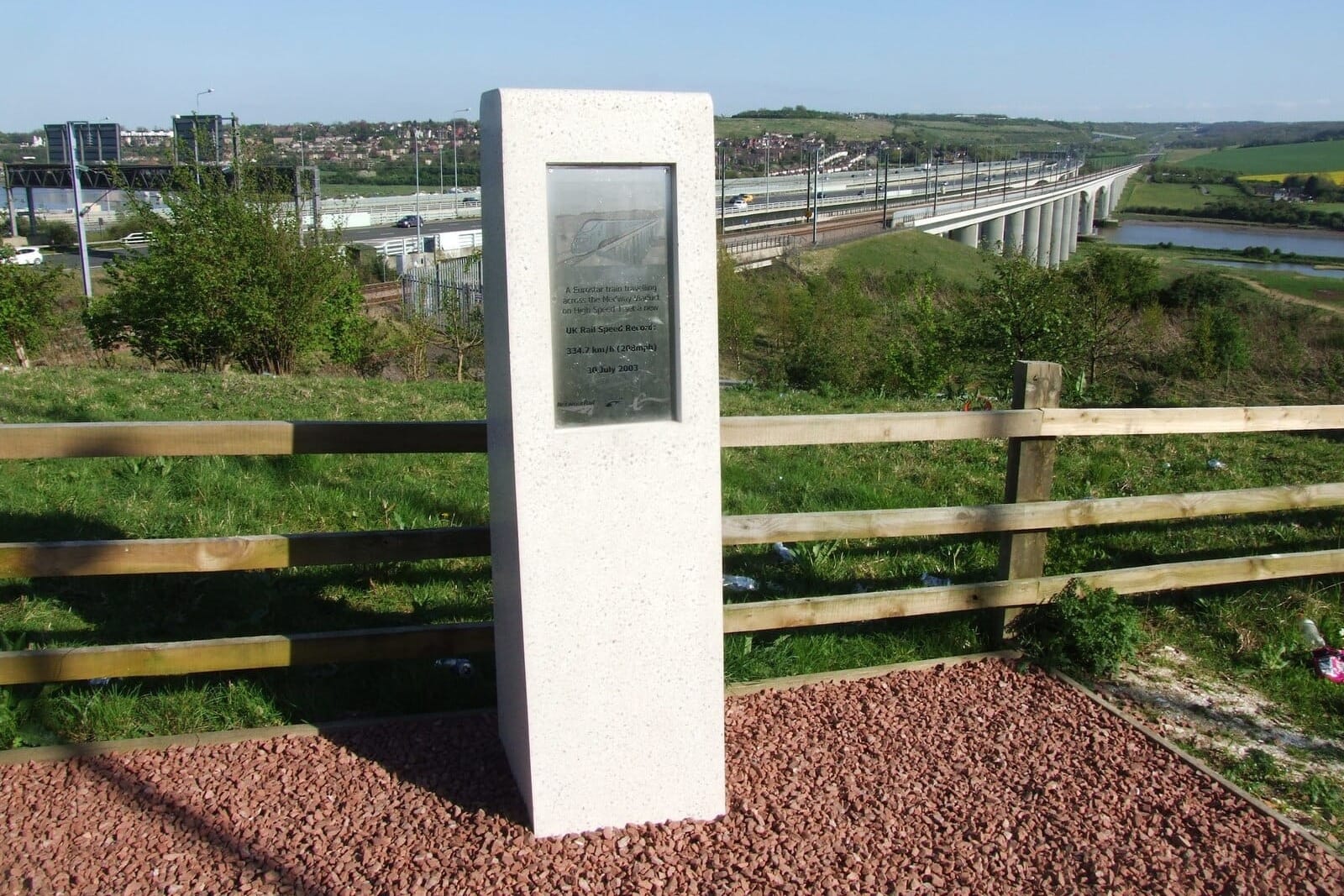
A monument near Cuxton marking the UK rail speed record on High Speed 1 had disappeared. Not just the plaque itself, but also the large plinth it sat on. Given it stood on a hillside overlooking one of the country’s most significant railway lines, that felt like the sort of thing somebody ought to have noticed.
The answer, it turns out, is both less dramatic and more annoying than simple theft.
The monument was removed deliberately after years of repeated vandalism and has now been transported to the National Railway Museum in York.
So now a marker commemorating a major Medway rail moment has been packed off to Yorkshire.
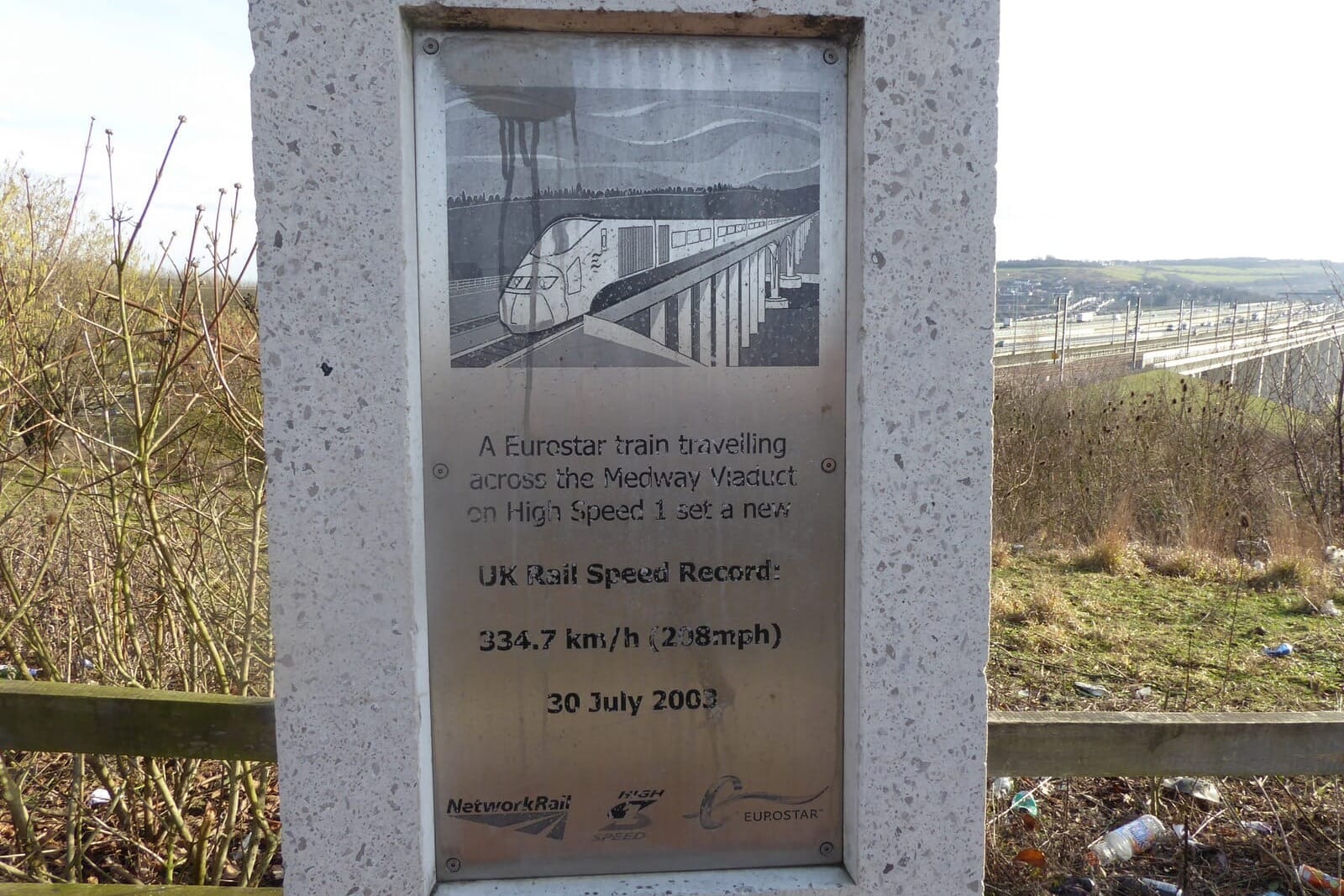
The monument marked the record set in July 2003, when a specially assembled Eurostar train hit 208mph on High Speed 1 through Kent. In 2013, a plaque was unveiled near Cuxton to mark the tenth anniversary of the run. It sat above the line the record had actually been set on, which was rather the point. Back then, it looked out across HS1. Since then, the site has been allowed to become heavily overgrown.
That was already a little telling. This was not exactly a monument being lovingly fussed over. It had been left to sit there, increasingly swallowed up by the landscape, until eventually it disappeared altogether.
At first, there was no obvious answer as to why.
When Local Authority started asking questions, Medway Council said it did not appear to be something it was involved with. A council spokesperson noted the plaque appeared to have been put up by Eurostar and bore old rail branding, but said the council did not seem to have any role in it.
Kent Police, meanwhile, said it could find no report of any theft.
That immediately narrowed things down a bit. If the whole plinth had gone and there was no sign of any theft report, then one of two things seemed likely. Either somebody had somehow managed to remove an entire monument from beside HS1 without much fuss, or somebody had removed it properly and not bothered telling anyone.
It was the second one.
Network Rail has now confirmed to us that the plaque had been subject to ongoing vandalism over the years and had broken at the bottom, raising safety concerns. As a result, a decision was taken by Network Rail High Speed, which maintains the HS1 railway, and HS1 owner London St Pancras Highspeed, to remove it. A contractor then carried out the work.
The plaque and plinth have now been taken to the National Railway Museum in York.
That is all entirely sensible, up to a point. If the monument had been repeatedly vandalised and had become damaged enough to raise safety concerns, taking it away is not some outrageous act of cultural vandalism in its own right. Better that than leaving it there until some idiot finished the job.
But it is still not a great look.
A monument marking one of the biggest moments on Britain’s modern railway has been removed from Medway because it apparently could no longer be trusted to remain standing in Medway.
That is funny, in a bleak sort of way. It is also slightly pathetic.
This was not some random decorative plaque to a person nobody remembers or an event nobody cares about. It marked the UK rail speed record, set here on the high-speed line running through Medway. That is a genuine piece of local and national history. Yet it managed to leave the area in about the most modern way possible: repeatedly vandalised, increasingly overgrown, quietly removed, and only explained after someone started asking where it had gone.
Nobody is pretending this is the disappearance of some priceless national treasure. But it is still a local historic marker vanishing from public view without any public explanation.
It also says something a bit dispiriting about how this sort of thing tends to work. The monument was put up with suitable ceremony to mark the tenth anniversary of a major moment on HS1. It overlooked the line. It made sense in its setting. It was there to tell anyone who stumbled across it that something significant had happened in that spot. Over time, the site became overgrown, the monument was repeatedly vandalised, and eventually the whole thing was taken away.
We have asked the National Railway Museum about its plans for the monument, including whether it will go on display, but they have not responded. For now, all we know is that the original has gone north.
That leaves one obvious question behind. If the original had to be removed to preserve it, does Medway now get some sort of replacement on the site?
That need not mean dragging the same thing back from York and hoping for a better outcome the second time around. But there is a fair argument for some sort of new marker where the record was actually set. The line runs through here. The record happened here. A monument like this is supposed to tie a place to its history. Once it is removed from the place itself, some of that point goes with it.
If that sounds a little grand for what is, after all, a plaque on a plinth near Cuxton, there is still a simpler way of putting it.
Medway had a monument marking one of the more unusual things ever to happen on its patch of railway. It no longer does.
The original may have been saved, but Medway has still lost it.
Finally, a budget chart normal people can understand
One of the recurring small frustrations of local democracy is that councils are required to publish enormous amounts of information, much of which is then presented in ways that make you want to put your head gently through a window.
So thanks to reader Phil Quinn for sending us something better.
After spotting underwhelming budget diagrams in the Spring 2026 edition of Medway Matters, Phil decided to create his own Sankey diagram of Medway Council’s 2026/27 budget.
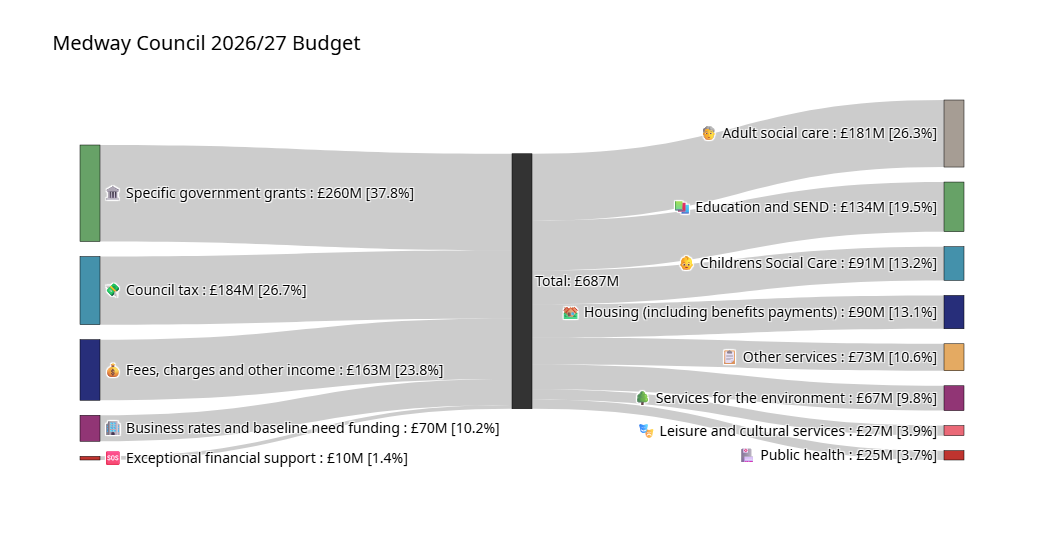
For those of you who are not the kind of people who spend their evenings making public finance diagrams, a Sankey diagram shows flows of money from one place to another. In this case, it shows where Medway Council’s £687m budget comes from, and where it goes.
It is not magic. It does not solve the funding gap, make adult social care cheaper, or stop anyone at the council from using the phrase 'challenging financial environment.' But it does something surprisingly rare in local government finance. It makes the budget's broad shape understandable at a glance.
On the income side, the largest chunk is from specific government grants at £260m, accounting for 37.8% of the total. Then comes council tax at £184m, or 26.7%. Fees, charges and other income bring in £163m, or 23.8%. Business rates and baseline need funding account for £70m, or 10.2%. Finally, there is £10m of exceptional financial support, the formal name for the government allowing Medway Council to prop up its budget using financial flexibility it would really rather not need.
On the spending side, adult social care remains the largest single area at £181m, or 26.3%. Education and SEND accounts for £134m, while children’s social care takes £91m. Housing, including benefits payments, accounts for £90m. Then come services for the environment at £67m, leisure and cultural services at £27m, and public health at £25m. Mysterious other services come in at £73m.
The chart does not make Medway’s budget position any easier, but it does make it easier to see. A large share of the council’s money is locked into adult social care, children’s services, education, SEND, and housing. These are not marginal bits of the budget. They are the budget.
By contrast, some of the things residents most immediately associate with councils, like parks, leisure, culture, bins, streets, and public spaces, sit much further down the list. That does not mean they are unimportant. It means the council’s room for manoeuvre is often much smaller than local politics makes it sound.
Phil’s version also comes with AI-suggested emojis, because apparently even local government finance must now have a little sparkle. We are not sure whether the tiny money bag next to fees and charges improves democratic accountability, but frankly, it cannot hurt.
If Medway Council ever wants to make its public finance documents a little more readable, it might want to get in touch with Phil.
RAAC, relocation and a former Debenhams full of furniture
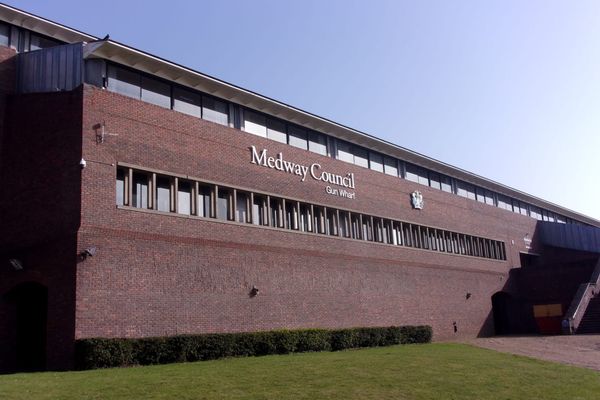
Medway Council’s £22m Gun Wharf refurbishment has reached the point every office move eventually reaches with the timetable is starting to wobble, floor plans flying, and a surprising amount of furniture has ended up in a former Debenhams.
The project began after dodgy concrete was found in the roof space of the council’s main headquarters in 2023. Since then, it has become more than a straightforward patch-up. Gun Wharf is due to be remade over the coming decades, even if Medway Council won't make it through the next two years, with new office layouts, a new reception, improved accessibility, carbon improvements, and a new council chamber.
The council says the building has not had substantial repairs or refurbishment since it opened in the late 1970s, and the works are intended to make it fit for another 40 years.
Somehow, the whole project manages to be sensible, expensive, and a tad messy.
An internal update sent to councillors shows the relocation phase is now well underway, with staff being moved out of parts of Gun Wharf and into temporary spaces across Medway while the building works are being prepared to begin.
Some teams will remain at Gun Wharf, while others will be sent to Pembroke Court and the Compass Centre in Chatham, Strood Sports Centre, Pender House on Medway City Estate, Kingsley House in Gillingham, and various leisure sites.
The former Debenhams building in Chatham High Street has also been pulled into service, not as the long-awaited revival of the town centre’s retail fortunes, but as somewhere to store furniture cleared from Gun Wharf.
There are early signs of the usual project complications. Planned moves have been delayed by third-party network providers and ongoing lease negotiations. Staff have been told they will not move on the original scheduled dates, although the council expects the delay to be short.
There are other loose ends. Child-Friendly Medway was due to move into a unit at the Pentagon Shopping Centre, but that is now described as “not viable,” with alternative premises still being investigated. In a project full of temporary homes, even one of the temporary homes has become temporary.
None of this means the Gun Wharf project is falling apart. Large public building works are fiddly, disruptive things, and this one involves RAAC, an ageing headquarters, political offices, public-facing services, staff teams and a council trying to keep operating while the building is pulled apart and put back together.
But it shows the scale of what is now underway. This is not just a roof problem being quietly fixed somewhere above the offices. It is a major reset of Medway Council’s headquarters, with staff scattered across the area, a future council chamber, and the authority’s main building being redesigned around a different way of working.
For now, Gun Wharf sits somewhere between civic renewal and office-move purgatory. The council has a £22m plan for a better headquarters. The reality of this week is staff heading to temporary bases, delayed moves, an abandoned Pentagon option, and a former Debenhams full of furniture.
Footnotes
Follow us on social media! We’re on Facebook, Instagram, and BlueSky, but not that other one.