“To bring them back to life”
What Steven asked Vern Hampton, guitar tech to Medway's music scene
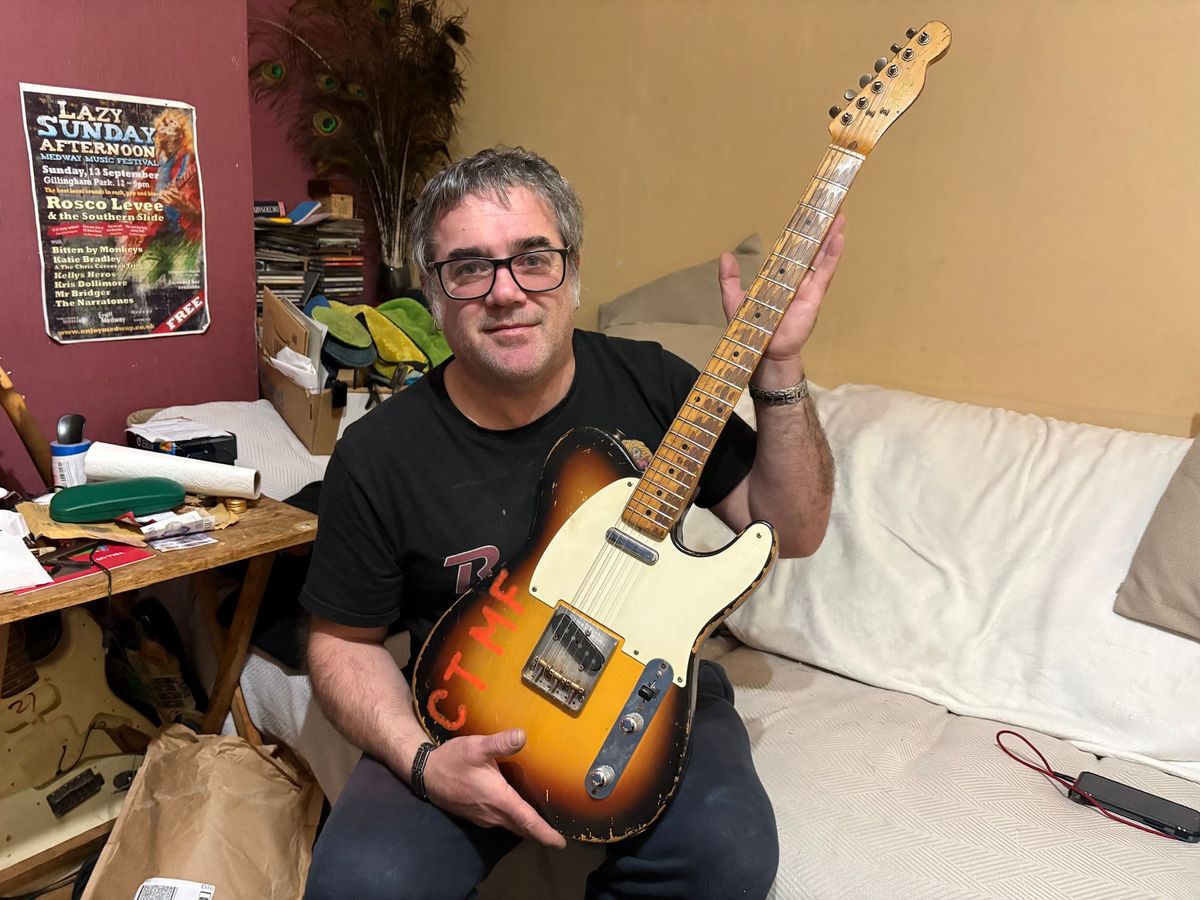
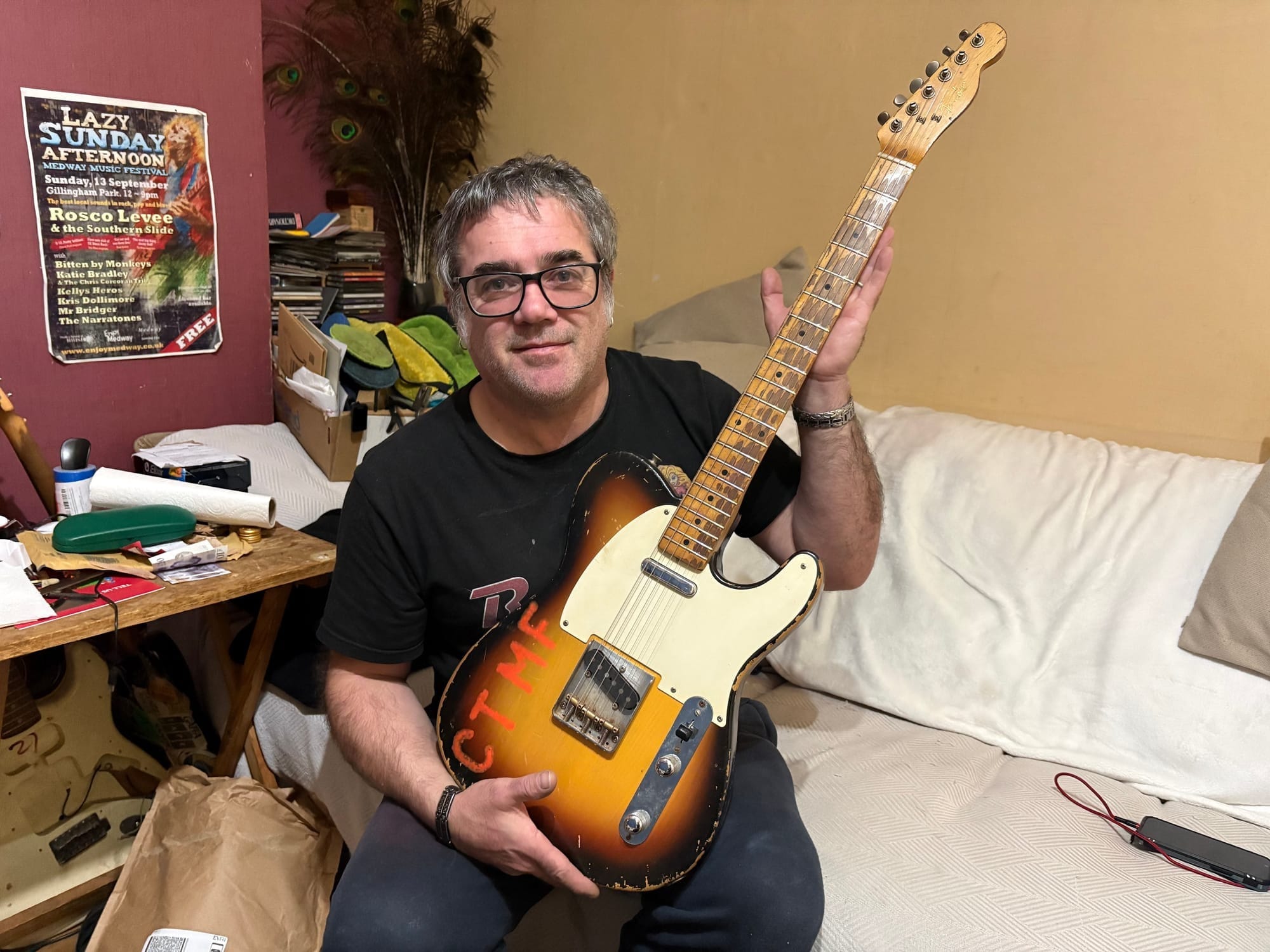
When Billy Childish donated a guitar to Second Chance Medway to raise money for food aid this Christmas, Steven was told to take it to Vern Hampton. He soon discovered that Vern seems to fix guitars for most of Medway. After restoring the guitar, Vern sat down with Steven to talk about his work, his decades in Medway's music scene, and why he doesn't go out for dinner in Medway.
What is your official occupation?
Guitar tech.
What does that entail?
Repairing and restoring guitars and other stringed instruments. I also do drum repairs and a certain amount of amplifier repair, as far as my knowledge goes.
Mainly it's repairs and setups, but I do a bit more than tech work. I also do body repairs, touch-ups and paintwork on a smaller scale, as well as repairing and building necks and making parts.
If a customer needs rare parts they can't find, and I can make them by hand, I will.
How did you get into that?
Well, I own a lot of guitars, probably around 50, and having them all set up professionally would cost a lot of money. I was never overly happy with some of the work done on my guitars. I thought I could do it better myself. So I did.
I looked into it, invested in a few tools, made a few tools and began doing setups myself. Friends would come and play the guitars, then ask me to set up theirs, and it progressed from there.
A good friend of mine, Tim Constable, who I've known and worked with over the years, passed my name on to Strum and Bass, and that brought me work. My musician friends brought me more work.
Then I completed a quick course on guitar tech, so now I'm a certified guitar tech, which qualifies me to go on tour with a band and tech for guitarists and bass players.
Where do you study something like that?
Initially, when I started looking, it was just online, really. Luckily, it was at a time when the internet was fairly new, but there was still enough online to teach me the basics of a good guitar setup to make it play its best.
I also bought a book by the American luthier Dan Erlewine. It was good and was probably my first major reading into how to work on guitars.
I'm not a great player, but I've got a passion for guitar being a drummer!
What is it about guitars? How do you end up with 50 when you can only play one at a time?
Shape, sound, style, tuning. I think it's a bit of an OCD addiction that guitarists have. There are so many makes, models and styles, old and new, and they're works of art, really.
They're nice to look at, though most of mine are in cases. There are a few around and hanging up.
Do you have a favourite guitar?
Not really. I prefer older ones, because at the end of the day, they're pieces of wood with strings on, which is what they all are, but some are nicer woods.
I certainly prefer to work on older ones that are really only fit for firewood and bring them back to life because of their historic value, or more sentimental value to people and families. They're the ones I prefer to restore.
They all do different things. It depends on what I'm doing at the time. I'm not a great player, but I've got a passion for guitar being a drummer!
The first guitars I had were always rubbish
If you are a drummer, why the passion for guitars?
I guess I wanted to learn to play guitar since I was a child. I couldn't have a drum kit indoors because it was too loud. You couldn't get a cheap drum kit when I was a kid. Now you can get anything cheap as chips, really.
The first guitars I had were always rubbish. I mostly bought them from catalogues and paid them off weekly. It was alright.
What makes something a good guitar?
There's a lot of snobbery, but I guess it's the wood it's made of, its resonance, especially acoustic guitars, as well as how it's set up and plays. The frets being level, nice wood, a nice feel to the neck.
It's a personal choice, and there are a lot of guitars that are highly priced but don't necessarily play that well. It's their age and provenance that makes them worth that money.
It is all down to personal preference and how it is set up. I try to get the guitars to play as nicely as possible for that person, depending on their style of playing and preferences.
Over time, I've got enough customers that I've got to know how they like them. I can tweak things to fit their playing style, and for someone else it might be completely different.
If you were blind-tested with two guitars you knew, would you be able to make an educated guess on whose guitar it was based on how it was set up?
Probably. A lot of people's favourite setup is to have it as low as you can get it.
What do you mean by low?
The action is low, so it's easy to play. You've only got to touch the strings, and you can bend them. It's easy to play.
Whereas a few other guitarists who only play chords and strum can have a higher action because they want volume from an acoustic guitar, so the lower action isn't so important.
How many different instruments can you play?
I try to play all of them, though whether I can play them or not is another thing.
Apparently, I'm an okay drummer and an okay guitarist. That works for me. I play a keyboard a little and a bit of bass, but drumming and percussion are really my main thing.
My house was full of equipment and loud music
What Medway bands have you played with?
Well, I played my first paid gig in 1984 with a band called Sceptre Z, who became All the Flesh. I worked with the Car Thieves, the Ragdolls and a few other jam things that never really had any name.
Through the 90s, I worked with Jim Riley, Glenn Barnes and Stu Cunningham in Gurus of the New Millennium, which was quite a popular band for five years or so. Obviously, we've all moved on from there.
I've done quite a bit of house music DJing, where I played percussion at the same time as mixing, and I recorded lots of dance music with a friend of mine. I did that for a while.
Over the last three or four years, I've been with the Camden Shades, which is a mod-ska-soul covers band. Matt Jarrell, who played bass with me in the Andy White band, joined us, and Tony Wilkinson is on guitar.
How did the Gurus come about?
Well, they started off with Jim and Glenn Barnes as a duo, and then Glenn suggested, “Let's get Vern on percussion and take it a step further.”
I already knew Jim, and then Jim said, “I've got a friend I'm working with, Stu. Let's get him in on bass.” And that was that, really.
We started to rehearse and record in my house. The second album was recorded in my house.
I also recorded a few other local bands, and then Jim went on to open Ranscombe Studios.