

The ghosts of a working-class landscape
Plus a proper Christmas for care leavers, new High Span album, our weekly events guide, and more
Two stories that take us deep into the social fabric of Medway this week, from the vanished pubs that once held whole neighbourhoods together to the volunteers making sure young care leavers aren’t spending Christmas alone. We’ve also got Stephen Morris on The High Span’s beautifully strange new record, plus a packed run of local events to see you through the week.
The ghosts of a working-class landscape
Chris de Coulon Berthoud on why Medway had so many pubs, and why so many are no more…
It once seemed like there was a pub on every corner in the Medway Towns. The names spoke of royalty, Britannia, the British Queen, Prince of Wales, Prince of Wales, of naval and military connections, The Army and Navy, The Cossack, The General at Sea, Imperial Forces, and of work and the trades, The Hook and Hatchet, The Jolly Caulkers, Brickmaker’s Arms, Carpenter’s Arms, Ropemaker’s Arms. Others were less august establishments, back-street beer houses that served dockyard maties, apprentices, and soldiers. Beer houses flourished after the 1830 Beerhouse Act, which allowed almost anyone to sell beer from their premises with minimal licensing. By the 1880s, Medway had hundreds of these. Many never made it into the official directories and survive only in remaining licensing records. Most are now long gone, flattened, converted, or living on as spectral memories in the urban landscape.
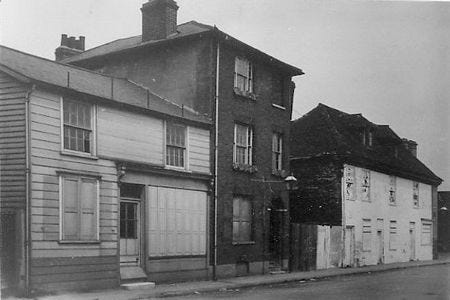
To understand why Medway once had so many pubs, and why so many of them have vanished, we have to look closely at the social and economic history of the area. Pubs were a vital part of the Towns. It needed them, because of the nature of work and military life. Pubs, like churches, were central to the rhythms of a largely working-class town whose daily life revolved around labour, sociability, and a need for temporary escape from drudgery.
Medway’s density of pubs was not an accident of geography. It was an outcome of three intersecting forces: the Dockyard, the military presence, and industrial working-class neighbourhoods. For more than 400 years, Chatham Dockyard was a giant of naval production, with thousands of men passing through its gates daily. Shipwrights, riggers, rope-makers, sailmakers, labourers, marines and officers, apprentices, and civilian workers. Traditionally, every naval town in Britain developed a strong pub culture, and Medway’s was no different. Above the dockyard sat barracks housing the Royal Engineers and Royal Marines who often operated on staggered paydays, meaning a near-constant churn of men with wages to spend and an evening to fill.
Pubs grew up where soldiers and sailors spent their free time. These were men whose “home” was the regimented life of the barracks, and so pubs of Brompton and Chatham were places to drink, fight, and find trouble, temporarily shrugging off the regimentation of military life. In his seminal work on prostitution in Chatham, Brian Joyce describes an incident in 1873, when fighting erupted at a temporary fairground erected outside the Fleur de Lis public house. An argument between a soldier and a marine quickly escalated into a mass brawl, with hundreds of men fighting with fist, boot, and belt. Order was only restored when the military police arrived and began cracking heads. It gives an idea of how full the pubs were, as well as how violent the “good old days” could be.
By the late 19th century, Medway was a dense cluster of manual industries, cement works, engineering shops, brickfields, rail workshops, and the commercial port. Working days were long and physically punishing. Pubs became the living rooms people didn’t have at home. Large families often lived in cramped terraced houses with little spare space, thin walls, and few comforts. The pub was a place to drink, but more than that, it acted as a social centre, a meeting hall, a job-seeking point, a place where news was swapped, and an informal union office. Pubs were also embedded in its cultural life. Folk clubs, darts teams, pool leagues, skittles, football teams, motorcycle clubs, railwaymen’s societies, model engineering societies, and charity nights all found their home in the pub. Many later became important places for the local music scene to take off. In short, Medway once had so many pubs because the community needed social spaces that matched the density and precarity of working people’s lives.
Some losses were inevitable due to changes in licensing, shifts in population, and redevelopment, but many were casualties of broader structural change. The closure of Chatham Dockyard in 1984 was a generational blow. Whole neighbourhoods lost their reason for being when thousands of jobs disappeared. Pubs that had survived a century or more of boom and bust suddenly found their clientele gone. The pubs of Brompton, Chatham Hill, and New Brompton were hit especially hard. As the need for housing increased, many were either demolished and redeveloped or turned into flats, much more profitable than the declining “wet trade”.
From the 1990s onwards, pub culture across Britain shifted. The “vertical drinking” model of large town-centre venues replaced smaller local pubs. Alcohol became cheaper in supermarkets, and home entertainment and gaming had evolved into a sophisticated industry of its own. Younger people increasingly preferred clubs, and Gen Z is increasingly likely not to drink at all. In the post-covid world, pubs were closing for a series of overlapping reasons. Rising operating costs, caused by increased energy bills, supply prices, and wages, made it far harder for pubs to stay profitable. Austerity and de-industrialisation meant many people have less disposable income, so they’re going out less often and spending less when they do. Social habits have also shifted, with people working from home and drinking cheaper supermarket booze at home instead of visiting the pub. The longer-term economic fallout from the pandemic, including accumulated debt and reduced footfall, has compounded all of this, leaving many pubs unable to survive. Many landlords found it increasingly hard to keep doors open when nearby streets were empty and boarded up.
The disappearance of Medway’s pubs is as much about changing drinking habits and economic decline as it is about a cultural and emotional shift, a restructuring of the social landscape that comes with the atomising of community. A part of working-class identity and community was deeply tied to specific pubs: “My dad drank in The Ship, my grandad in The Two Brewers, I learned to play darts in The Eagle.” When pubs closed, these community ties became attenuated. Pubs were informal centrepieces of local life where birthdays, wakes, wedding receptions, and football celebrations were all accompanied by a few pints. The pubs functioned as democratic spaces, often being the only place where people from different backgrounds would meet as equals, and the slow loss of these places also meant the loss of a layer of social glue that held the Towns together.
It is also indicative of the hollowing out of social space in many parts of Medway, where the pub was the only warm indoor space where you could sit over a half pint and chat without spending much money. Their loss is part of a wider pattern of disappearing public infrastructure, youth centres, libraries, community halls, and local shops. When pubs disappear, so does some of the connective tissue of neighbourhood life.
Pubs shaped the emotional map of Medway, and as we lost them, we lost landmarks of memory. A demolished pub leaves a psychological gap even when something else is built over it. Medway is not alone in this: a pub in Britain closes its doors for good every day. But the scale in Medway is striking. What remains is a landscape of fragments, a former sign bracket on a wall, a tiled façade on a convenience store, a street name that recalls a pub long gone.
It’s not all about the ghosts of the past though, even as enjoyable are the stories of Lord Haw Haw being chucked out of the Lord Raglan on Chatham Hill for distributing fascist flyers, or how local character Fred Low, a thirsty regular of The British Queen in Chatham’s East End, was known in the 1930s for waiting for the last tram, the “Midnight Special” from Rainham to come down the track, at which point he would stand on his hands in the centre of the rails singing “Rule Britannia.”
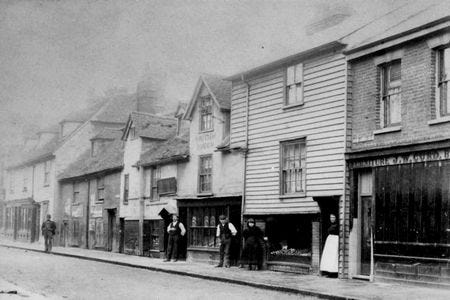
Understanding the lost pubs of Medway is ultimately about understanding the changing identity of the towns themselves, from naval-industrial imperial powerhouse to post-industrial place searching for new forms of community. And these new communities are emerging in fresh spaces as well as the few old ones that remain, places like the Wolfe and Castle in Rochester, a warm, craft-ale micropub, or the 12 Degrees in Chatham Intra, where you can hear live music, meet neighbours, and drink good beer, these exist alongside older and equally popular businesses like The Coopers, or The Nags Head.
To paraphrase the last words of Joe Hill: “Don’t Mourn, Organise”, and by that I mean, organise a night out with friends at your local and help keep a much-loved social space open. - Chris de Coulon Berthoud
Heather Haythornwaite and our exciting merchandise arm Medwayish have produced a new tea towel commemorating the lost pubs of Medway.
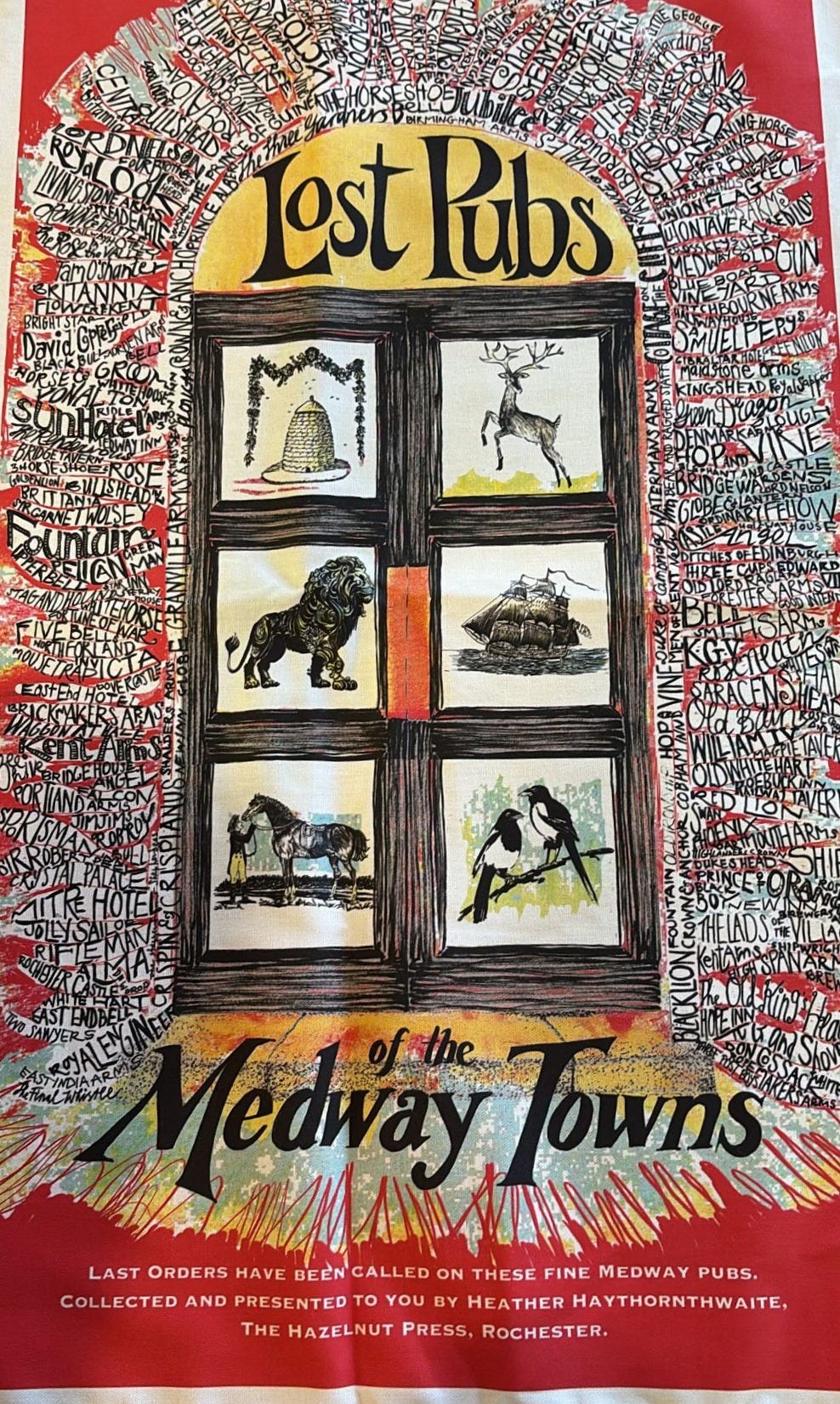
If you're interested in ordering one of these glorious new tea towels, email medwayish(AT)gmail(DOT)com, and you’ll be sorted out.
Giving Medway’s care leavers a proper Christmas
Sarah King is a member of a group organising the Care Leaver Christmas Dinner in North Kent. The dinner is an opportunity for care leavers to experience a home-cooked meal and have a fun day this Christmas. They need your help, so we spoke to Sarah to find out more…
The Care Leaver Christmas Dinner North Kent started as a conversation between four people in February of last year, when one of Sarah’s friends volunteered at a Christmas dinner in Folkestone for young care leavers. They realised that young care leavers from Medway and Dartford were having to travel to Folkestone to avoid being alone for Christmas dinner.
Young people who leave local authority care at 18 are supported in limited ways until the age of 25. They will often be living independently for the first time. Sarah is one of a group of 48 volunteers who will be crafting and creating Christmas, including Christmas dinner for a group of 40 young care leavers.
The group is focused on north Kent, as other groups exist, and works under the guidance of Gold from the Stone Foundation, which is a national organisation headed by Lemn Sissay, himself a care leaver. He started these Christmas dinners almost 15 years ago and now provides an excellent guide for local organisations offering this service. They have been applying to Gold from the Stone for a small grant per head towards the costs, though that is not guaranteed. They also join a network of all the dinners via Zoom once a fortnight, to gain further information and support.
Having identified a venue in Medway and working with people from Maidstone and Tunbridge Wells, they have started putting this year’s Christmas Dinner together. This includes providing transport, primarily taxis. They are liaising with other Dinners, including South London, to ensure friends can have Christmas dinner together rather than being split by geography.
The organisation's steering group includes young care leavers to help ensure they meet the needs of the people they are trying to support. What do they want for Christmas dinner? What gifts? And, to make it a good day, what movies and games? The aim is to make it as good a day as possible for all involved.
You can also help by raising awareness of young care leavers and what happens when they turn 18. They can be alone and expected to live independently with minimal support. They don’t always return to their families, and they don’t have the same opportunities available to others through natural networks of family and friends. If you can help, they have a GoFundMe page to help cover the costs. - Steven Keevil
The Blithering High Span
Englishness has taken a fair old battering of late. From the Tommy Robinson acolytes cable-tying polyester St George flags to lamp-posts down Dock Road to the Guardian readers feeling ashamed to share a postcode with followers of Farage, the idea of simply being English seems to have got a little bit… muddled.
Fortunately, The High Span are on hand to still the waters - to put things back on an even keel - to steady the Buffs.
This may not have been their intention. No doubt Kevin Younger and co probably just wanted to churn out a half-decent indie-pop record. But Blithering, The High Span’s second long player, turns out to be a perfect antidote to all the nonsense. And, of course, one of the chief weapons in their arsenal is just that: pure nonsense.
There’s nonsense aplenty in the fever dream of ‘Ambrosine’ (an “Edwardian lady” who “fills a goldfish bowl with vanishing cream”), in the surreal depiction of voices from a radio pointing to insanity on ‘Forgotten’ and in the Icke referencing ‘Reptilian Conspiracy.’
But where The High Span truly deliver is their understatement, word-play and reserve – devices used to convey all manner of hidden pains. A relationship breakdown may be compared to the violent agony of “the world’s longest amputation,” but on ‘Phantom Limb’ it is described simply as hurting “like billy-oh.”
Later, on the Glam Rock pop of ‘A Clue’, our poor narrator hero stumbles around trying to ask why the love of his life is leaving. Then, on ‘British Summer Time,’ the mustn’t grumble mantra of a man supposedly “living like a king” is only hiding the fact that “I’m starving half to death.”
There are chinks in the English armour, though. ‘Crying Eyes’ may seem to bounce along with nary a care in the world, but the lyrics convey a chilling anger at someone’s betrayal.
And just as ‘Mulberry Accelerator’ morosely accepts the inevitability that “life goes fast/until at last/it blows up in your face,” so there is a sorrowful admission in album closer ‘Long Barrow’ that “I thought I knew the way it was/when I met you I got lost.”
It’s all done with a wonderfully understated post-punk, indie pop score that pays musical homage to The Beatles, circa Magical Mystery Tour, Robert Wyatt and Medway’s very own Dentists.
Blithering is the absolute definition of a bittersweet record, light to the touch but concealing a heavy, heavy heart. - Stephen Morris
Blithering is released on 28 November by Spinout Nuggets, with a limited run of 300 vinyl copies, CD, and download, all available via Bandcamp.
Events this week
💗 28 - 30 Nov - Heart of Rochester Studio Trail // Original work created by local artists, ceramics, paintings, jewellery and original prints. Rochester. Free.
🏛️ 28-30 Nov - Artists Christmas Market // A wide variety of artists and creatives, including millinery, precious metal jewellery, fashion jewellery. Chatham House, Rochester. Free.
🐭 Sat 29 Nov - Christmas at the Wooden Mouse // Pop-up artisan market, explore the handcrafted works of local artists and makers. Wooden Mouse School of French Polishing, Rochester. Free.
🪿 Sat 29 Nov - Wayzgoose Print Fair // Meet printmakers, find unique prints and take part in their ridiculous 20p tombola. Intra Arts, Rochester. Free.
📖 Sat 29 Nov - Author Fair // Meet local writers and get some Christmas shopping done for the readers in your life! Part of Medway River Lit. Nucleus Arts, Chatham. Free.
📖 Sat 29 Nov - Melissa Todd // Writer, performer and unapologetic sex worker tells stories from her latest book. Part of Medway River Lit. Chatham Library. Pay what you can.
🎸 Sat 29 Nov - The High Span + Dutch Embassy // Launch of ‘Blithering,’ the second album by The High Span. Rochester Social Club. Free.
🎭 4 - 13 Dec - The Sherlock Carol // Sherlock Holmes is approached by Dr ‘Tiny’ Tim Cratchit to investigate the death of Ebeneezer Scrooge. Medway Little Theatre, Rochester. Tickets £12.
More Authority
We recently held our second Local Democracy Café event, bringing together a panel and audience to discuss the relevance of Medway culture, what it means, and how to improve it. In this final edition of a series on the subject, Steven shares the findings from the discussion, and you can listen to the panel conversation in full.
How do we make Medway culture matter?

Last Thursday, we hosted our second Local Democracy Café to discuss Medway arts and culture. Panellists Cllr Nina Gurung, Cabinet Portfolio Holder for Culture, poet Barry Fentiman-Hall of Wordsmithery and Medway River Lit, and Tracy Brunt, director of Ideas Test, a creative project based in Medway and Swale, joined us at MidKent College to ponder the qu…
Footnotes
Follow us on social media! We’re on Facebook, Instagram, BlueSky, and Threads, but not that other one.
If you enjoy Local Authority, please share it with your friends, family, associates, and enemies. We have no meaningful marketing budget, so rely on word of mouth from our readers to find new readers. You can even get some sweet rewards for sending new readers our way. Details here.
Really interesting stuff, as ever. Re the pubs, I wonder how many women used the pubs. I didn't grow up in Medway, but in the 60s and 70s I was part of a working class community in Epsom. Women rarely went to the pub. They were at home looking after children and making the dinner. In my dad's working men's club, women weren't allowed to go to the bar.
Excellent article on the local Pub history. Thanks