Medway eyes £46m housing buy from mystery provider
Plus Gun Wharf gets a glow-up, and Hoo developments go to the Planning Inspectorate

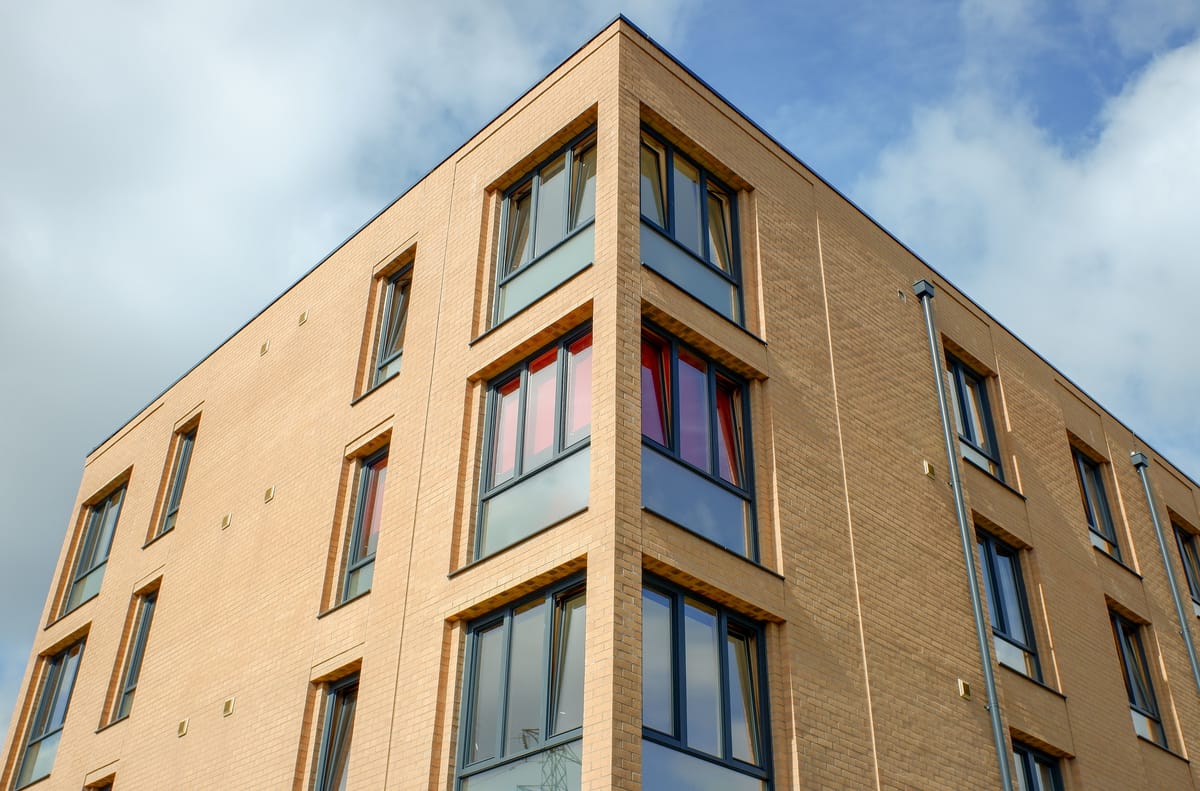
Medway is preparing to borrow nearly £46m to buy 569 homes from an unnamed social housing provider, in a deal that would significantly expand the council’s stock while leaving key details out of public view for now. We also look at the £22m rebuild of Gun Wharf and what it suggests about Medway’s ambitions ahead of local government reorganisation, and at two major Hoo housing schemes that have already been appealed to the Planning Inspectorate because councillors were too slow in making a decision...
Medway eyes £46m housing buy from mystery provider
Medway Council is preparing to borrow nearly £46m to buy 569 homes from an unnamed social housing provider, in what would be one of the largest single additions to its housing stock in years. The deal, due before Cabinet next week and then full council because of the scale of the borrowing, also includes a wider package of non-residential and ancillary assets, taking the total portfolio to 791.
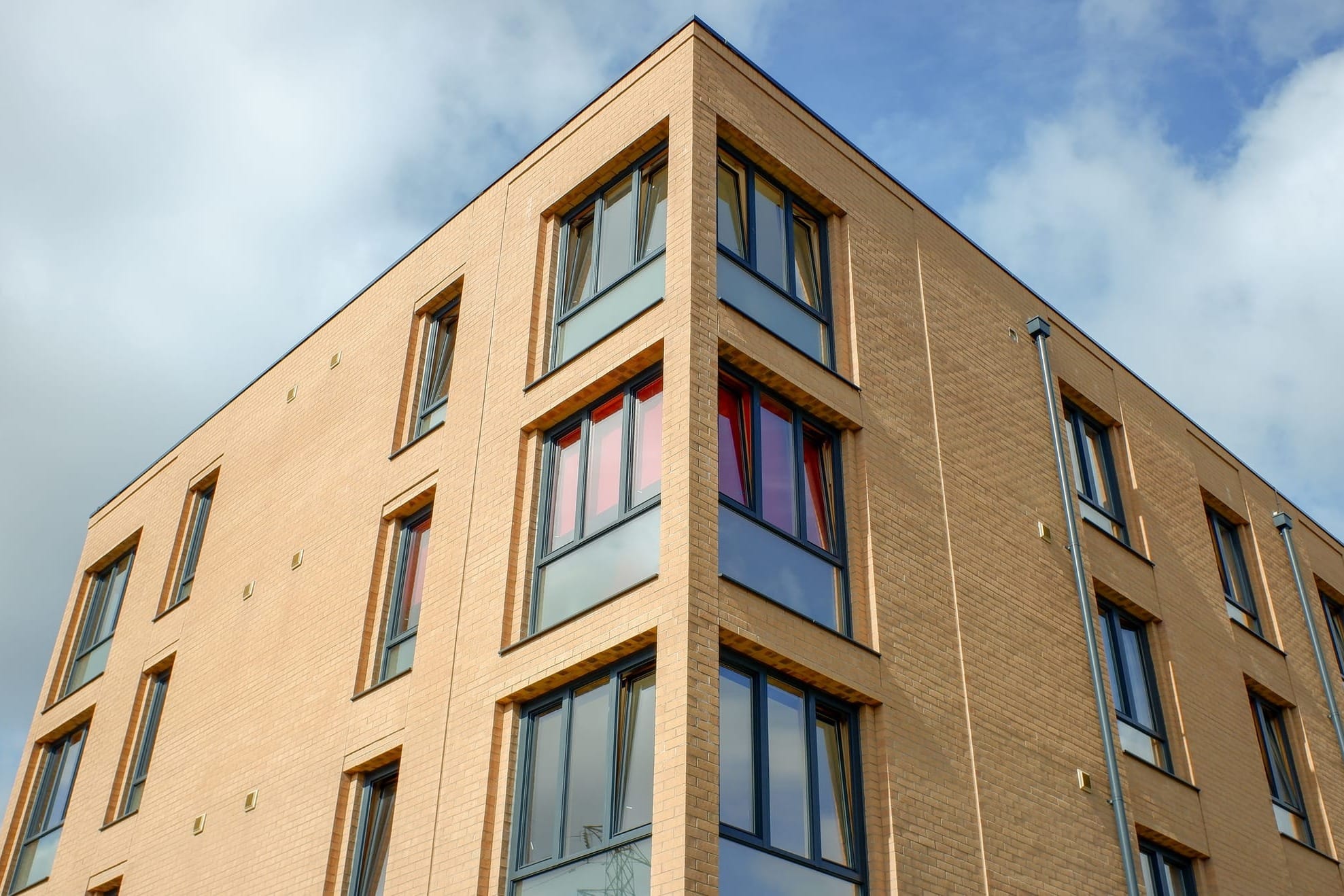
For Medway, the appeal is obvious. The council says the acquisition would bring hundreds of social and affordable homes under its control in one go, rather than relying on slower, more expensive routes such as new-build or buying properties individually on the market. Savills has been asked to assess the impact on the Housing Revenue Account business plan, and the report going to councillors says the purchase is financially viable and would strengthen the HRA over the long term.
That is the official case. The harder question is how much of it can be tested in public at this stage.
The provider is not named anywhere in the report. Medway says only that it was approached by an agent acting on behalf of a registered provider looking to dispose of stock as part of a wider asset rationalisation strategy. The council signed a non-disclosure agreement, initially passed because the timetable was too tight, then resumed discussions in January. Local Authority has approached the provider it believes to be involved for comment.
There is also no public breakdown showing exactly what sort of homes Medway would be taking on. The report refers to general needs, affordable rent, sheltered housing, shared ownership, and leasehold sheltered units, and also includes leaseholders, commercial units, garages, freeholds with services, and playground or games areas as part of the overall package. However, no breakdown of the quantities of each property type is available.
That matters less because of the headline number than because it goes to the nature of the job Medway would actually be buying. This is not just a bundle of straightforward council tenancies. Shared ownership brings staircasing, resales and lease administration. Leasehold interests bring service charges, consultations and disputes. Commercial units and garages are a different management task again. Some ancillary plots may also carry future development potential.
The report acknowledges as much in its own way. It says extra resources will be needed to manage and maintain the enlarged portfolio. It says existing contractors and service providers may have to cope with around 20% more work. It lists risks related to borrowing rates, stock condition costs, and the possibility that rent and service charge data may not match what has been supplied so far.
The council is not asking members to approve a finished transaction at this stage. It is asking them to approve the direction of travel on the basis that due diligence will fill in the harder parts later.
That due diligence is doing a lot of work here. It is meant to test value for money, stock condition, arrears and income, service charges, regulatory issues, and bad debt provisions before anything is completed. The report itself notes that condition costs could prove higher than expected, and that its business case is based on assumptions that still need to be validated.
None of this necessarily makes the acquisition a bad idea. Medway is right that chances to add this many homes in one go do not come along often. The council currently has around 3,000 homes in its own stock, so bringing in another 569 would be a significant expansion. The report also notes that its acquisition programme has added 169 general homes since 2016, as well as 187 temporary and supported units. By comparison, this is a much bigger leap.
But it is also a more complicated one than the council’s summary presentation allows. Councillors are voting to support a large borrowing package before the public can see the full breakdown of what is being bought, the detailed financial modelling behind the claim of value for money, or the identity of the provider selling up.
The timetable adds another layer to all this. On paper, the deal could be completed within months rather than dragging on for years. That still leaves it brushing up against the wider local government reorganisation process, with councils already operating in the shadow of structural change. The report itself assumes an anticipated transaction by April 2027, which gives Medway time to get the deal done, but leaves little room for the leisurely pace that local government processes often prefer.
If Cabinet and then the full council sign it off, Medway will not just be buying homes. It will be taking on a large and mixed portfolio, a heavier management burden, and the task of proving that a deal sold as a rare opportunity really does stack up once due diligence is complete.
Medway rebuilds Gun Wharf with one eye on what comes next
Medway Council is about to spend more than £22m on Gun Wharf, which began as a building fix and has since developed into something more akin to a glow-up of its headquarters.
The sensible bit comes first. Gun Wharf has RAAC, the pesky concrete that closed several schools a few years back. It is Grade II-listed and needs work. As a result, staff have been pushed out to temporary workplaces, including MHS Homes' Broadside and Kingsley House, and the condition of the building has been a long-running internal complaint. Nobody is pretending this is a perfectly fine office.
Even so, Medway is not just fixing Gun Wharf.
Cabinet papers going to councillors next week recommend awarding Apex Contractors a nearly £15m contract for the refurbishment works, with the total Gun Wharf Improvement Programme budget put at £22.263m. The plan is for work to begin in May, with the first phase due to finish in December and the second by July next year.
A council spending serious money on its headquarters is one thing. A council spending serious money on its headquarters while local government reorganisation looms over the county is another.
If this were just about making a problem building safe and usable again, the story would be fairly dry. Costly, yes, contentious, almost certainly, but basically straightforward.
Instead, Medway appears to have looked at a building problem and decided it might as well also solve a political one at the same time.
The papers make clear that the project began with RAAC but has expanded well beyond basic remediation. The scope now includes a reconfigured reception, a refurbished self-service café, replacement toilet and welfare facilities, upgraded meeting rooms, wellbeing spaces, a more flexible office layout, major mechanical and electrical replacement, and new windows and doors throughout.
Some of that is plainly unavoidable. Some of it is what happens when you are already tearing a building apart and decide you may as well sort the rest while you are there. But some of it looks very much like Medway has spotted an opportunity to build itself the kind of civic base it wants for whatever comes next.
The council is not especially subtle about this.
The report says the refurbishment will create a flexible space that can be converted into a council chamber big enough to accommodate local government reorganisation, while also being used for hot-desking and team working when not in chamber mode.
So yes, this is a refurbishment, but it is also a pitch.
The details are where that really comes into focus. The new chamber is expected to have a capacity for 100 councillors (more than 40 more than Medway currently has), with room for the press and a public gallery. The hope is that next year’s budget meeting will be the first one held there. That is a council laying out the furniture for a future it would quite like to inhabit.
To be fair, Gun Wharf is not fine. The building does need to be brought up to scratch, and listed buildings do not come cheap. The papers also stress the less glamorous but entirely real parts of the project, such as safety, compliance, accessibility, replacing failing systems, and future-proofing the building, so the council is not just dealing with the immediate problem and leaving the next one to fester.
But there is still a fairly obvious gap between fixing a difficult building and quietly building a post local government reorganisation power base for yourself.
The awkward question is how much of the £22.3m sits in the first category, and how much sits in the second.
How much is essential remediation, compliance and replacement of knackered building systems? How much is chamber ambition, workplace rethink and broader civic makeover? This split hasn't been set out in a way that can be interrogated. And when you are spending this kind of money at this kind of moment, people are inevitably going to ask.
The timing is impossible to ignore. The original decision to tackle Gun Wharf predates the current LGR fight. But the politics around it have changed. Medway is now pressing ahead with a large, expensive project while the whole shape of local government in Kent remains unsettled. On one reading, that is practical long-term planning. On another, it is Medway getting in first, trying to make Gun Wharf look too useful, too central and too ready-made to ignore.
There is also enough in the paperwork to show this is not some neat, risk-free capital project drifting serenely toward completion.
The procurement has been classified as high risk. The council says it went out to tender before reaching a fully detailed design stage because waiting longer would have left an unworkable construction timetable. Fair enough. But the report also acknowledges the trade-off, with greater risk around price, timelines, outcomes and quality.
None of that means the scheme is doomed. It does mean this is a chunky, politically charged refurbishment with a lot more riding on it than whether the council gets nicer toilets and a shinier reception.
What Medway is really doing here is trying to answer two questions at once. How does it handle a headquarters with genuine building issues? And how does it make sure that, when north Kent’s map is eventually redrawn, people still look at Gun Wharf and see the obvious place to run things from?
Two Hoo housing schemes go over Medway’s head
By the time Medway’s Planning Committee gets to two major housing schemes on the edge of Hoo next week, the real argument will already be somewhere else.
Both applications have already been appealed to the Planning Inspectorate on the grounds of non-determination. Put simply, the developers got fed up waiting for Medway to make a decision and went over the council’s head.
So councillors will not really be deciding either scheme in the traditional sense. They will be setting out what Medway says it would have done if it had managed to determine them in time.
That decision? To approve one and refuse the other.
Taken together, the two outline applications would mean up to 690 homes on land to the northwest of Hoo St Werburgh. Gladman wants up to 240 homes off Ratcliffe Highway. Taylor Wimpey wants up to 450 homes on a larger site west of Hoo, along with commercial floorspace, a community building, open space and sports provision.
Both sit inside the same wider picture. Medway needs housing. The emerging Local Plan points towards major growth around Hoo. Both applications come with the standard rows over roads, schools, healthcare, wildlife, countryside and whether local infrastructure is once again expected to catch up later.
Despite this, officers have landed in different places.
The Gladman scheme is recommended for approval, but the Taylor Wimpey scheme is recommended for refusal.
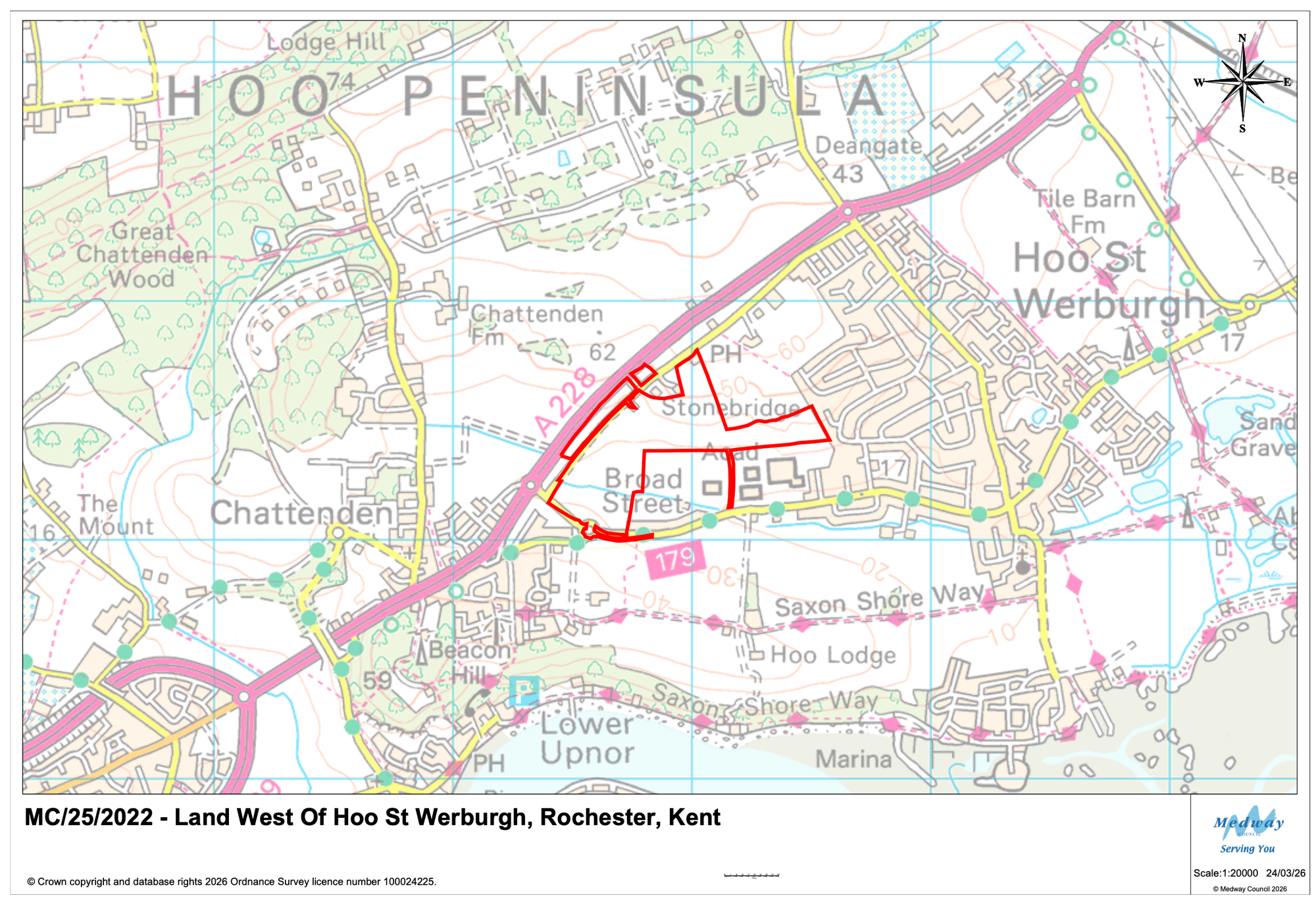
The split is less about whether this side of Hoo should be built on at all and more about where expansion tips into sprawl.
Officers say the Taylor Wimpey scheme would fail to provide a sufficient landscape buffer between Hoo and Chattenden and would lead to the two places blurring into one.
That argument is not new. A previous scheme on the same site was refused more than a decade ago and dismissed at appeal in 2016. A Medway Design Review Panel looking at the current application late last year also backed the principle of development, but said the plans were not acceptable, described the scheme as car-dominated, and was unconvinced by the supposed green gap between Hoo and Chattenden.
Yet the Gladman site next door is being waved through.
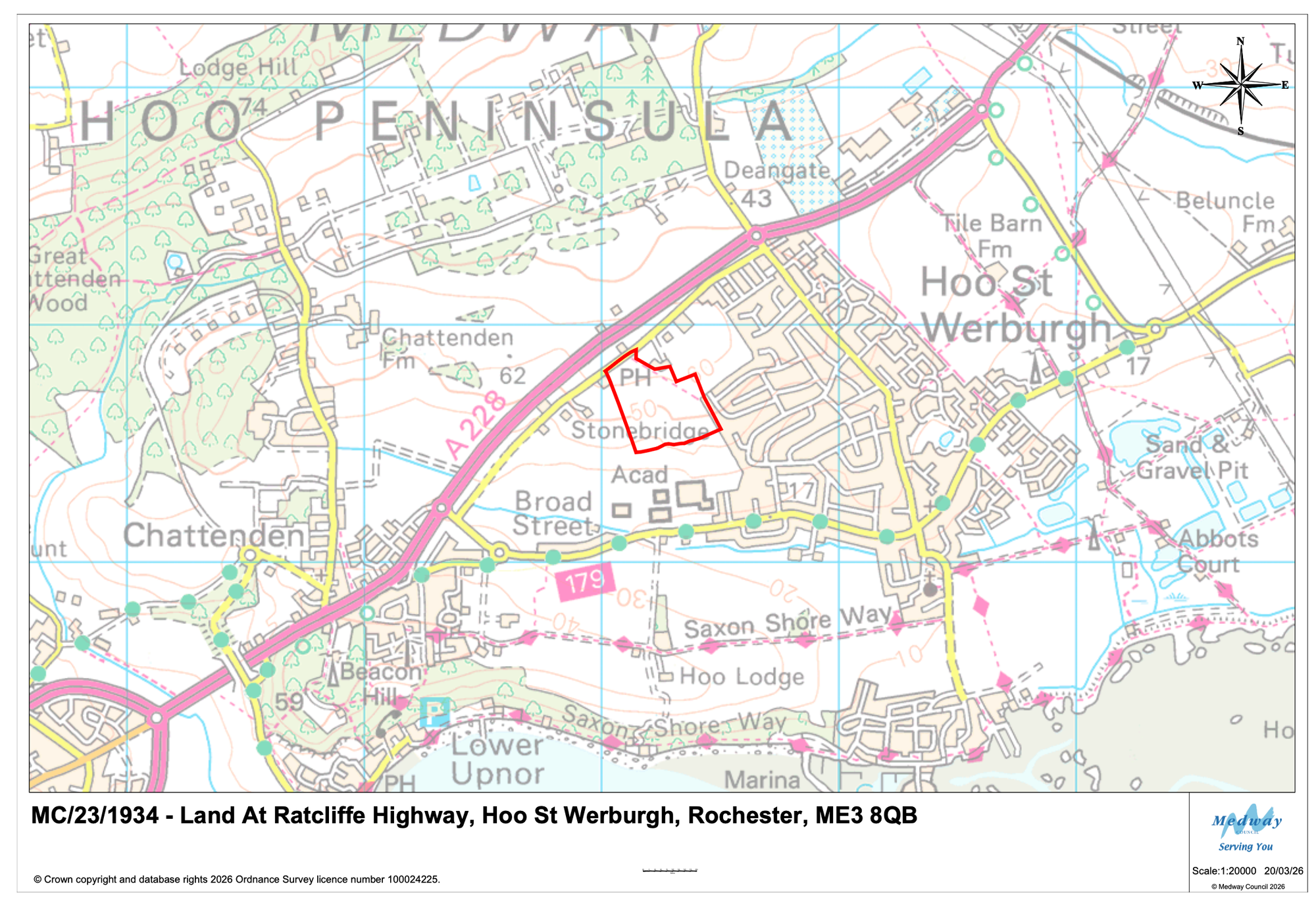
That does not make it uncontroversial. Objectors have raised the full set of usual Hoo expansion complaints, from traffic and school places to biodiversity and loss of agricultural land. Regardless, officers have concluded the 240-home scheme can be made acceptable when weighed against housing need and the site’s role in the emerging Local Plan.
There is an irony in all this, too. Even while Medway says the bigger Taylor Wimpey scheme should be refused, the Gladman application is clearly being treated as part of the same wider future growth area, with links planned between the two sites.
So Medway’s position is basically yes to major expansion here, but not so much that Hoo and Chattenden too obviously become one long smear of development.
Whether the Planning Inspectorate agrees is another matter.
Footnotes
Follow us on social media! We’re on Facebook, Instagram, and BlueSky, but not that other one.