“I had no idea that it had its heart ripped out”
What Steven asked Phil Gomm, former lecturer at Kent Institute of Art & Design
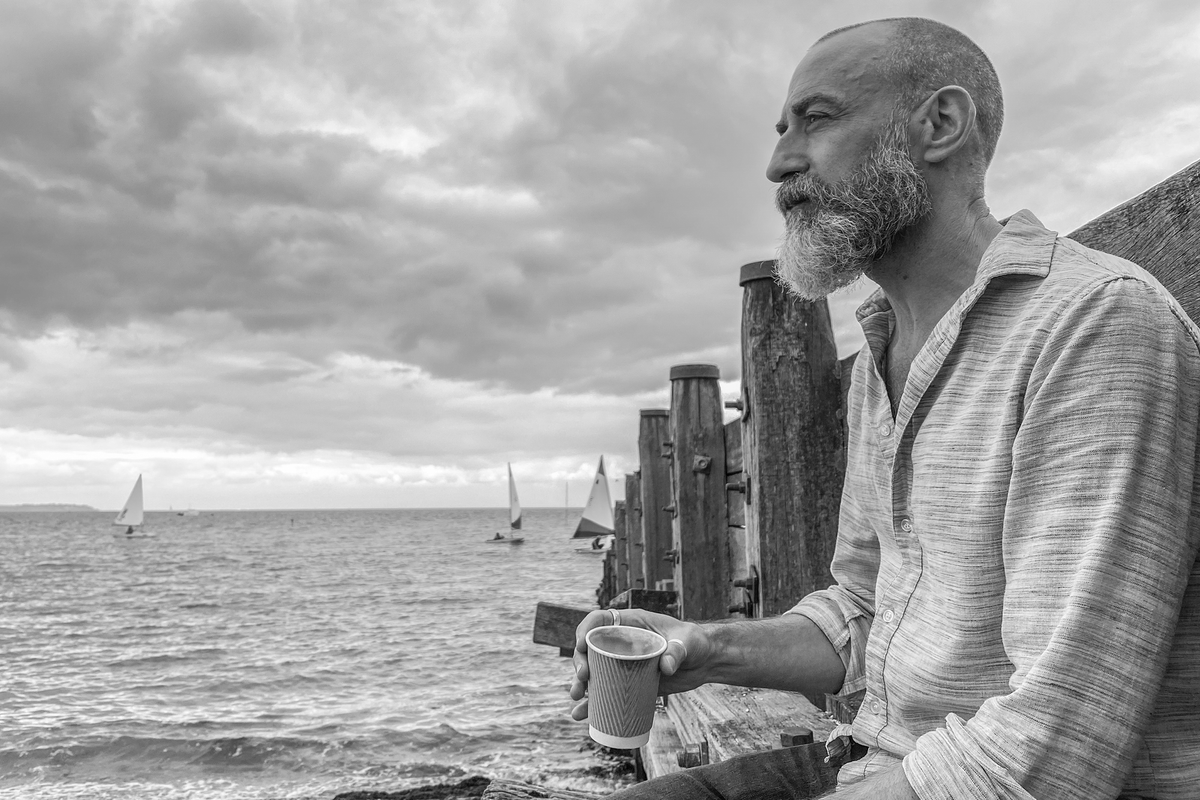
Phil Gomm designs and builds learning experiences and has launched Still in Motion, a project marking 25 years since photography students at the Kent Institute of Art and Design transformed an abandoned school into an exhibition space. Steven met him to discuss his journey from art student to lecturer, his creative project, Red's Kingdom, and his work as a model-maker in the age of AI.
Before we begin, Phil has something to say about his name...
I think Gomm is a stupid surname because you're supposed to have at least two syllables in a surname. Gomm just sounds like you've swallowed a fly. At school, I was a Gomo for years.
There is a Phil Gomm somewhere in Kent who is a former journalist for Meridian News. Then there's a Phil Gomm who is a Reform councillor, I think there's also a Phil Gomm who's got a travelling disco, and there's another guy who's a druid. I'm none of those people.
What is your official occupation?
My official occupation is Director of Learning Experiences at Ding.global. I run it with my business partner, Dr Tony Reeves. It is a creative agency that designs, builds and consults on learning experiences for other companies. We do a lot of work with tech companies and apprenticeships, but we also work with the Open College of the Arts.
We often design and build learning experiences in subjects that we ourselves don't know. We work with subject matter experts. Because both Tony and I come from a background in thinking about what learners need from an experience, that's the expertise we add to other people's expertise to build courses for them.
We started that company during lockdown. I had left UCA [University for the Creative Arts] at Rochester at that point and had done some consultancy for Amnesty International in terms of their communications. Tony and I figured we had this skill set, we could do this stuff for other people, and we set up a business. It was a bit squeaky bum for a while, what with covid, but we've been up and running for six years now.
How did you go from UCA to comms for Amnesty International?
The short version is that I was a course leader for an animation degree. I came from a 3D-making background. That was my big love. I thought I wanted to work in film and cinema, particularly in prop-making and world-building. As a kid, I loved monsters, worlds, environments, concepts, all of that stuff.
In my role as course leader, I was always thinking about how an audience could understand what's happening. The students would come in with big elaborate ideas, and my job was always to say, “How does the audience know how your character feels? How am I going to know how to feel when this or that happens?”
I was always interested in that relationship between information and why other people should give a shit about it. You might say that if you stripped out all of the animation stuff, I was always in the business of communication. How do you get people to worry, or care, or feel anything?
Amnesty had a big project where they were doing amazing work, and they needed to get it communicated to another group of people. I was involved in the work to take that story and sequence that story so other people cared about it. The people who needed to care about it were the donors. It was essentially, how can you get people to keep giving money? How can you get people to understand how their money's been spent?
Back in 2019, when I first went from my course leader job to the consultancy work, I felt like the biggest imposter in the world. But thinking about it now, it wasn't such a big leap after all.
I had a fully positive experience of failing something
What brought you to the Medway Towns?
I studied at Kent Institute of Art and Design [KIAD]. I'm one of those classic people who didn't have a big plan. I went in '94. I graduated when Labour got in. I grew up in Buckinghamshire, and not the posh bit, I must say. I did my foundation course at Amersham and Wycombe College, where I went big into puppets, monsters, and creatures.
Kent Institute of Art and Design was one of the few places that had a degree in model-making. Model-making is just a description of building things in 3D, often for a commercial context. Model-making for advertising, model-making for architecture. In other words, you were building something for a commercial space.
Medway was the only place that had a degree course in what I wanted to do. My student house was in Chatham, up by Luton Arches. I knew nothing about Medway, knew nothing about its colourful reputation. I didn't even know that economically it was, at that point, one of the most depressed areas in the south east because of what happened to the dockyard. I had no idea that it had its heart ripped out. I just thought, 'I want to do this course.'
After my second year, I didn't go home. I worked in some of the pubs in Rochester. I did the summer there and really got to know Rochester. I wouldn't have predicted it for myself, and it wasn't a plan. I began to understand, from a postcode and class point of view, what made it feel different but also familiar to me.
I failed my 12-plus. I went to a comprehensive in Bucks and met some amazing teachers who didn't make me feel like I'd failed anything because I wasn't at grammar school. I had a fully positive experience of failing something, and I came to understand why education really matters and that there are certain postcodes where it matters more.
You're about to launch a project commemorating something from your KIAD days. How did students end up taking over a derelict school in Hackney?
We have to go way back, way before I was a course leader on the animation course, the film course.
After my degree, I did my master's at KIAD. I made a film as part of that. I had to use the one computer. There was one computer in the entire institution, this is how long ago it was, that had video editing software on it. It was up on the top floor in the photography department.
I sweet-talked my way into the room and ended up being quite good at video editing, so I got to know the photography staff a bit. I also built an installation, which meant I had to go into a big photography studio and install this exhibition.
I think that Kevin Liggett, who was then the course leader of the photography department, thought, 'Who is this guy? He can film edit, and he's also up a stepladder.'
He noticed me, and somehow I ended up being invited to teach his students video editing. I was only a year or so older than his students. Through that creative working relationship with Kevin and the photography department, I ended up walking right into the core of that department and met some amazing people.
To answer your question, there was a project where the third-year photography students took on this derelict school in Hackney Downs, which by that point had been shut for five years and abandoned.
The idea was that they would transform that school, and this graduating cohort would populate the classrooms, corridors, atriums and outside spaces with work. In order to do that, there was this huge effort to make over the school.
Because I was teaching film and film editing at the time, I was the man with the film camera. I can't remember if it was an official decision, but a decision was taken that, because we were doing this interesting thing, we should record everything, or as much as possible.
It took about 100 days to transform the school. I certainly wasn't there every day, but I always made sure the camera was. Sometimes I was filming, and sometimes I was inheriting footage, so the opportunity came to make this big set of films chronicling the transformation.
I should say that all of this was 25 years ago, before smartphones, way before any of those things. It was all very analogue.
Sadly, we think that all the original video files and digital copies are lost. Kevin had a VHS copy, from which he then did a 4K transfer. This kicked off a conversation late last year. Because it was a bit glitchy, Kevin said, “Is there anything you can do?”
I took that archive copy, and the question arose, now we had this archive copy, where were we going to put it? Maybe we should share this story of transformation, because it was an impressive project, a tribe of plucky art students going to an abandoned school and doing an amazing thing.
That exhibition was on 8 May 2001, and we knew that this year would be the 25th anniversary. We decided that we would build a website and an archive site and make it go live on 8 May 2026.
Everyone knew about KIAD in Rochester. It was this important educational space for creatives. It was important to the town, important nationally.
25 years on from that, KIAD itself is gone. It's shuttered. I think it's being turned into flats, so it felt like there was a story there, and the story told itself, because all you had to do was look at that 25-year timeline.
It starts off with Cool Britannia, where culture and art, designers and filmmakers, no longer needed to be apologised for. They were important. Then you arrive at a point where suddenly you've got the 'Mickey Mouse degree' thing, then you've got the art college shuttered.
It felt like there was a story there that was poignant, political, and interesting.
The archive tells a number of stories, and some are about how much things have changed and how the narrative around art and design has changed.
Where will people be able to see this?
It's a website, stillinmotion.co.uk. In Motion was the original name of the exhibition, the idea being that everything was in motion. The school was in motion, the graduates were in motion.
These ideas were still in motion, although 25 years on, there was so much change. One of the things that became clear to me, because I still work in education and think about learners and what makes for a great learning experience, is that when I look at what happened in that project, I think there should be more of it, not less, because it was such a rich, amazing experience for everyone involved.
We called it Still in Motion. It wasn't a sad story. This is ongoing. We know that there isn't an art school in Rochester, but I know that there are other providers, and I know that it's over, but artists will be artists, and one of this country's greatest exports is our creativity.
Even though there is some disappointment around the positioning of the arts in the UK, its influence and power can't be underestimated.
I left because I felt that the institution was losing confidence and losing its way
Were you still involved with UCA when the decision came to close the Rochester site?
I left in July 2019. At that point, there was a big restructure. To be honest with you, I'd lived through many restructures, but the decision to close was not public at that point.
Part of me wishes I'd been there when the doors closed for the last time, because I have such a long association with the place.
I left for my own reasons. I left because I felt that the institution was losing confidence and losing its way. I left on principle, really.
I was always sad to see that we weren't telling the story of UCA Rochester. We stopped telling the story locally, and we stopped telling regional stories about art colleges.
The storytelling around that location, and around that building, and around the area, was ill-served by the direction that it went. It was impossible to make the case for that provenance. It was hard to make the case.
And yet you felt it if you were there. It was poignant to see it go.