“We are breaking down barriers that keep people socially isolated”
What Steven asked Nic Lamont, in the first of a two-part interview about Medway Playlab CIC

Medway Playlab CIC is focused on providing improv and performing arts opportunities for adults in Medway. Steven met with its co-directors, Nic Lamont and Kate Mechedou, at Store 104, where they host many of their events. In this first part, we speak about their new project about Leonards Department Store, how they came to form Medway Playlab, and then focus on what brought Nic to Medway and how she came to have a crucial supporting role in a Netflix production...

What is your official occupation?
Nic: My official occupation is an actor and theatre maker.
Do you have any additional roles, paid or unpaid?
Nic: I feel like lots! I work on and off for Funny Women CIC, which does a lot of work down here as well. I am the producer for Medway for their Glitter Project, which I did a lot of work with last year and hopefully will be doing a lot of work with again this year.
I'm an actor where I have an agent, and I'm going up for castings all the time, and I'm doing screen work. I tend to work a lot on other friends’ projects as well.
I work as a co-director of Medway Playlab, where I am a workshop facilitator, an events producer, a social media manager and a writer.
What is Medway Playlab?
Nic: Medway Playlab is a community interest company that mainly presents performing arts opportunities for the people of the Medway Towns. That includes different workshops and theatrical events as well.
Kate: The social conscience of the organisation is that we are breaking down barriers that keep people socially isolated, we're giving opportunities to get out of the house, and this is for adults as well. A lot of people focus predominantly on children. Having said that, we do do stuff for families as well, but the majority of the stuff we do is for grown-ups to kick back and have a good time and get to know other people.
How did you come to be working together?
Nic: We actually met at a Funny Women event that was here, I believe. Upstairs, Was it here? [Store 104]
Kate: I think it was, yes.
Nic: Quite a few years ago now. We seemed to have a lot in common and be two theatre professionals living here in Medway, and we also had a lot of interests about improv, and I think we first got talking about improv. I think it was after lockdown that we started thinking seriously about starting a company.
Kate: The improv connection was we realised we were coming at it from two different angles. Nic's background has been in comedy and improv for comedy entertainment purposes, Whose Line is it Anyway, Edinburgh Fringe-y, Showstoppers-y thing. Mine has been through the Historic Royal Palaces. If you've ever seen Henry VIII at Hampton Court Palace or been to Tower of London, chances are, over the last 20 odd years, before lockdown, I've had something to do with it. I decided to work locally from 2018. I went away from that world, but I still completely understand that world and I've led lots of trainings in it. It is a very unique skill set when you don't have a proscenium arch, and you don't have the curtains, and you don't have the audience there. You're here, and you're creating what your performance space is. Those two things gave us a lot to talk about, and I wish I was funnier.
Nic: You're very funny.
Kate: I'm funny in moments.
Was there a particular moment? Who approached who about setting up Playlab?
Nic: That's a really good question.
Kate: I can't remember who mentioned it first, but I suspect it was me that made it happen, like Romeo and Juliet when Romeo says, 'I love you girl,' and she says, 'Well, marry me then.' It was kind of probably a bit like that.
Nic: I think I said, “We should definitely have improv workshops down here.” And you said, “Do you know what? We should make this a company, because we've noticed that there isn't a lot of that around here…”
Kate: For grown-ups, fun for grown-ups, that isn't of a dodgy sort.
What is Project Leonards?
Nic: Project Leonards is a national heritage funded project that we started last year. It looks into the history of this building. We've got many connections to it. I have a quite big one in that Paddy, my husband, is the owner of this space. This is also where we run all of our workshops and it's been our hub for PlayLab ever since we started. What we do in this project is we research the history of Leonards department store. This shop [Store 104] itself was actually the first ever building that was part of that huge set of buildings that made up the department store. We research the history of this place, we collect artefacts, we collect people's personal memories of this shop that was a huge part of Rochester High Street. We take all of that information, and what we're going to do is create a site-specific performance, which will be taking place in April. We've got some other products of this project. We have a website we are building where we can collate everything, and we're also going to have an exhibition at the Medway Archives as well.
Kate: Specifically, we're thinking about the Easter weekend for the performance. Across the Easter weekend, specific dates to be confirmed.
The High Street is changing radically all the time
Why is it important to remember Leonards?
Kate: The Heritage Lottery Fund, who are funding this project, are concerned with all aspects of heritage, and what is heritage? It's disappearing in front of our eyes all the time. The High Street is changing radically all the time. Many shops are going under, pubs are disappearing. This shop is still thriving thanks to Paddy and the good work he's done with changing the way that the configuration is and expanding the cafe and the products that he's having. It's a unique, independent shop. The idea that it happens to be in this building that has been a shop for a long time, I think is worth preserving. We know that people do have memories of coming here over many years to buy things. Maybe not when it was the cafe or the book shop and gift shop as it is now. Maybe when it was Leonards department store. Once you start thinking about what these buildings actually were used for over time, Leonards stretched right the way down to the Eagle Tavern. All the buildings between here and there, some of which are no longer there, were all part of Leonards department store and some you could go from one to the other. I just think that's fascinating. In the research we've been doing and speaking to the people who have memories, that's been the delight in their eyes when they remember. When you look at the building itself, it's got a beautiful staircase that's been there for some time. It's got some of the original cabinets. I think they call it in philosophy terms, 'the dawning of a new aspect.' When you look at something that you've seen a lot, but you suddenly are looking at it in different eyes, and that's what heritage is doing and that's what we're doing with this building.
We had both thought independently, this is a beautiful building, we're really fascinated by it, but we don't really know a lot about it, and we love performing in it as well. We discovered that the upstairs room in this building in 1889, very early on in its life span, was where the family lived. They used to call the staff, because they had more than just themselves, up every morning for breakfast, and they'd sit around a big table in that room upstairs and eat breakfast. Mr Charles Leonard Senior presiding over it all, and then they start the day after they've had breakfast with a staff meeting at the top. The idea of the way that these spaces were used is something we mustn't lose and forget.
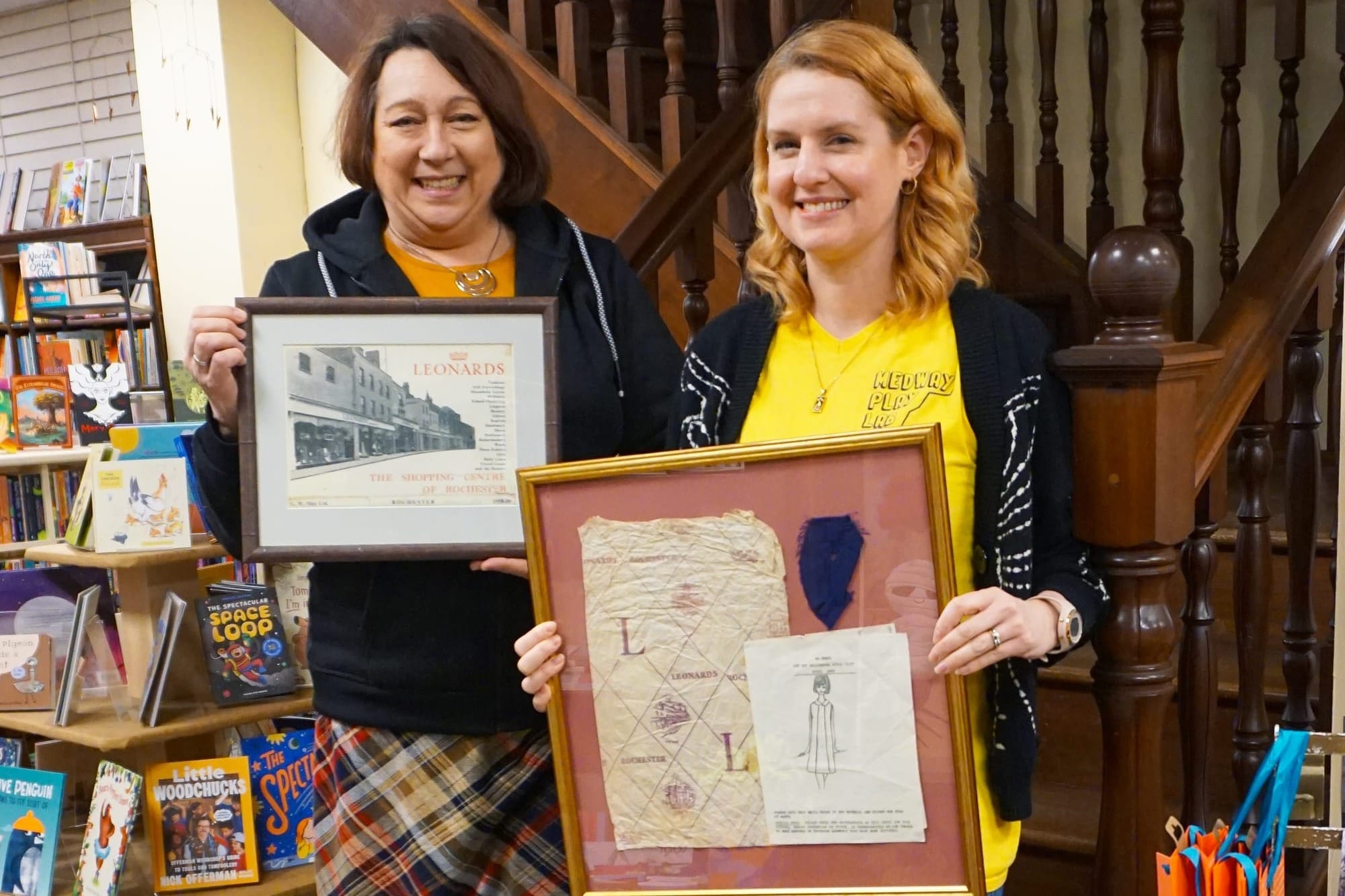
Unusually for an interview, you have brought props.
Nic: We have an original paper bag from Leonards. As Kate said, this building was bought by the original Mr Leonard in the 1880s, then become a department store right up until the late 60s. Somebody has included the dress pattern and some fabric that they bought in 1965. We also have a lovely picture of Leonards. You can see how huge it was on the high street, and then it had all of these different departments.
And The Buttery?
Nic: The Buttery was the name of the restaurant that was here.
Kate: It had a drinks license at one point.
Nic: We went to the Medway Archives and had an amazing day there, and also some ladies who had come to our Leonards tea parties to give us her memories of Leonards, also accompanied us to the Medway Archives, which was lovely.
Kate: We've now got a little team that's working on research, and we may well use them in other projects as well.
Nic: We found so many wonderful things. We found photo albums, found flyers from the fashion shows that they had here, we found adverts, we found the menus from the restaurant, we've got a rich source material for the performance we're going to represent what Leonards was.
Kate: Certainly through the 40s, 50s and 60s.
Nic: This prop here [an old-style dial telephone] is our Record Your Memories Here phone.
Kate: Credit for which must go to Oral History Medway because they also use this. We can charge it up, plug it in, and people pick it up, and it says, 'Hello, do you have any memories about...' probably in my voice, and then people can record their memories.
Nic: We've been holding tea parties here, where we put out a lot of the artefacts we've found people can come and literally give us their memories. Even last time we had a lot of people come specifically for that, but there was also a lady passing who said, oh, I remember, which is a lovely thing. Obviously these are people that are a little bit older that have these memories, or they might remember when they were little, walking past the window and what they saw there, or a lady was saying she had a very affluent aunt who always shopped at Leonards.
Kate: It definitely had snob value, it's worth saying.
Why did Leonards end?
Kate: That is a mystery inside an enigma wrapped up with a bow. The papers in the archives are mostly those of John Leonard, who was the last member of the Leonard family to run and manage the store. It happened very quickly. In the late 1950s, certainly from the coronation period onwards, it was thriving. Was it the modern liberation of the 1960s when society changed completely? Because it seemed to almost be overnight. There may well be members of the Leonards family reading, because he only moved to Tenterden, to run Mr Leonard's Linens as an offshoot once he'd given up the shop. There was a moment of bad management. He effectively passed it over to a gentleman that I believe we would commonly refer to today as a con man. He definitely had a background in retail. He took over the shop management, while Mr Leonard went into the background.
Why did he choose to disappear? I don't know. Admittedly, the business was changing. This bloke took it over, he sold it, he sold other parts of it, because it was not just this building, it was all these buildings and made a complete pig's ear of it. And within a very short time, it had to be sold again to Chiesmans. If you've been to Lewisham, they've got a department store there. They took it over, they ran it until 1979. They were old-fashioned by then.
Nic: What we're doing now in improv workshops, is we're taking stories we've picked up from our research with Leonards and using that as stimulus for scenes that they might create or play games in different areas or maybe playing exercises that are shopkeeper and customer based but maybe that's taking place in the 1900s, so that we can start creating little scenes for the performance in April. We are going to be using our community performers as well.
All of a sudden, I was going for a costume fitting at Pinewood Studios.
Nic, how did you come to have a pivotal role in The Thursday Murder Club?