Stories of the Cannon
A Victorian dockyard death, a prison execution bell, a pub landlord’s 'man-fish,' and the changing face of our pub landscape
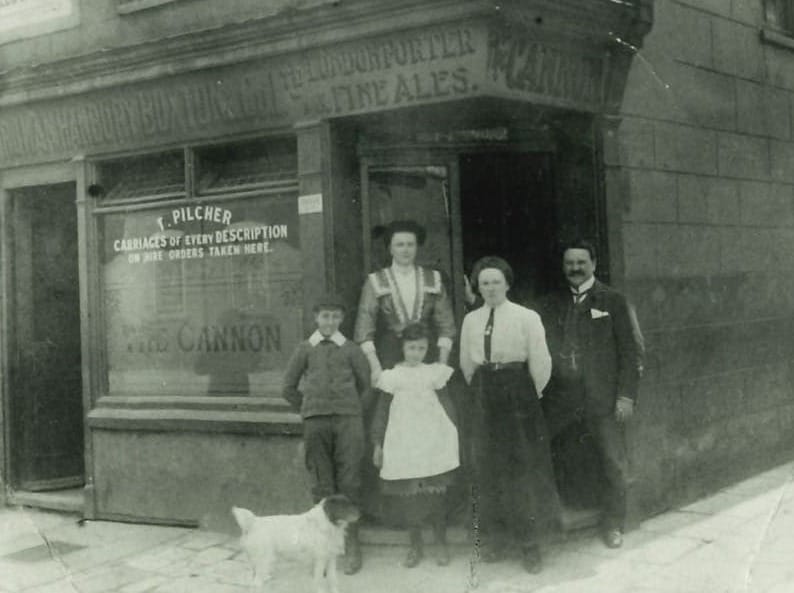
Chris de Coulon Berthoud has written before about the slow disappearance of pubs in the Medway Towns. Not all of them are gone yet, but even the ones still standing carry the marks of what they’ve been used for. Today he turns to The Cannon in Brompton, and a run of stories that chart a place shifting from dockyard and military local to community institution to something stranger, funnier and occasionally darker than nostalgia tends to allow...
The Cannon was established sometime in the mid 19th century, close to the Volunteer Artillery Drill Hall in Garden Street, from where the pub’s name came. The Artillery unit originated in Rochester as the City of Rochester Rifle Volunteers, and in 1860, their name changed to the 12th Kent Artillery Volunteers. They were stationed at Old Brompton, where the drill hall was built to house them. The corps later became part of the 1st Kent Artillery Volunteers, remaining so until the creation of the Territorial Force in 1908. In a further reorganisation, they became No. 1 Company, Kent Royal Garrison Artillery, which then returned to Rochester at Fort Clarence.
Like many pubs in the area, The Cannon served a mixture of local dockyard workers and servicemen, and like most pubs, it was both the place of companionship and recreation after a hard day’s work, as well as a place of drunkenness, and occasionally worse.
On Saturday evening of the 23 April 1859, a group of Dockyard workers were drinking at the Cannon, then one of the busiest pubs serving Chatham Dockyard labourers. Among them were John Robinson and William Moore Bensley, both employed as shipwrights. Contemporary reports say they had been drinking throughout the afternoon and evening, and everyone was 'very drunk.'
An orderly from the Medical Staff Corps who was drinking with them challenged Robinson to a bare-knuckle prize fight for a stake of five shillings a side. The money was given to Bensley to hold, and the men left the pub and set off for the nearby Chatham Lines, where bare-knuckle fighting in the defensive trenches that were dug there was a well-known, if illegal, practice. After several rounds of fisticuffs, Robinson was beaten, and the winnings were handed to the soldier.
Drunk and angry, Robinson then challenged Bensley to a fight. Witnesses later described Bensley as 'behaving like a madman,' and during the first round, the two men drunkenly grappled with each other and fell heavily to the ground, with Robinson underneath. As they fell, Bensley’s forehead hit the raised ground with considerable force. His head was seen to 'sink immediately,' and after three groans, he died in the arms of a bystander without speaking.