"It's really important for people to see that we're just the same as everybody else"
What Steven asked Dalia Halpern-Matthews, Chair of Trustees at Chatham Memorial Synagogue.
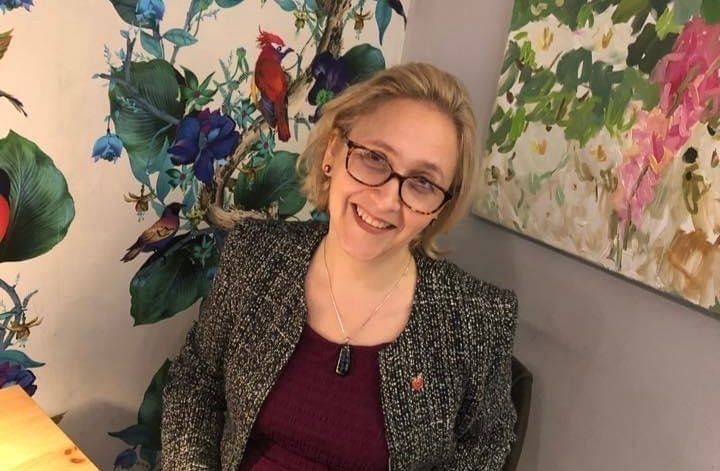
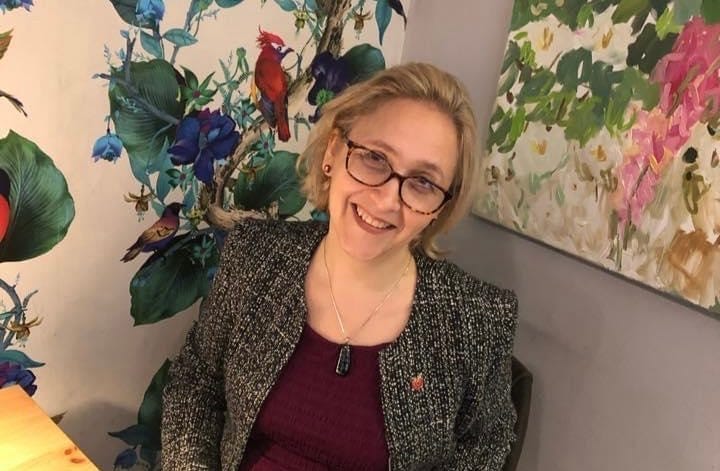
Dr Dalia Halpern-Matthews is the former Chief Executive of the Halpern Trust, where she helped to set up Nucleus Arts. Steven met her at the Chatham Memorial Synagogue, where she is the Chair of Trustees. They discussed her family’s long involvement with the synagogue, the vandalism that has plagued it, Israel, and lots more. During the interview, Steven learnt something about himself and left the Synagogue a changed man…
What is your involvement with the synagogue?
I am currently the Chair of Trustees here at the synagogue, but my family has been here and heavily involved since the 1890s. Starting with my great-grandfather Solomon, and then my grandparents, Alec and Dora Halpern, and then my parents Hilary and Mari Halpern. With my son, that's five generations of Halperns.
What is it that makes Chatham Memorial Synagogue unique?
It is completely unique in many ways, actually. There's the obvious one: We have a cemetery, and it is the only synagogue in the country that has a burial ground attached to it because Jews don't put their burial grounds next to the synagogue because the priests are not supposed to go into a cemetery in case there are any bad spirits that would taint them. For that reason, they don't put them together. In fact, the burial ground is older than the synagogue itself, which is how this has happened here. Jews were banned from England for hundreds of years, and then we were allowed back, and people started to come with the docks and the military, and there wasn't a burial ground, and there wasn't a synagogue. I think the Jews were leased an area of land from the hospital, where they started to bury their dead. At a similar time, they rented two of the tenement houses that were more or less in the same plot, but not next to each other. One of the tenement houses they used for the rabbi's house and the other as the synagogue. Then after a few years, the tenement houses were dismantled, and the first synagogue went up on a similar site, and they carried on burying. This building was completed in 1869. They moved it further forward on the site, and then the graveyard grew. Although, in fact, there's no such thing as a Jewish cemetery, only a Jewish grave. Anywhere a Jewish person is buried is a Jewish grave.
Is the graveyard full?
Yeah, it's been full for years. The last burial was in the 80s, but the new cemetery off Chatham Maidstone Road, Palmerston Road, has been used. Certainly, my grandparents were buried there, and grandpa died in ‘75. But it's also unique because we are one of only three surviving synagogues that were designed by Hyman Henry Collins, who is considered to have designed the most beautiful synagogues in the country. It also had a mikvah when it was built. A mikvah is a ritual bath. It's something that's really important for a community, but for a tiny provincial community like Medway to have a mikvah is incredibly unusual. It hasn't been there in my lifetime. I don't know why or what happened to make it removed. The nearest mikveh now is up in Bushey. A Jewish person, when they die, for example, needs to be cleaned in a mikveh. That's quite significant. The synagogue is a grade two star, the cemetery is a separate scheduled park and garden, and the Magnus Memorial has its own grade two listing. We're triple-listed.
What is the Magnus Memorial?
The reason why it's Chatham Memorial Synagogue is because it was built in memory of Captain Lazarus Magnus, who died in his 30s of an accidental overdose of laudanum following a toothache. He was quite notable. He was a friend of Brunel. He was a mayor, I mean just lots of different things. His father, Simon Magnus, was distraught. He built this in memory. The big memorial is for Lazarus. It's been quite badly defaced. We've had a lot of vandalism in the cemetery, unfortunately, over the years.
Is vandalism something that still goes on today?
The cemetery has been. It's been much better since we’ve had the new CCTV, which is much better than the old one. But we have still had issues. Just last month, someone threw pigs trotters onto the synagogue grounds. It's not like things don't happen.
Someone a few months ago, I'm assuming that it was something to do with drugs, but I don't know. CCTV picked up these people climbing over a wall at the front. They actually managed to knock over the front wall. That, luckily, was covered by the insurance. It has all been done. We're just fundraising at the moment to do some extra security works that will stop people from being able to get in.
How did you come to be Chair of Trustees? Was it the family connection and you had no choice?
Oh no, it was very much a choice. I've been running companies and charities for more than 20 years. It's a world I live in. In fact, I think my father was still alive actually when I first became a trustee. He was the previous chair, I have to admit. It hasn't always been a Halpern.
There wasn't a chair to start with. There was an interim chair. But the thing is that because I knew how to run a charity, because of the work I was doing day in, day out, the comments that I would make and suggestions, I was fairly soon essentially running things. All the other trustees said, ‘You're doing the job. You might as well be the chair.’
I took over, and every year, I say, ‘I don't have to remain chair, I'm happy to step back.’ So far, they refused to let me do so. It's not a good idea in many circumstances for someone to be the same chair for a long time. I'm very conscious of that. On the other hand, integrity is an exceptionally high part of my moral code, and I will only ever do things the right way. When someone else becomes a trustee who would be appropriate and fine to take over as chair, that's absolutely fine. Until then, for the moment, I will carry on.
Can members of the public come and visit the synagogue?
We're always happy to have visitors. We do, for security reasons, like it to be pre-arranged. We prefer people not just to turn up when we're having a service. We have unfortunately had issues, which is why we feel we need to do that. We have to even have a security guard when we're having services, which is a really sad state of affairs. But we do things like Heritage Open Days. We do that every year, and we often do other things, for example, the Closer Than You Think event here alongside the LGBT community. Queer Culture Counts at The Ship, which was an amazing event, Holocaust Memorial Day meets LGBT History Month and remembering the men who wore the pink triangle. We had an exhibition, and did a lovely event in the main synagogue, music and talks, and it went down really well. There were far more people here that were not Jewish than were Jewish. We're a part of the Holocaust Memorial Day events, which are held normally on the 27th of January every year or sometimes the day after it. The Medway Peace Walk, we’re part of that every year. This year, they'll be coming in briefly for a service for peace as part of the walk. We're very open. For us, it's really important for people to see that we're just the same as everybody else.
Before the interview started, I mentioned my mother and how, when I said I was coming here, she mentioned, for the first time in 45 years, that my grandmother was Jewish. You said that if that was her mother, that would make me Jewish. How does that work?
Judaism always comes down the maternal line and has done since time immemorial. It doesn't matter if it was your maternal great-great-grandmother and no one has practised since. If it's followed through the maternal line, then that person would be Jewish still.
(I message my mother to confirm which Grandmother.)
You've probably heard of the 12 tribes of Israel, and most people don't know which tribe they come under. But the Levites and the Coens, who are the sort of priestly and the most holy tribes, they do still come down, but that comes down under the father's line. That's the paternal line. Because the father wasn't Jewish somewhere along the lines, you’ve lost the Levites or the Coens, so there are various things that only Levites or Coens can do in the synagogue, including not going into the cemetery.
(My mother messages back that it was her mother.)
Then you are Jewish.
Because my mother doesn’t have any daughters, that means that line ends with her?
Yes.
Fascinating. I’m a changed man.
Where were you born?
I was born at All Saints Hospital in Chatham. I grew up in Rochester. My parents lived in the same house from 1962 until they passed away.
What jobs did your parents do growing up?
My father was an international architect and town planner. Which was something he practised for 50-odd years. He worked literally all over the world. He built trade centres and all sorts of really big stuff. He was a fascinating man, very charismatic, not someone you forgot easily. Mum was a dental surgeon in an era when women did not go to a university. She graduated in 1954, the only woman at the university, and she initially started her own dental practice, but fairly soon afterwards, she went to work for the NHS, and she worked for the NHS from about 1957 until in about her 70s when she retired.
Did you enjoy school?
Mostly, yeah. I went to St Matthews, which has long since closed in Borstal as a primary school. Then I went to Borstal Manor for two years. I didn't realise at the time that I'd read all the books in the school by the time I was halfway through the second year at juniors or that I had done all of the maths work that they had for the next two years. I was vaguely aware of the fact that I wasn't doing necessarily the same as everybody else. Apparently, the headmaster called my parents or my mother in and told them to take me to a better school. I spent two years at St Andrew’s, did my 11 plus, and my parents wanted me to go to Cobham Hall, which is where my sister went, and my brothers all went to King’s. I was the rebel. I didn't want to go there. I passed the exams, and I said I really don't want to go there, so they said, ‘Fine, well, if you pass your 11 plus, you can go to a grammar school,’ and I had my heart set on Chatham Grammar which is where I went to.
Where did you go to university?
I didn't. I had my places all set. In those days, no one did deferred entry. I applied, I got my places offered. I did pretty badly, I will say, in my A-levels, but I still had unconditional offers. I didn't have to go until the following year, and I started working, and then I set up my first business, which was a catering company. I didn't really want to go and do quantity surveying. I did a diploma at Leith School of Food and Wine, and I ran my catering company for a while. Then all the laws were changing, and I was going to have to completely change loads of my equipment, and my van wasn't any good and all these different things. I went to work at Selfridges for a while in the food hall, and then I moved to Safeways, where I did their management training program, which is equivalent to a foundation degree in business. I'd been there a while. I was just waiting for my final posting, and unfortunately, I got ME. I was unwell for four years. I was in a wheelchair. During that time, I did start a law degree, but I didn't complete it because my brain was just not functioning when I had ME. Then I got better and ended up running the family property company and then setting up Nucleus Arts and all that stuff.
Do you have a PhD?
I have an honorary doctorate. Which I still find extraordinary and both hilarious and wonderful.
What is your honorary doctorate in?
Arts, from the University of Kent.
And is that because of the work with Nucleus Arts?
Primarily.
What is your official occupation now?
I am Chief Exec of Creating Cultural Capacities, but essentially, I'm a consultant working mostly with charities, but sometimes with local authorities or occasionally even SMEs.
Do you have any other additional roles, paid or unpaid?
Funnily enough, not at the moment. I've been trying to pare down a bit. I was chair of the Rochester Riverside Community Board, and I was chair of the consortium Ideas Test. I was on the governing board of North Kent College, and there's all these different things. But sometimes you do need to… I am not 20 anymore. I'm not doing all of the different things at the moment.
(Following the interview, Dalia emailed)
I thought afterwards, I must be doing more volunteer roles and remembered that I sit on the IAG (Independent Advisory Group to the Police), the SACRE (Standing Advisory Council on Religious Education), and the Prevent Advisory Group with the Home Office!
Do you have any involvement now with the Halpern Trust?
Not anymore. Which is a bit weird. But it was the right decision to move away when I did. I'm still hopeful they will give us some money at the synagogue because that's part of what it was designed for.
What was your involvement with Nucleus Arts?
I was running the family property company, Halpern Properties Limited, and Dad had recently retired. In his retirement, he wanted to sculpt. That was actually his first love. He'd even done a tutelage under Henry Moore for a short while. He realised fairly quickly that the only place he could fire something was if he enrolled in the adult education centre. Dad did not like doing things in the perceived way of doing things and the tutor at the adult education centre, who I'm sure was a perfectly reasonable person, didn't want Dad to do things differently from how she wanted them done. You can imagine that it wasn't really a match made in heaven. He had started to talk to the council about whether they would be prepared to help get something going. KIAD (Kent Institute of Art & Design, which later became UCA) was sitting on the hill and all these notable people over the years who'd come out of Medway in terms of the art world. At the time, Medway Council did not see the value in the arts at all, and Dad was banging his head against a brick wall. He went to the Arts Council, Southeast Arts as it was, and they said, ‘Lovely idea, you find a building, and we'll help you open it.’
He bought the first building himself out of his own money, 272A High Street. The first of the buildings that the main centres are in, and he bought the building then banged his head against a brick wall for months I think they completed it in July and by February, he asked me to come along to a meeting, and there were people from the council and from the Arts Council and various other people. I sat quietly. I didn't know the first thing about the art world or setting up an art centre or, for that matter, anything to do with charities or anything at that point. I went to this meeting, and I just listened. At the end of the meeting, he asked me what I thought, and I told him. He said, ‘There's a building, you open an art centre, I'm going to visit your sister in New Zealand.’ He promptly went off, literally within a few days, to New Zealand. so that was late February, maybe early March 2002, and we opened on the 22nd of June 2002. It didn't look pretty. We hadn't replaced all the carpets. We did it on a shoestring because it was Dad's money. I didn't want to spend more of his money than I had to. I ran it alongside the property company for years, and sometimes we had a manager in, and sometimes we didn't. Then I would have another mad idea, and we'd just do something else. We were doing stuff on loneliness and social isolation long before anyone else was talking about it, and it's just amazing seeing how it transformed people's lives actually. Very proud of it.
Why did you step away from Nucleus Arts?
I moved away from both at the same time. David Stokes was appointed as the Chief Exec, and that was a good time to have a clean break. He had a blank canvas, so he didn't have me looking over his shoulder.
Does the property company still exist?
It does. I carried on running it for a period. We took on a new manager when I became Chief Exec at Chatham Maritime Trust. I moved away from day-to-day running but was still a director. I stayed a director for another few years.
What does your average day entail?
Oh, that's a difficult one because I don't know I have an average day. I always have a ridiculous number of emails, and I have to admit that admin is not always my best thing. But it can be totally different. I was recently master of ceremonies at an event held at the MidKent College with 160 people there. This morning I've had 31 children doing a three-hour session at the synagogue and learning about why, amongst other things, we should help other people. But then equally, it might be helping a charity write a strategy and, in order to do that, talking to different beneficiaries and understand what the need is, and there might be a research part of it where you're trying to understand, the local, regional, national, international context. Sometimes it's a real question of digging down. What is this charity really trying to do? Are your current actions really fulfilling that or not? Is there a mission creep? Is it the most appropriate way of doing it? Are there other organisations you could work with that would add greater impact? I often get asked to do talks and panels.
Sorry about that.
No, that's fine. I just always like to stress to people I'm an ordinary person. I am Jewish, absolutely. But I'm not a rabbi. I'm not the most learned Jewish person by an enormous chunk.
But as the chair of this trust, you are a community leader in that respect.
Indeed. I am generally considered to be, which I do still find amusing and weird. On the other hand, I do understand in what context and I like the platform that it gives me to be able to extend those messages of we're the same as everybody else. Everybody is the same. There are so many similarities between people, whether they're Jewish, Christian, Muslim, Baha'i, Buddhist, humanist, whatever.
What do you do to unwind?
Genealogy or gardening. But mostly genealogy. I can just disappear into a family tree, one or other branch of the family tree and five hours pass, and I just don't notice. I have a very good friend who also loves to do it, and they have a home office which is really big, and it's got two desks, a really big screen which is great fun when you're looking at a big tree and stuff. When we're both available, we might sit there and then either one of her kids or her husband just sort of appears with coffee every so often. You don't realise how many you have drunk, and time disappears, and they laugh and think it's very funny if I actually leave before midnight.
Who has been the best Prime Minister of your lifetime?
That's an interesting one. God, you haven't got a lot of good choices here.
Some people do approach it as who has been the least bad Prime Minister.
On that basis, probably Tony Blair. Yeah, I was kind of thinking of it along those lines. Although I have to say, whilst I don't agree with a lot of how Keir Starmer has been doing things, I think stepping up to the plate in the current world situation, he has done well, and that's good. It was needed. I'm impressed with that.
Where do you like to go for dinner in Medway?
Cafe Nucleus, of course.
There are currently three options. Which is your favourite?
Oh, I have to admit I love Rochester. If it's gorgeous weather, sitting outside in the courtyard in Chatham is lovely. But I'm more likely to have Rochester meetings these days.
What improvements have there been in Medway in the last 25 years?
Oh, that's an interesting question. I will say I don't think it was helpful that Medway was under the rule of one party for that long. I have always made a big point not to be party political. When you're working in the charity sector, it's really important not to be. If you'd asked me, I probably would have said I'm more towards the Greens than anyone else. But I will say, when I went to that first meeting with Dad before we opened Nucleus and he'd already had some of the meetings with council and they were not interested at all, and I remember meeting with, fairly soon after we'd opened, the director of the Medway Development Research Unit, as it was. She looked around, she was all very nice, she realised, ‘You're going to have to close it in 18 months or so when we do the Trafalgar Centre.’ So, I said, ‘I'll agree to disagree with you because I don't believe so.’ Now I know that has finally been demolished, but you know, more than 20 years went past. I'm pleased to see that people like Scott Elliott in the council are fantastic. They've really seen the value of arts and culture in health and wellbeing. I would say one of the best things is valuing arts and culture more than just it being the castle and cathedral. It's about a lot more. It's something that touches pretty much everybody's lives in some way, and it can improve people's lives.
I don't normally ask people what their relationship is with a country, but this is something that seems to come up whether you want it to or not. So, what is your relationship with Israel?
That's a big question. I'm going to just stress this is a personal opinion. I am not going to, and I could not even possibly speak for the whole of the Jewish community or the whole of the Jewish community here in Medway or any aspect of that. It has to be a personal opinion. My personal opinion is whilst I understand that Israel considers itself to be the homeland of the Jews, I do not consider Israel to be my homeland. I am a British Jew, and I think it's really important that people understand that. I think it's really important that people understand that whilst a lot of Jews consider Israel to be their homeland, there are also a lot of Jews who do not. Generally, the less vocal ones are the ones who don't. If they believe that Israel is the homeland, then they're Zionists. If they're not, then... Well, different people will call them something different. But to be clear, they're not anti-Zionist. That's a completely different thing altogether.
One of the things I always try to really explain, though, is whether or not you agree with Israel being your homeland and whether or not you agree on how Israel is acting, commentary on Israel in a negative context is not the same as antisemitism. If you said, ‘Jews are doing this,’ that's antisemitic. But to say that Israel is doing this is purely factual. That's a really, really important thing. I have to say my eldest daughter is a historian in international and world history and her specialism is in the Middle East. She has lived in Israel and Palestine and done internships there. She has spent a long time working with people in Hebron and further into the West Bank. I have visited her there, and I visited Hebron and Nablus. As a personal opinion, what is being done is wrong. Palestinians lived there. It was not… I don't see it as anything other than apartheid. But there will be people who disagree completely with me on that. That's fair enough. But I will say that when my daughter lived out there, she saw the fact that the people living in the West Bank had less electricity, less water, all of these things that you consider basics. The Palestinians were not allowed on the settler bus from Jerusalem into Hebron, for example, and the settler bus was heavily subsidised by the Israeli government, so it cost a fraction of what the Palestinian bus was. If you dared to stray onto the wrong side of the road, woe betide you, so I’m inclined to believe in those circumstances that Israel is in the wrong.
Footnotes
This interview has been lightly edited for length and clarity.
You can read our previous interviews here.
If you want to suggest ideas or send tips for people to interview, email Steven.
Steven Keevil still manages to watch hundreds of films a year. He recommends The Nice Guys. He listened to no music whilst writing this but recommends reading Chaucer by Peter Ackroyd.