Medway backs School Streets as Rochester opposition grows
Plus Medway watches Kent meningitis outbreak and a sign that needed another draft

Medway is preparing to present its first School Streets as a success, but in Rochester, opposition is building around a new scheme that residents say has expanded far beyond the road outside a school gate. We also look at how fear around the Canterbury meningitis outbreak is spreading into Medway despite no confirmed local cases, and at the newly installed Gillingham Pier sign that appears not to have survived contact with proofreading.
Medway backs School Streets as Rochester opposition grows
Medway Council is preparing to hail its first School Streets as a success. In Rochester, plenty of residents are preparing to tell it otherwise.
A report on the scheme, due to be discussed next Tuesday, says the first tranche has delivered “safer, calmer streets,” sharply reduced car use during the school run and improved air quality indicators, and asks councillors to support the continued development of the programme.
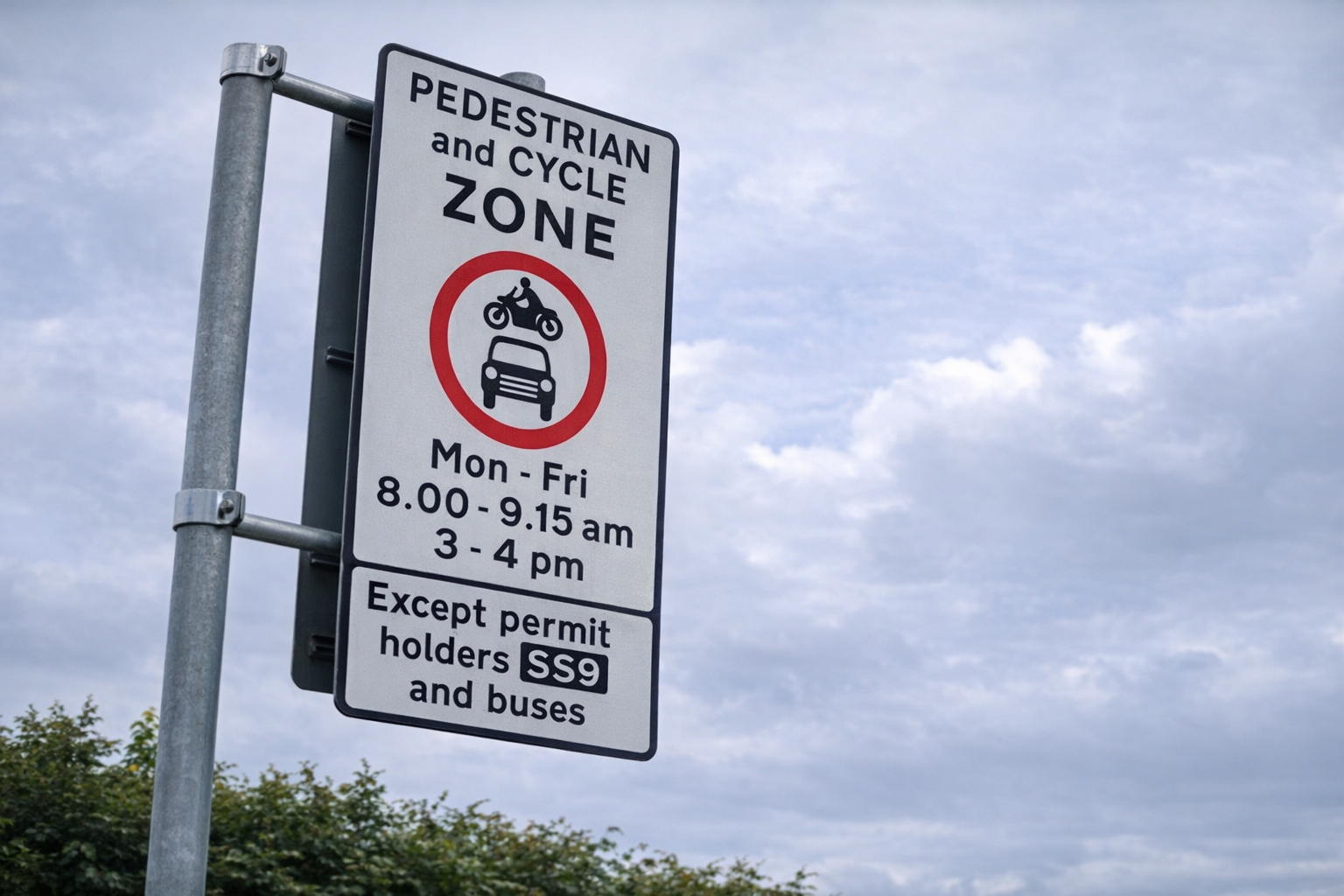
The headline case is neat enough. The council says 68% of parents and carers and 69% of staff reported safer, calmer environments outside schools. During the restricted periods, the share of journeys made by car fell from around 28% to around 10%, while the share made on foot rose from about 68% to 86%. No collisions were recorded at any School Street site during operating hours over the monitoring period.
Cllr Alex Paterson, Medway’s portfolio holder for community safety, highways and enforcement, is leaning into that case.
“As well as delivering an environment outside the school gate which feels safer to those using it, this data shows a fall in school run car use, an increase in pedestrian journeys and a reduction in traffic-related pollutants being breathed in by children and their carers,” he said.
That is the council’s argument in one tidy block. School Streets are making roads outside schools feel safer, cutting traffic where it matters most and improving the air children breathe.
The catch is that the council’s own review also accepts a point opponents have been making all along. Some of the traffic has simply been pushed elsewhere. The scrutiny paper says displacement has shown up at some locations and varies by site, from minimal on smaller or more self-contained roads to more pronounced on roads where schools sit in messier local traffic networks.
At St Thomas More Primary School in Walderslade, officers say displacement was significant, particularly along Walderslade Road. At Miers Court Primary in Rainham, they describe a “vast amount” of displaced traffic onto Nightingale Close and Harvesters Close, including pavement parking, double yellow line parking and blocked driveways. At Phoenix Junior Academy and Greenvale Primary, traffic was pushed towards the Symons Avenue and White Road crossroads, creating safety concerns for people crossing there.
There is another awkward wrinkle, too. Medway has strong enough data on what happened once the schemes were in place, but baseline travel-mode data was not collected before tranche one went live. The monitoring report says officers had to rely, in part, on retrospective parent and carer responses and that, despite some movement away from single-occupancy car use, the figures suggest only limited modal shift. It explicitly recommends proper baseline surveying on future schemes.
Ultimately, the road outside the school may get calmer. The roads nearby do not necessarily thank you for it.
The enforcement numbers tell a similar story. Across the seven tranche one sites, 13,507 penalty charge notices were issued in the first year, with Burnt Oak Primary in Gillingham accounting for 5,888 and Phoenix 3,424. Officers say compliance improved after the initial warning period. This may be true. But thousands of fines in year one do rather undercut any idea that this has all quietly settled down without friction.
Paterson also tied the programme to a wider fall in child casualties.
“Placed in the context of a 40 per cent overall reduction in child road casualties across Medway from 2023/24 to 2024/25, I am confident that schemes like these, alongside our wider road safety initiatives, are an important tool to help deliver safer, healthier streets for our children,” he said.
That is a fair political case to make. But Medway’s own scrutiny report is careful on the point. It says the borough-wide drop from 109 to 65 child casualties cannot be attributed solely to School Streets and also reflects broader road safety initiatives.
If that first half is Medway’s case for why School Streets are worth doing, the second half is Rochester’s case for why every new one can still turn into a neighbourhood row.
The current consultation around King’s Pre-Preparatory School and Nursery in Rochester runs until 27 March. On paper, it is another School Streets proposal. In reality, it is now something broader. The revised March 2026 notice covers St Margaret’s Street between Vines Lane and Roebuck Road, King Edward Road and Lockington Grove during weekday drop-off and pick-up hours. But it also adds a longer one-way section on St Margaret’s Street, a one-way restriction on Roebuck Road, a no-entry into Watts Avenue from Roebuck Road, a no-entry into King Edward Road from Maidstone Road and two new road humps in Roebuck Road. It explicitly says this notice supersedes the notices published in March and April 2025.
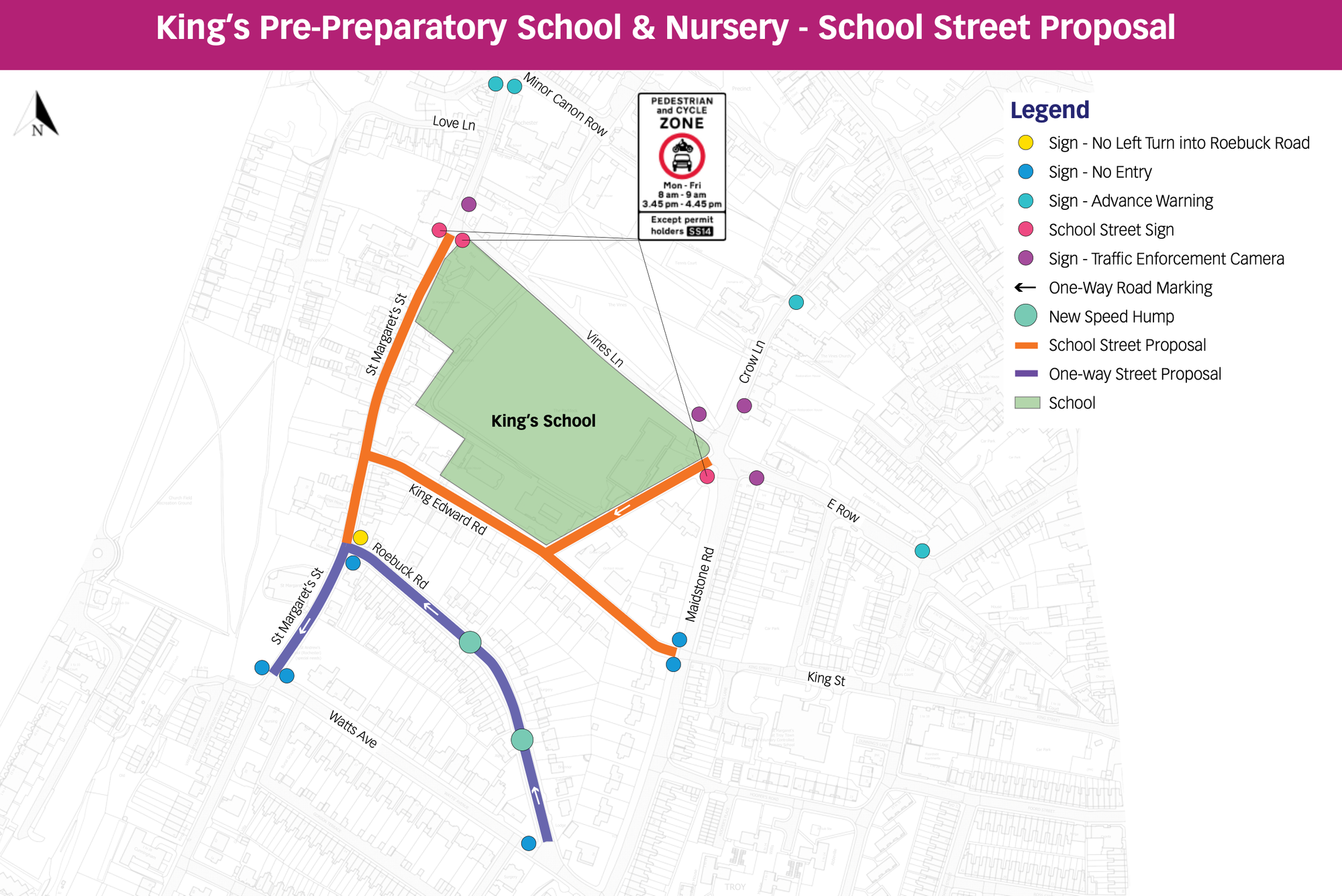
This is no longer just a school gate restriction. It is a wider attempt to reorder how traffic moves around that patch of Rochester.
Crucially, this did not come out of nowhere. Medway’s December 2025 consultation report shows King’s was already the clear trouble spot. Across the three schools subject to the extended consultation, there were 181 representations and 158 objections. King’s alone accounted for 135 representations, including 125 objections, five queries and just five letters of support. The council’s response was not to back off. It was to amend the design and go back out again.
The objections raised then sound very familiar now. Residents raised concerns about traffic and congestion on neighbouring roads, longer walking distances from remote parking, access to properties, requests around one-way working on Roebuck Road and Watts Avenue, and calls for some kind of drop-off arrangement. The report says the council’s revised answer was to implement traffic management measures around the school street zone, including making Roebuck Road one-way and installing speed humps to reduce potential impacts on the surrounding area.
That is what makes the Rochester row more interesting than a generic anti-traffic-management grumble. Opponents are not just saying safer school gates are a bad idea. They are saying the King’s proposal has grown into something much larger than that, and that the public case for the expanded restrictions still feels thin.
Attendees of a public meeting about the plans told Local Authority that more than 100 people turned up to a recent public meeting on the proposal, with former South Thanet MP and now Lord Craig Mackinlay taking a leading role in the opposition. The complaints were not just that the plan is inconvenient. It was that Medway had quietly turned one proposal into something much bigger. Some attendees noted that Cllr Paterson did not attend the meeting, despite being invited.
For his part, Paterson says there is a reason he did not attend a recent public meeting on the scheme.
“As with a meeting convened last year during a statutory consultation on a previous iteration of the scheme, it would have been improper for me to have participated in that forum, given that I am one of the decision makers,” he said.
“This time-limited restriction has not prevented me from discussing the proposals with a variety of stakeholders during the long intervening period, including during a meeting with the school senior leadership team as recently as the 27th of February.”
“However when the statutory consultation closes, officers will compile a report which reflects all contributions to it and it is on this, alongside information and responses from officers, that I will base any decision.”
That is a fair enough process answer. It is unlikely to do much for residents who think the council is asking them to comment on a broader, more interventionist scheme without having clearly shown its workings.
Medway has enough evidence to argue that School Streets are doing something useful. The first tranche does appear to have made the roads immediately outside some schools calmer and less traffic-dominated during the restricted periods. But the same evidence also shows displacement is real, behaviour change is patchier than the headlines imply, and the politics get much nastier once a School Street stops being just about the road outside the gate and starts reshaping movement across a wider neighbourhood.
For Medway, the first School Streets are proof the policy works. For one part of Rochester, the next one looks more like proof of how messy that can get.
Medway watches Kent meningitis outbreak as social media fear spreads
Two young people have died, and 15 cases of invasive meningococcal disease have now been linked to Canterbury, with health officials saying the majority of cases trace back to Club Chemistry and associated contacts. Our sister title, the Kent Current, reported yesterday on how the outbreak was already disrupting life in Canterbury. Now the concern is spreading more widely, including into Medway, where Facebook posts, WhatsApp messages and other social media chatter are filling up with unconfirmed claims about possible cases elsewhere in Kent.
 Ed Jennings
The confirmed picture is serious, but still much narrower than the one circulating online. The UK Health Security Agency said today that 15 cases of invasive meningococcal disease had epidemiological links to Canterbury, while Health Secretary Wes Streeting told MPs that the majority of cases link back to Club Chemistry on 5-7 March “and their associated networks.” He also said the club is currently closed voluntarily.
That is the backdrop to Medway Council’s response. Council leader Vince Maple said in a statement today, “My thoughts are with the family and friends of the young people who have very sadly lost their lives to meningitis, and to everyone impacted by the outbreak. As a parent myself, I fully understand the emotions and worry caused by this evolving situation.”
He added that the “public health team in Medway is working to assess any possible risks to residents and settings in Medway. If there are any specific updates affecting those who live, study or work in Medway, we will ensure to update you as soon as possible.”
That feels like the right line. There is no confirmed Medway outbreak at this stage, but there is clearly a lot of local concern, not least because online speculation is now reaching well beyond the places where officials have actually confirmed cases.
You can see that in how businesses are reacting to. The somehow still operating Tap n Tin in Chatham said it didn't open last night “as a precautionary measure due to the recent meningitis outbreak in Canterbury,” adding that “the safety and wellbeing of our customers and staff is always our highest priority.”
That does not prove there is wider spread into Medway. It does show how quickly a serious but still only partly understood outbreak can start changing behaviour beyond the area where cases have actually been confirmed, especially once social media fills the gaps with half-heard warnings and second-hand reports.
For now, Medway is left in an awkward middle ground. There are no confirmed local cases, but there is a serious outbreak nearby, a lot of understandable concern, and online fear is spreading faster than hard information. That is why the sensible response is neither panic nor shrugging it off, but keeping a close eye on the official advice as the picture develops.
Proofreading abandoned at Gillingham Pier
A new sign has appeared at Gillingham Pier, and while it is undeniably smarter than whatever was there before, it also seems to have gone up without the radical step of anyone proofreading it.
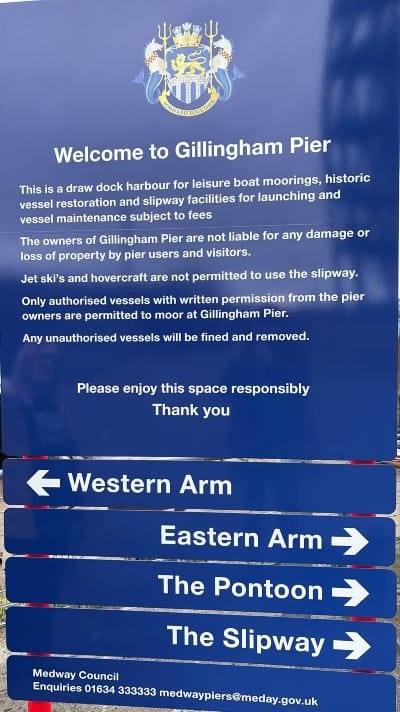
The large blue sign, carrying the Medway crest and a welcome to Gillingham Pier, explains that the site is for “leisure boat moorings, historic vessel restoration and slipway facilities for launching and vessel maintenance subject to fees”, which has the distinct feel of several separate thoughts being forced to share one sentence against their will.
It then notes that “Jet ski’s and hovercraft are not permitted to use the slipway”, which is bad news for apostrophes as much as personal watercraft.
Best of all, anyone with further questions is invited to contact medwaypiers@meday.gov.uk. Not Medway. Meday.
None of this is exactly a crisis. The pier still exists, and boats will continue to boat. But there is something wonderfully Medway Council about spending money on a smart new public sign and then immediately undermining it with the sort of mistakes that would shame a parish newsletter.
We approached Medway Council for comment, but did not receive a response.
Footnotes
Follow us on social media! We’re on Facebook, Instagram, and BlueSky, but not that other one.