Let’s talk about the bus again
Why Medway’s bus network still feels fragile, plus hospital merger wobbles, and pothole politics

Today's Local Authority looks at why buses remain such a fragile part of Medway’s transport system despite millions of journeys each year, and why large parts of the area still feel poorly served by a network that many residents rely on daily. We also report on a change of pace in plans to create a hospital group linking Medway and Dartford, and on Reform’s entry into a long tradition of local pothole politics...
Buses are vital in Medway, so why do they so often feel like an afterthought?
Buses are not glamorous. They are not sleek. They do not arrive with the faint sense that your life is about to improve, in the way a train sometimes does. They are a public service in the most literal sense. Functional, slightly grubby, and disproportionately important to the people who have the fewest alternatives. Which is why it remains faintly absurd that in Medway, buses can still feel like an optional extra bolted on to a place that mostly assumes you’ll sort yourself out.
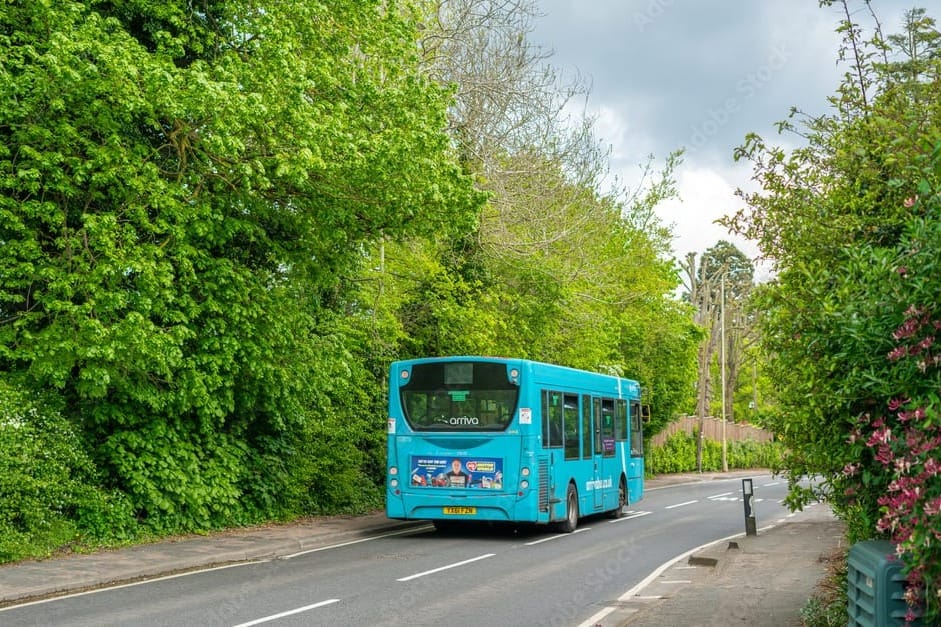
Medway’s own Bus Service Improvement Plan (BSIP) puts annual bus passenger journeys at 7.7 million in 2023/24. That’s a decent recovery from the pandemic slump, but it’s still below the pre-covid world the council describes as roughly 8m, and well below the 9.5m peak in 2011/12. The target is to get back to 9m journeys within a few years. If you’re not a bus person, those numbers probably feel like the sort of thing transport officers say to each other at conferences. But they matter because they tell you buses aren’t a niche hobby. Millions of trips a year is what you get when a large chunk of Medway is quietly relying on a network the rest of us only notice when a bus cuts in front of us.
It’s also worth saying, before anyone files this under 'transport nerd stuff,' that buses have a habit of paying you back even if you never get on one. London’s own evidence summary makes the basic point brutally well. The bus is the workhorse of its public transport system, carrying more than 5m journeys on a typical day, and the average bus trip bakes in around seven minutes of walking. In other words, even if you don’t care about buses, you probably care about the things they affect like congestion, air quality, health, and whether people can get around without every journey requiring a car-shaped amount of road space.
One reason 'the bus network' can feel slightly abstract here is that it’s effectively one company’s empire with a few satellite states. The council says Arriva accounted for 91.7% of passenger journeys in 2023/24, with 7m million trips compared to 0.6m across everyone else combined. So when we talk about reliability, integration, ticketing, and all the other worthy things councils like to say, we are mostly talking about what happens when Medway Council and Arriva try to build something that resembles a system rather than a collection of routes.
None of this is abstract if you actually rely on it. A thread from last week on the Medway subreddit is essentially a communal sigh about services not turning up when they should, particular routes being singled out as especially grim, and the knock-on costs when the day falls apart. One commenter said, “The timetables are absolutely pointless,” and others describe being left waiting far longer than they should be, or having to shell out for taxis because the bus simply didn’t appear.
To Medway’s credit, it has at least made it easier to see what that system is supposed to look like. The council now publishes an all-operators bus map and a bus and rail guide that sets out frequencies. This is progress. It is also a little like putting a 'you are here' sign in the middle of a maze. Useful, yes, but still a reminder that you’re in a maze.
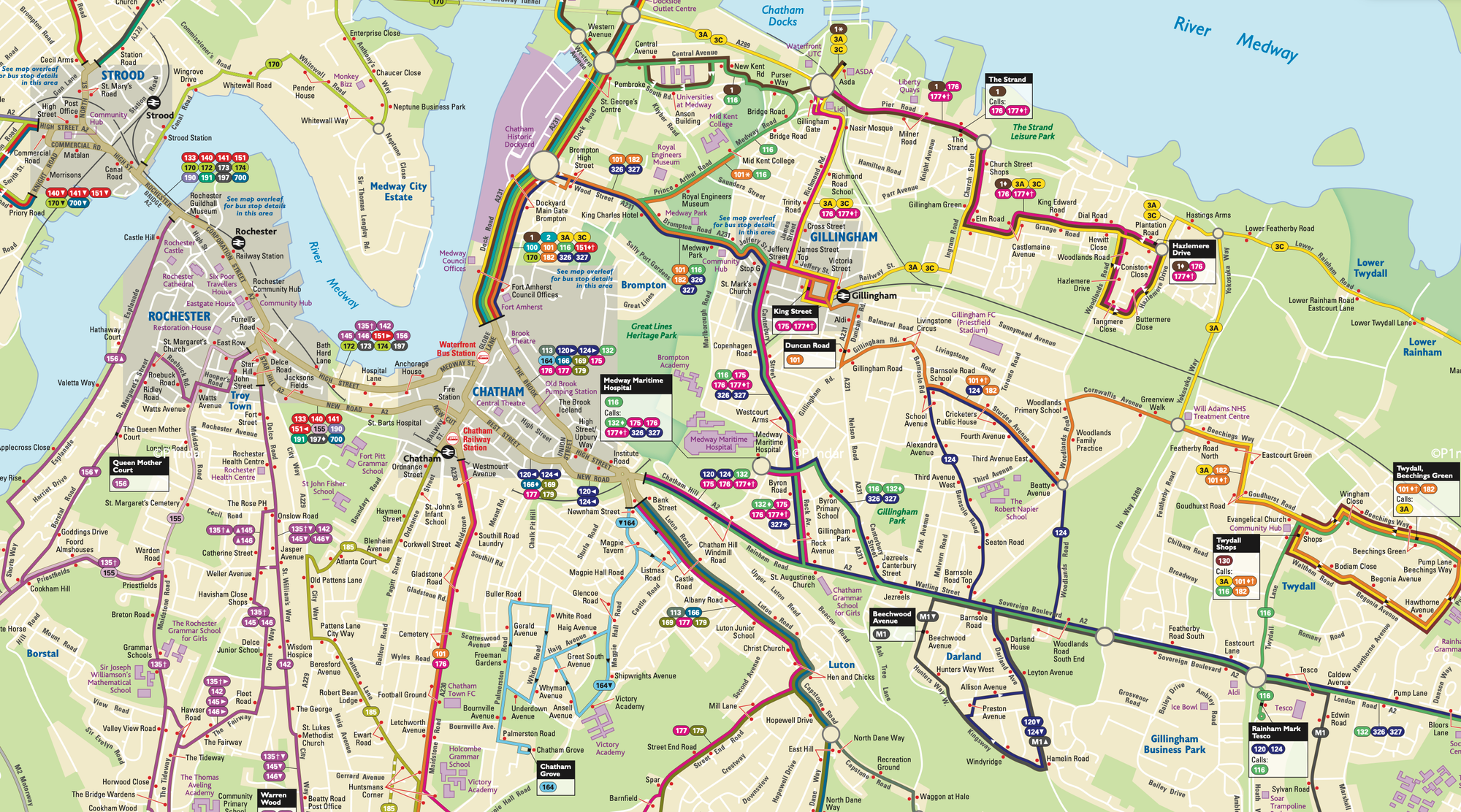
The all-operator map, amusingly, doesn’t really include the Hoo Peninsula in the main view. Medway does publish a separate Peninsula map, which is nice, in the same way it is nice when someone acknowledges you exist. It also makes the reality of rural services even more stark. There isn’t much network out there. It’s not a web. It’s a handful of lines doing the work of an entire transport system.
The council’s own documents clearly draw the dividing line. The bus and rail guide summarises route 191 as reasonably frequent to Hoo, and then hourly onward to the villages further out. This is not public transport as most people imagine it. It’s more like a recurring appointment you have to keep. Miss it, and you haven’t missed a bus. You’ve missed your hour, and you will now have time to reflect on your life choices while standing in the wind.
This is where the 'it only matters to people who use it' assumption really falls apart. A report on the economic impact of local bus services makes a simple argument in a slightly more formal tone. Supported services generate real economic and social value, not because they’re charming, but because they connect people to work, education, shops and services. It estimates that more than 680 million bus journeys a year start in rural areas nationally, and links rural-origin bus travel to £7.1bn of spending in local economies. The Hoo Peninsula is not a remote Highland community, but the logic still applies. If your public transport offer is hourly and fragile, you don’t just limit personal freedom. You shrink the catchment area of everything else, then act surprised when the Peninsula feels like it’s living slightly apart from the rest of Medway.
Away from the Peninsula, Medway does have a few corridors where the bus behaves more like an actual service. The 101 between Gillingham and Maidstone runs every 12 minutes in the daytime on weekdays, dropping to every 30 minutes in the evening. Other routes between Chatham and Twydall, Warren Wood, and Lords Wood also get the 12 minute treatment. That’s not exactly Berlin, but it does mean the bus can be something you fit around your life rather than the other way round. On those routes, the bus can feel like a plausible option rather than an act of faith.
Step off the stronger spines, and the familiar Medway rhythm kicks in. Half-hourly if you’re lucky, hourly if you’re not, and services that start thinning out in the evening like they have somewhere better to be. This is the bit that turns buses into an afterthought for anyone who owns a car, and into a daily logistics puzzle for anyone who doesn’t. It’s also what keeps Medway in the loop of declining use. If the bus is slow and infrequent, people avoid it. If people avoid it, it becomes harder to justify improving it. Eventually, the only people left are those who don’t have a choice, which isn't a great foundation for a thriving transport system.
There have been some attempts to do the kind of improvements Medway actually needs, and it’s worth giving credit where it’s due. Nu-Venture’s 3A/3C is exactly that kind of route. It links Chatham to parts of Rainham and Lower Rainham Road and loops through places that no other operator covers. It is not presented as a high-frequency trunk route, but it is a sensible intervention that acknowledges that Medway contains actual places people live and actual places people need to get to, which are not necessarily served by a single straight line into Chatham.
On paper, Medway’s longer-term pitch runs to 2035, and it says all the right things. Reduce congestion-related delays, decarbonise the network, build a fully integrated public transport system, improve fares and ticketing, improve stops, information, accessibility and safety. It’s hard to argue with any of that. It’s also hard to read it without thinking, yes, fine, but what does that mean for someone trying to get from Grain to Chatham on a Tuesday afternoon?
Perhaps some answers come from the improvement plan 2025/26 measures document, which turns the BSIP into a shopping list. The biggest number is £1.6m to support 31 socially necessary routes covering evenings, weekends, rural services and Mobility. In other words, a big chunk of Medway’s bus offer exists because the council is paying for it to exist. Without that money, it goes away. That's the truth of how bus networks work in places where routes aren’t always commercially viable. It does, however, limit the fantasy that 'the market' will solve this sort of thing.
Beyond that, the spending tells you what Medway thinks the immediate problem is. There is money to patch up evenings and Sundays on key corridors, nudging services toward something closer to usable outside peak times. There is support for smaller additions like the 3A and 3C. There are demand nudges, like free travel weekends and kids going free in school holidays with a fare-paying adult. There is also a lot of capital spending on the unglamorous things like Chatham Waterfront capacity and upgrades, real-time information, stop and shelter improvements, and a series of junction and signal changes intended to stop buses from being trapped in traffic, particularly on the A2 corridor.
None of this is silly. In fact, it’s mostly the kind of competent, boring work you want councils to do. The issue is what it doesn’t yet change. A green shelter does not provide an hourly service. A new real-time screen does not create a network where there isn’t one. A smoother junction does not magically make the Peninsula feel like part of Medway rather than a place you have to plan an expedition to reach.
Medway’s bus system isn’t collapsing. Passenger numbers have recovered a long way since the pandemic, and some of the right infrastructure work is finally happening. But the documents also confirm what residents already know. The network is still shaped around a few corridors, still dominated by one operator, and still too thin in the places where buses are most essential.
If Medway wants buses to be taken seriously, it has to do the one thing we keep tiptoeing around. Make them a default option, not a contingency plan. That means a network you can use without studying it, frequencies that don’t punish you for living off the main corridors, and evenings and Sundays that don’t feel like a special request. Until then, we’ll carry on with the same arrangement, where the people with cars will barely notice the buses at all, the people without them will keep building their lives around an hourly gamble, and the council will keep publishing new plans explaining why this time it’s all about to change.
Help us keep going. Local Authority can only exist because some of our readers pay to support it. If you value our journalism, please consider joining them. An annual subscription costs just £1.15 per week and helps us build a better way of telling the stories that matter to our towns.
From 'imminent' to 'for the time being'
Medway and Dartford’s two main hospital trusts have been working on a plan to join up under a new 'hospital group.' The idea is not a full merger into one new organisation, but something closer than ordinary partnership working, with shared leadership at the top, shared priorities, and a push to standardise and improve services across both sites while the trusts remain legally separate.
That plan was set out publicly in November, when Medway NHS Foundation Trust and Dartford and Gravesham NHS Trust announced they would create the county’s first hospital group. The starting point, they said, would be the appointment of a Group Chair and a Group Chief Executive, who would then work up the detailed structure and priorities.
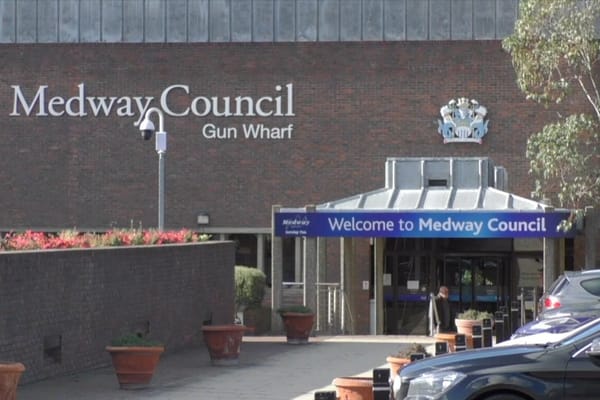
Later that month, the proposal went to Medway Council’s health scrutiny committee, where councillors asked the obvious question. If you have one chief executive across two hospitals, do you end up with leadership stretched too thin to manage either properly? They were told the Group Chief Executive appointment was imminent, with the Group Chair due in the new year. They were also told that there would still be strong leadership at each hospital site, including managing directors, and that the new Group Chief Executive would be expected to return with a fuller case for change, with March 2026 mentioned as a likely point for an update.
Which brings us to today’s update, which is where things get messy.
The two trusts say they are still developing the hospital group, but have decided not to move to a single Chief Executive arrangement for the time being. Instead, they will keep two Chief Executives, citing the scale of operational and financial pressures facing both organisations and the need for sufficient leadership capacity to address immediate priorities.
In practice, that means Jonathan Wade will continue to lead both trusts until 31 March, after which he will return to focusing solely on Dartford and Gravesham. Medway will begin recruiting a substantive Chief Executive, with Siobhan Callanan continuing as Interim Deputy Chief Executive. To manage the wider project, the boards will set up a joint committee to decide the most appropriate approach, pace and structure for the group, supported by an experienced programme director.
If you think this sounds like a step back, it is. The trusts have not just tweaked a detail. They have walked back the first step they previously described as imminent. What they have not done is explain, in plain terms, why the original timetable has changed or what that means for the rest of the plan.
Was there a recruitment problem? Did NHS England or the integrated care system tell them to slow down? Has the group model been redesigned so it no longer starts with a single chief executive and chair? Or is this simply a pause while Medway stabilises and Dartford deals with its own pressures?
Medway’s Conservative group have seized on the change as evidence of a wider leadership problem. In a statement this afternoon, Cllr David Wildey said his group had “serious concerns regarding the consistency of strategy and leadership” at Medway NHS Foundation Trust. He added, “We are now unclear of the Trust’s direction,” and warned that “stumbling from failed strategy to failed strategy is not good enough for our community.” He called on DHSC, NHS England and the trust board to set out “a clear strategy for the future of the Trust,” and, of particular relevance, one that delivers “consistency of leadership”.
The trusts, meanwhile, insist that everything is going fine. The group remains the direction of travel, they say, but the pace has to match reality, and for now, reality is waiting lists, finances, and two organisations that need dedicated leadership attention.
In November, this was a plan with job titles and a timetable. In February, it is a plan with committees, programme directors, and a lot of carefully chosen wording. If the trusts want people to trust the project, they need to do the one thing they have not done in today’s statement. They need to clearly say what has changed and what happens next.
Reform discovers the classic Lib Dem crouch
Nobody needs persuading that a lot of Medway’s roads are in a grim state. Reform has now waded into that particular crater with a press release quoting residents of Abbey Road in Strood who say they are “utterly furious” and calling on Labour-run Medway Council to fully resurface the road. Reform also add a bit of politics about priorities, including a claim that money has gone on taking down flags rather than fixing roads, and some headline pothole-repair numbers that Labour says look worse precisely because more of the budget is going into full resurfacing.
All of which is fair enough. The thing that lingers, though, is the photo. Councillors John Vye and David Finch crouched at the kerb with a tape measure, faces set to 'serious detective drama,' carefully documenting a puddle-filled pothole like they’re about to file it as evidence. It has strong remake of Randall and Hopkirk (Deceased) energy, except the guest star is a length of yellow tape.
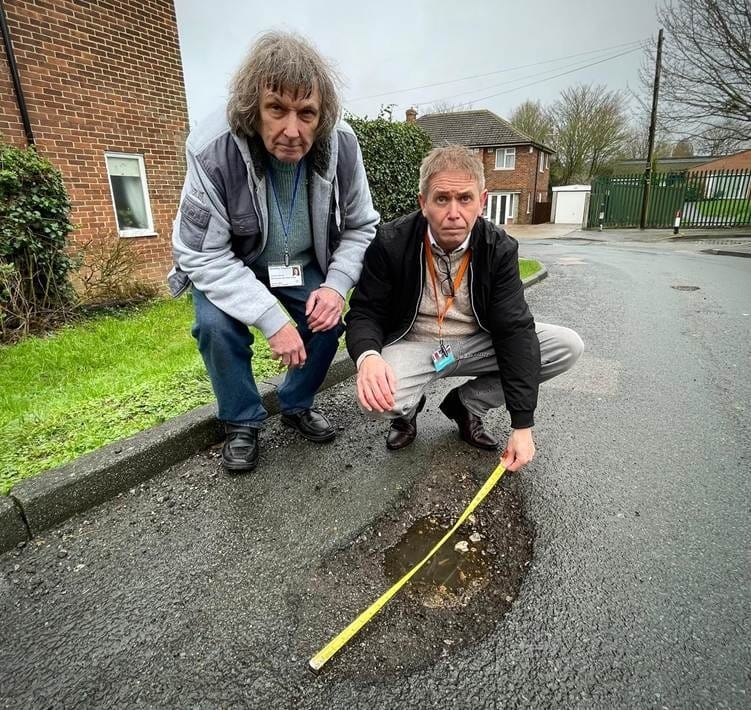
There is also something oddly comforting about it. This is, after all, classic local politics content. For years, the Lib Dems practically owned this genre of a councillor, a crater, a concerned expression, a promise to chase it up. Reform, it turns out, is learning the form. New party, same crouch.
Footnotes
Follow us on social media! We’re on Facebook, Instagram, BlueSky, and Threads, but not that other one.